
Q2 2026 Conference Call
Edited Transcript of the 2nd Quarter 2026 Conference Call with Dave Iben and Alissa Corcoran
Kopernik reviews the audio recording of the quarterly calls before posting the transcript of the call to the Kopernik website. Kopernik, in its sole discretion, may revise or eliminate questions and answers if the audio of the call is unclear or inaccurate.
July 30, 2026
4:15 pm ET
Mary Bracy: Good afternoon. I’m Mary Bracy, Managing Editor of Investment Communications here at Kopernik. Welcome to our second quarter 2026 Investor Conference Call. Please note that today’s call is being recorded. You may submit questions at any time using the Q&A box. We will address them at the end of the call. I will now turn the call over to Mr. Kassim Gaffar for a brief firm update.
Kassim Gaffar: Thank you, Welcome, everyone, to the second quarter 2026 Conference Call. I’m joined by Dave Iben, our co-CIO and Lead Portfolio Manager for the Kopernik Global All-Cap strategy and co-PM for the International Strategy, and also Alissa Corcoran, our co-CIO, co-PM for the Global All-Cap and International strategies, and Director of Research. Before I pass the call to Dave and Alissa, I’ll provide a quick firm update. From an asset standpoint, we closed the quarter in a strong position with approximately $9.9 billion under management compared with roughly $9.4 billion at the start of the year. The majority of this growth was driven by slight market appreciation and positive net flows across our funds. From a personnel standpoint, at the end of the second quarter, we stand strong with 49 employees, with no material changes to report. Moving along, just a couple of key housekeeping items. As you know, our Global All-Cap Mutual Fund has been closed to new investors since the summer of last year. As previously we had communicated, we soft-closed our Global All-Cap Strategy across all vehicles and wrappers at the end of April 2026. Please note, this soft-close does not impact current clients as it is a soft-close. Also, our International strategy, which you know is managed by the same team, utilizing the same investment philosophy and process and approved list, is still currently open with a 95% correlation to our Global All-Cap strategy.
We also recently announced the launch of the Global Opportunities strategy. This strategy will be managed by our co-CIOs, Dave and Alissa, and will invest globally in securities with a market cap greater than $3 billion, hence ex the micro-cap names that Global All-Cap can buy. This strategy is scheduled to launch in the coming quarter and will initially be launched in the UCITS market. Please note, Dave and Alissa will be referring to the presentation, which can be found on our website, kopernikglobal.com, under the News and Views section. While there, you’ll discover Dave’s recent commentary and other thoughtful pieces by the team. Without further ado, I’ll turn the call over to Dave and Alissa. Dave, please go ahead.
Dave Iben: All right. Thank you, Kassim, and thanks to everybody for joining us. Anyhow, a lot to talk about after a quarter like that, so let’s get going. It will not surprise anybody to learn that there’s all kinds of amazing good things happening in the world. Also, it won’t surprise anybody that there’s a whole lot of less-than-great things going on in the world. There will be big winners. There will be big losers. Lots of unknowns. Lots of risks. Much of it is priced into the market. Much of it is not. In other words, this is a stock picker’s market, our kind of market. Indexers, take notes. Anyhow, let’s look at some examples. Who better to start with than Howard Marks? [slide 8] He’s talked about, is it a bubble? Nobody knows these things for sure, but he always has a solid way of looking at, let’s examine it what is and where we probably are. He’s saying, here’s some questions to ask. Are valuations reasonable? Are prospective returns adequate? Are they applying skepticism, discipline, the basics? Are investors appropriately risk-averse? Are investors declining any new deals, and are there limits on faith in the future? Interesting questions. [slide 9] Are valuations reasonable? I guess that’s a rhetorical question. There’s, of course, nothing reasonable about the valuations in this market. This is a whole hodgepodge of different ways to measure the markets, and here we are at all-time highs. Then, of course, there’s the famous Buffett indicator [slide 10] showing that the size of the market compared to the size of the GDP [Gross Domestic Product] has never been anywhere near this high. Fascinating. When I came into the market, it was down at 25%. We’re talking almost 10X more expensive relative to the economy than when I came into the business. It’s a fascinating thing.
That’s not considering the fact that GDP has probably never been more overstated than it is now for a lot of reasons. The claims of debt relative to the economy have also never been so big, so interesting indeed. Then there’s the price-to-sales ratio [slide 11], also by far at all-time highs and up 10X from when I came into business. That’s just price-to-sales. If you add debt to that, enterprise value to sales, I imagine it’s a much scarier number. Does it matter that things are expensive? Logic says yes, but history supports that also [slide 12]. Historically, when you pay a high price for a stream of cash flows, that stream is a smaller return. When markets have been expensive relative to the fundamentals, it’s not been the best time to invest. Here we are, as we’ve shown, the most expensive market ever in many ways. Skepticism. Are they applying skepticism? Another rhetorical question. This chart [slide 13] shows they’ve never been less skeptical. They are all in. They want nothing to do with cash or anything that is not a security. Anyhow, the other side of cash is negative cash [slide 14], I guess. People are borrowing at extreme levels to buy their stocks. Take a look at Korea to see how those sort of things work. They’re beautiful on the upside, less fun on the downside. I don’t know how it fits into this chart, all the 5X leverage, one-stock ETFs that are out there. It is a casino out there.
Moving on to the next topic [slide 15], then. Are they risk-averse? Are they applying any discipline to things? It is fun, these sort of markets. A great headline and people get excited. It is interesting to watch manias, having done it a few times. Certainly, this catches some of the mood. Anyhow, comics and headlines [slide 16] tell the story. There’s not a lot of risk aversion going on out there. If we look at SpaceX compared to Amazon [slide 17], and few people have ever referred to Amazon as a bargain stock, but it sure looks like a bargain compared to SpaceX. Same market cap. One has revenues. The other basically doesn’t. One has profits. The other does not. One has free cash flow. One has mind-blowingly negative free cash flow. Not much of a book value to speak of either. Then there’s Elon’s own words. “To be clear, I thought the probability of SpaceX succeeding was less than 10%”. You can read the rest of this on your own. Certainly, not a lot of skepticism there. The opportunity is real, but no skepticism. People will always say, “This time is different. Haven’t we noticed that there’s been this amazing new technology out there?” That’s what people were asking me back in 1999. [slide 18] People were hearing similar questions in 1968 when semiconductors were all the rage, and in 1929 when radio, telephone, assembly lines, and automobiles were all the rage. They asked the same thing when canals came, when railroads came. There’s a lot of good articles out there that bubbles, the idea that bubbles don’t have when there’s great things going on – no, bubbles only happen when there’s great things going on. People usually don’t go overboard for things that aren’t too interesting. This does have lots of potential, just like all these others have big potential and are all still with us doing well, railroads, canals, telephones, internet, you name it. Maybe this time is different? No, math is math.
Great things require great amounts of capital [slide 19]. Once you have a great amount of capital, return on investment. When the investment becomes large, the denominator becomes hard. It becomes very hard to have a good return on investment. Of course [slide 20], you guys have seen the articles; we’re not telling you anything you don’t know, but the amount of CapEx [Capital Expenditure] getting spent on AI [Artificial Intelligence] is fascinating to watch. I think it’s a game (excuse me, I’m getting over a cold here) but adding people, I feel like they have to play the game because there will be some big winners; that’s for sure. No one wants to get left behind, but that was the case in all these other breakthroughs too. All that spending led to very hard times before eventually paying off way in the future.
Moving on. Investors, though, are notably not piling into the Mag7 [Magnificent Seven] these days [slide 21]. Matter of fact, it’s interesting these points in the cycle that things start looking toppy and rotating and getting volatile. We all knew that the things to own were the FANGS [Facebook, Amazon, Netflix, and Google (Alphabet)]. Then everybody says, well, no, not the FANGS, it’s time to own the Mag7. Then Mag7 were out, and AI was in. Then that was out, and space was in. Then space was out, and chips were in. Now chips are getting walloped. We’ll see. It’s getting very interesting out there. We’ve pointed out in the past that when something is doing really, really well, that’s all fun, but it is not a predictor that they’re going to keep doing really well in the future. Matter of fact, it’s usually just the opposite. Things tend to get overdone. As this chart shows [slide 22], things that have gotten overdone usually have a long hangover before things get better. Speaking of hangover, let’s go to beer [slide 23]. Up until now, we’ve been pondering the minefield of things that might affect people in the future. Fortunately, it’s not just a minefield out there. Fortunately, there’s a whole lot of great potential. For that, to discuss the geology of beer, let’s hand things over to Alissa.
Alissa Corcoran: Yes, thank you, Dave. There were a lot of scary charts that Dave just showed and the next part of the presentation is to reiterate that with every negative, there are positives. Inflation is a really good example. Mises [Ludwig von Mises] points out that inflation is a policy choice[slide 24]. It’s not a policy that we agree with, but it is what it is. The monetary basis increased 134X since 1960. It’s up 6X since 2008. There are a lot of losers, notably savers and people who do not own assets, and there are a lot of winners. We believe one would do very well to study the 1970s, which is really the last time anyone cared about inflation. You’ll notice on the right side of this chart [slide 25], there are a lot of real assets that did exceptionally well, not only in nominal terms, but clearly they beat inflation as well. Do we need protection from inflation? Is all this inflation we’ve been talking about for years a non-issue? Anyone who owns a 10-year treasury or a 30-year treasury [slide 26] better hope that it is a non-issue because I don’t think anybody is happy with a 1% real yield, which is what they’d be getting if you assume that CPI [Consumer Price Index] is a good level of inflation or a good indicator of inflation. We believe it vastly understates the inflation. We just all celebrated our 4th of July. If you look at Almost Daily Grants [slide 27], they had a piece that said that New Yorkers shelled out 31% more just to host the same barbecue. ShadowStats calculates inflation rates of 12%. If you listen to Rick Rule, who’s all over podcasts, he’s been out there saying that his consumption basket is 8%. It’s really hard to know what the real inflation number is, but CPI seems too low. People who are owning 10-year bonds are likely getting negative yields. They’re depreciating at least 4% a year, most likely. There’s more inflation on the way. We are running $2 trillion deficits on our way to $3 trillion deficits in 10 years from now. That’s debt to GDP of 120%. If you include the present value of our entitlements [slide 28], this number gets very, very scary. Defaulting or defaulting are really our only options. You can default by monetizing the debt, which is what the Fed has clearly shown it would like to do.
What is an investor to do? It’s fortunate that gold, which is one of the best stores of value [slide 29], just went on sale and is down 20% from its high. Meanwhile, gold miners have underperformed the gold price. We are starting to nibble back into these companies that have done so well [slide 30], and now they are back in range where we see some more upside. Other monetary metals like platinum and silver have had even more pronounced corrections. These share the monetary characteristics that gold has. They’re durable, they’re divisible, they’re scarce, they’re portable. They’re both down more than 45%. Platinum miners are really a focus for us. You might ask why. Supply and demand dynamics are some of the best we’ve seen. For starters, 2026 is expected to be the fourth year in a row where demand is greater than supply. Prices are not high enough to incentivize. As you’ll see on the map on the right [slide 31], mine supply is shrinking. There are two reasons why the deficit in 2026 is supposed to narrow, one of which is a huge boost to recycling, as you can see on the right, which doesn’t really make sense anymore now that prices just dropped 40%. The second reason for this shrinking deficit is a reduced estimated demand for investment. This assumption might also prove to be wrong post a 40% correction [slide 32] in the platinum price, especially when you compare it to gold, and it’s trading at a 60% discount to gold. There have been many times when platinum has traded at a premium to gold. Over the very long term, it trades around par. We could certainly see platinum getting to the same price as gold, and highly likely.
Meanwhile, demand is not going away. True, pure battery EVs [Electric Vehicles] are growing [slide 33], but they still only make up 15% of auto volumes. Further, hybrid EVs are also growing, and those use platinum group metals. Our largest position in the fund, in mining, in materials, in the whole fund, is Valterra Platinum [Valterra Platinum Ltd.], which is the world’s largest platinum producer [slide 34]. It’s the largest platinum refiner in the world. It’s the owner of arguably the best platinum mine in the world. It has a very good balance sheet. It makes money even at these prices. By our estimates, if platinum gets to even half of the gold price, risk-adjusted, the upside’s more than 150%. Then you can just imagine if platinum actually reached the gold price.
Other real assets [slide 35], inflation is not just going to help monetary assets. It can flow into other scarce, needed real assets such as copper, uranium, natural gas, which should benefit from inflation, but also it should benefit from AI. Yet, if you looked at the stock prices, you would not think that. They’re all down significantly off of their highs.
Agriculture land is another scarce, needed real asset, and supply has not grown since 1960 [slide 36]. Meanwhile, there are a lot more people, and these people all want to eat. Increasingly, they want to eat well, which is why the crop consumption rate of growth is faster than the population growth. Yet, when you look at emerging market agricultural land, they’re giving it away. It is true that Emerging Markets should trade at a discount [slide 37], but what is the right discount? Is it 70%, is it 80%, is it 90%? Those are the discounts that are currently being offered in the market. Many of these companies have very high-quality farmland. If the discount was more like 50%, they would more than double. A related theme to agriculture are the fertilizer stocks [slide 38], particularly in potash. Potash, as we’ve just seen, we have more people to feed on the same amount of land, and therefore yields need to rise. Potash is an important part of that dynamic. There are many areas in the world that are under-applying potash, most notably African countries, India, and Indonesia. The soil balance of potassium has been declining globally. Demand growth over the last 20 years has been about 3%. We think demand should continue to grow. It should at least be stable. Forecasting demand, though, is very difficult, and we prefer to think about supply, which also is very encouraging for investors.
Minus the 2021/2022 spike [slide 39], potash prices have been below the incentive price for about a decade. As such, outside of the BHP [BHP Group Ltd.] Jansen project, which has been a disaster in many ways, no major sources of supply are being brought on. And should supply ever, if the prices were to get to a point where new supply is attractive, new supply doesn’t just turn on. Greenfield supply takes a minimum of 10 years to bring to the market. Potash is found in very deep parts of the world. It can take years of drilling just to reach the deposit. We think that prices should rise higher to balance the supply and demand equation, but also perhaps some of this monetary inflation finds its way into real assets. Timber, since 1973, is up 7X. Platinum, up 10X. Potash, up 9X [slide 40]. The Nasdaq [Nasdaq Composite Index] is up 9X just from 2011. We think there’s room for these real assets to reflect some of the money that has been printed.
All right. What about Emerging Markets [EM; slide 41]? Emerging Markets for 15 years has been very poor. A dog. It’s up only 51% since 2011. Year-to-date, though, it has beaten the S&P [S&P 500 Index] and Nasdaq, and what is driving that are an increasingly small number of stocks and countries. The index [MSCI EM Index] is no longer a good proxy for the broad performance of Emerging Markets. South Korea and Taiwan [slide 42], these two countries combined, are a fraction of the population, a fraction of the GDP, a fraction of the land when you compare it to China, India, or Brazil on its own. Yet, combined, their weight [in the index] is a third greater than China, India, and Brazil combined. Peeling back the layers even further, 31% of the index is in just three stocks [slide 43]. Information technology makes up 45% of the index. Somebody who is buying the index is not buying an extremely diversified portfolio of stocks. They’re buying concentration. In the U.S. [slide 44], you’re buying a concentrated number of stocks and a small number of industries, and it’s the same in EM. EM is still a better value than the U.S., but to the active investor, this is really an amazing opportunity, particularly in China, Brazil, the Philippines, and Indonesia. These countries are extremely attractive. China, in particularly, is interesting to us. Outside of nominal GDP, China is a bigger economy in every other measure. PPP GDP is 25% higher [slide 45]. China produces two times the amount of electricity, three times the number of cars, and more than 10X the steel production. They have two and a half times more. College grads, three and a half times more patents, one and a half times the percentage of global imports. Yet, they are 125th the weight in the MSCI ACWI index. This is a huge opportunity for active investors. China, every year, their quality and their innovation is getting better [slide 46]. They dominate in many areas. Batteries, solar manufacturing, their cars are flooding European markets right now. Many of their products are as good. Some are superior, and they’re produced for a fraction of the price. One recent example: many of you probably saw that ASML [ASML Holding N.V.] just dropped 8% in one day on the news that China is closing this gap on a technology that, at this point, has not been able to be replicated by any company.
Yes, we understand that there are risks. However, we’re being well compensated to take these risks. The U.S. forced us to sell some valuable telecom companies at some point much below what they were worth [slide 47]. Might they do it again? It is a possibility, and it’s one outcome out of many possible outcomes. When investors start to only think about the negative outcomes, stocks become oversold. It’s our job to maintain an even keel and not let the markets tell us what our opinion will be. When people loved Emerging Markets in 2011, we didn’t find much value there. Now, 15 years later, these Emerging Markets have grown. In many cases, their stock prices are the same or lower.
When you compare China, the Chinese companies, to their U.S. equivalents, you can see [slide 48] that the Chinese companies have gone nowhere over 10 years, yet their book value per share plus dividends have all grown very significantly. Their valuation metrics are very attractive. Conglomerates, we are also still finding value [slide 49]. All are very inexpensive on multiple metrics. It’s the same story. The share prices have gone nowhere, but the fundamentals of the business have improved. The business has grown. To take us across the finish line, I will turn it back over to Dave.
Dave: All right. Thank you. Anyhow, we’ve talked about how having expensive prices happen during great technologies is a normal thing. We’ve also talked a little bit about how bifurcated the market is. There are some expensive things and some cheap things. Great as an active manager. Marc Faber, who writes some great stuff, last month wrote about how market tops aren’t as easy as people think. It’s not so much that it peaked on this day, which is how everybody looks at it, because that’s when the index peaks. Back in the ’60s during the tech mania, a lot of things peaked out in ’68. For the next four years, many stocks were dropping. They were camouflaged by the Nifty 50, which peaked out at the end of ’72. ’99, as I remember well, it was painful enough not owning the tech stocks that were going up, but one by one, everything else started dropping. So not only were you left out, you were not making money or losing money if you owned tech stocks. We’ve seen a bit of that. Seems like six years ago, we were telling people, a lot of expensive stuff out there, but gold looks good. We were viewed as so gold centric, that’s where the value is. Fortunately, that’s played out. As the markets rolled, all the money went into the exciting stuff. It was gold that was cheap, and then uranium got cheap, and then oil got cheap, and then copper got cheap, and then other metals got cheap, and then agriculture got cheap. Recently, we’ve talked about how forest products have gotten cheap. This is a good thing. Here we are, the most expensive market of all time. There’s a lot of things. As a matter of fact, many things, maybe most things that are getting attractive now. That’s good. That’s why you’ve seen that we can buy things like China that in 2007 were obscenely overpriced, or two years ago we could buy Korea that was ridiculously underpriced. You just heard about conglomerates; you heard about Southeast Asia- opportunities across the board. Here on this page [slide 50], you can see we’ve been active in volatile markets, trimming and adding. You’ll notice on both the trims and adds, we’re trimming all kinds of things. Yes, resources, of course, but consumers and financials and healthcare, and it’s pretty broad-based, industrials. Lots and lots of good companies are falling into places where active managers can take advantage of it. Then in June, you’ll see a lot more buys than sells. Of course, the run-up lately changed a little bit of that, but there’s been all kinds of opportunities to buy, and we’ve been buying across the board.
When you add it all up to have portfolios [slide 52] of good companies at less than book value and just over tangible book value is a pretty amazing thing. When we have so much money in companies that won’t start mining their things for a few years, otherwise no one needs their cash flow now, and yet the portfolios as a whole are no more expensive than the markets even on that basis. Holding our own there and getting real bargains in terms of assets, and a lot of what you just heard is assets are probably the place to be. They are underpriced [slide 53], and they will provide protection for what seemingly must be on the horizon [slides 54-55]. As you would expect, we’ve continued to take advantage of bargains outside of the US, and we continue to be predominantly in real assets [slides 56-57], hard assets across the board, whether that’s metals or oils or infrastructure like railroads and phone companies and things like that. These are things that historically will hold their value, logically will hold their value, and they’re trading at bargain-based prices. With that, let me focus on a few things.
One month or two back [slide 58], I sent out the commentary Bayou Jubilee, and we go into more depth on some of these things if you’re interested. The idea is, last year was fun. The last four months have been not fun, but they have been exactly what the doctor ordered in terms of a chance for people to get back into some of these things at bargain prices. The exact things you want to own in the likely environment going forward are what’s on sale now: hard assets across the board. Real assets, we think, are the place to be. Emerging Markets have tended to do well when real assets do well because many of these Emerging Markets have real assets. They all did well in the ’70s, and they did well coming out of the 2000s. We believe that between the valuations and the particular businesses they’re in, they are well suited this time around. Why these things all look attractive, we showed you plenty of slides that say the alternative to attractive is some pretty ugly risk-reward possibility in the major indexes. Very interesting times, important times, not easy times, but exciting for active investors. With that, let’s stop for questions [slide 59].
Mary: All right. Thank you, Dave and Alissa, for another great presentation. We’ll begin the Q&A portion of the call now. If you have not yet typed your questions into the Q&A box, please feel free to do that at any point. To help us manage time, I’ll group similar questions together. I might not read each one verbatim. If we’re unable to address your question, please contact us, and we’ll follow up. We’re going to go through, as we usually do, probably all of these.
I want to start with a little bit more on some of these corrections in some of these real assets that we’ve seen. Let’s start with uranium and nuclear power. I believe we have the slide of Paladin [Paladin Energy Ltd.], [slide 35] up a little bit earlier that showed how much that has come down from the high. You can find these slides on our website. If you go to the News and Views section, you can absolutely go in there and take a look at these slides. Maybe, Alissa, do you want to talk a little bit more about the opportunity in uranium and nuclear power right now?
Alissa: Yes, uranium is still attractive to us. We have a smaller position than we used to. As Dave pointed out, this is a stock picker’s market. Owning the entire uranium ETF, maybe you still do well, but Cameco [Cameco Corporation] has done much better than some other companies. Paladin is a good example. Kazatomprom [NAC Kazatomprom JSC] has corrected much more than Cameco. It was nice owning Cameco at $10. Now it’s $120. The risk-reward is just not as appealing, and so we don’t own it. Paladin is still something that we find is a significant position, 2% position. It seems like you have to have a little hair. You have to either be in an emerging market like Kazakhstan to own the best uranium company in the world, but it’s in Kazakhstan. Paladin has a mine in Namibia, which is higher cost and has had some issues. They also have a fantastic mine in Canada, but it’s not up and running. There are opportunities in uranium. They’re just not the obvious “own Cameco” opportunities. There was a point where pretty much every uranium company we looked at had a lot of upside. That’s not the case anymore. We still own the physical uranium. We still think there’s some good upside, and the supply and demand looks interesting. Dave, would you add anything?
Dave: Yes, I would add that you mentioned that we own less uranium than we used to. Understandably, we liked it way better when uranium was $20 than when it was $100. That’s the reason why. Even bouncing around between $70 and $100-something, we still see upside from here. We still do like it. I’d also like to point out, even though uranium made us look bad for six years, ultimately, it made us look good. It’s one of my favorite things because we’re telling people there’s a return on patience, and volatility is a good thing. It tested our patience for a long time, but volatility allowed it to take advantage of the opportunities. Alissa talked about when the price finally went from $20 to $100, the return on even a six-year and seven-year timeframe was very good annually. That was good. Also, the idea that we were getting free optionality in some of the non-producing mines also played out because those went up 10X instead of 5X. It played out perfectly. Now we’re thinking, as we have looked at things like platinum and palladium and lithium and magnesium and things like that, we think you’ll find the same thing, that volatility helps you, and the market’s fickleness helps, and that the ultimate upside is so good that hopefully we don’t have to wait long. Even if we do, the match should be pretty good.
Mary: Okay, let’s keep going with some questions on other real assets. We have a question about water, especially any of the U.S. West names, Boswell [Boswell Inc], TerraCycle [TerraCycle, Inc]. Dave, you want to take this one?
Dave: Sure. Water is something that’s clearly important for a lot of reasons. It would also be a source of tension in places like Asia where there are billions of people trying to compete for the same water. Having spent most of my life in California, you see the competition for water out there. It’s a big thing. Over time, in the past, we’ve been happy to own irrigation companies and other ag [Agriculture] companies that help with irrigation and things like that. We’ve owned filtration companies at various times. That’s worked out pretty well. The Boswells and other things are interesting. The upside is compelling, controlling scarce assets that are going to become more important. Then there’s always the argument on people saying water is a public good, and there’s legal fights, and some governments take the water back, and some try to take it back. Smart people will be on both sides on whether, 20 years from now, one will still own that. We like the area. We don’t know that we have a competitive advantage in the legal and political field, so we haven’t done much recently, but we are very interested. Water is important, and you’ll see more water investments from us in the future, of various types.
Mary: Okay, continuing on, we talked quite a bit about the metals already, but we have a question that is a little bit more of our thoughts on silver. We don’t and have not owned just a huge amount of silver, and so what are our thoughts given that it’s the worst-performing asset thus far this year in terms of precious metals? Alissa?
Alissa: Silver is harder to buy because there aren’t as many pure-play silver companies. There used to be more, and as you grow, the market size is just not as big, and so silver companies become hybrid gold companies, and so you end up owning, as they themselves get bigger, they become more gold-like. It’s really not a thing about not liking silver. It’s just the opportunity set is not very large.
Dave: It’s interesting. The worst-performing metals last year are best-performing, and that’s the case in a lot of things. Everything that did really well last year is getting hit this year. Even this year, I think Korea just had the worst month in their history, worse than the Asian meltdown, and it’s still up big on the year, and tremendously over two years. Silver, when you go from $20 to $120 pretty quickly, a correction is not to be unexpected, but we, as Alissa said, have owned it when we can, sometimes directly, but sometimes we own big silver positions. It’s just a very small piece of Barrick’s [Barrick Mining Corporation] business, or whoever else owns the silver. It’s hard to own.
Mary: What about any thoughts on critical minerals, the rare earth sector in particular?
Alissa: It’s, I think, corrected, but it also, as Dave pointed out, had a huge run, so we haven’t spent a lot of time on that recently.
Mary: Continuing on in our real assets theme. Let’s talk a little bit about U.S. natural gas that we own in the Global All-Cap Strategy. Can you expand on the upside potential that you see in natural gas names, Range [Range Resources Corp], and Expand [Expand Energy Corp] in particular, and how those are doing and the activity in those? Dave?
Dave: Okay. Yes, natural gas is interesting because in a market where, as you saw, the U.S. is 60-something percent of the market cap of the world, with nowhere near that percentage of the teens, I think, of the economy, there’s not much in the US that’s that interesting, and yet, where does the US have a huge competitive advantage? I mean, we’ve got lots of natural gas, and it’s cheap natural gas, and it’s been growing, and it’s deliverable to the world where, for various reasons, people are no longer able to get natural gas from Russia or from the Middle East, and so the U.S. has cheap, high quantities of gas. That should be worth a big premium. You look at the U.S. natural gas companies; they’re way more expensive than six years ago, but they’re actually way, way cheaper than they were 12 years ago. How could this be? If you look at the potential for gas to converge with oil at some point, and every few years it does, it is cheaper and cleaner. It makes a lot of sense relative to oil, and you’ve read reports about how more countries- even countries like Saudi Arabia- are thinking, let’s start using gas more, export the oil, things like that; we’ll converge the prices together. Should that happen, the upsides on the ranges of the world are multiples, and that’s with decent risk-adjustment margin of safeties that we put on it. We are a big fan of natural gas in the U.S. and Canada.
Alissa: Yes, I would just add that Canada is increasingly more attractive as the spread between the Canadian prices and the U.S. has really widened. The oil-to-Canadian natural gas ratio is very large.
Mary: Talking about oil and natural gas in the U.S. and in Canada, we have a question about thoughts on the price levels of those commodities, especially given the uncertainty in the Middle East, especially the odds for further supply chain disruptions, given that several refiners have been damaged and things like that. Alissa, you want to start with that one?
Alissa: Well, I think they’re probably going higher. It’s been surprising to me that the price of oil has stayed as low as it has, and same with natural gas. Maybe with less refining capacity, though, that makes more sense. I think the end price, the price at the gas station, would imply a higher price. That spread between crude oil and refined oils is very large.
Mary: Yes, Dave, do you have anything you want to add there?
Dave: Yes, one thing we try to keep reminding people is, even though we spend lots of time and effort trying to figure out what we think a fair price for commodities are, we pay attention to what we come up with, but we don’t take ourselves too seriously. We are less interested in what we come up with and more interested in when society, the groupthink herd, comes up with their own price that’s crazy. If their price is different than ours, fine, but crazy gets us interested. We’ve always said, “Well, oil at $75, we’re fine with that. Someone says $50, we’re not going to argue with them. If they say $100, we’re not going to argue with them. We have noticed that when it goes to $140, too much supply comes on and we’re always long gone. Every now and then, the price drops into the $30s, which is crazy, and everybody stops drilling, and the price comes back. That’s when we tend to buy oil, when people are panicked out, when we bought uranium at $20 and $30, when nobody was going to build a mine. Europe, we’ve seen when copper a few years back was down, people weren’t doing what they needed to do. Platinum, when it was at $800 a year and a half ago, those things can’t last, and so we take care of extremes. I think with natural gas now, if you look historically, the ratio to oil and the price on its own are very low without even taking into consideration the fact that the world seems to be arguing for more gas as they struggle with oil.
Mary: Thank you. Our next real asset that we will move on to is one that we talked about quite a bit last quarterly call, and that is timber. We have a question about both Rayonier and Weyerhaeuser, which are a couple of our portfolio companies, timber companies. Alissa, do you want to give an update on those?
Alissa: I mean, not too much to update versus what we talked about last quarter, but as the table we had in the presentation showed, timber is one of the commodities that has least reflected the amount of money printing. It’s only up seven times since 1973. The thesis is really, if these companies traded at what the private transactions are, what you can buy in the market is, EV/acre [enterprise value/acre] , half of the price that these companies are paying for private land. There’s one opportunity. If you compare it to a more global average, timber is very undervalued. The supply has really not done much for a long time. The price has not gone anywhere. Should these supply and demand dynamics start to correct? Should some of this money printing seep into real assets like timber? That’s upside. Then should the gap between the private transactions and public transactions, public prices converge. There’s another opportunity.
Dave: Add to that, those of us that have known us a long time know that we have pretty low portfolio turnover. Times like 2002, 2009, and COVID 2020, our turnover was much, much higher, taking advantage of the volatility. I showed you a chart earlier showing way more activity than usual with all the volatility. Software, it’s been wonderfully volatile. We’ve been able to buy and then turn around and sell and then buy back some of these things already, and then some other ones that we bounced before we were finished with the research. I won’t be surprised if they don’t come back to us. The market’s trying to figure things out. I think you’ll continue to see us get opportunities to both add and trim the positions we have. It’s a lot of good companies being roiled around.
Mary: Very active this quarter, as you can see from our portfolio activity slide this year. Question about the market in the UK. It’s been an unloved market, out of favor for a long time. Have we found anything interesting in the UK recently, or what are we looking at there? Dave?
Dave: Fortunately, we found a lot last year. As many of you know, we spent a few months out there doing research, and that did pay off. We were able to buy mostly financial companies, but a lot of them have bounced and worked out pretty well for us. There’s been some industrials and other companies we’ve looked at, but there’s opportunity. We’re still doing it. A year, and year and a half ago were big opportunities. Then on a tangent, we went there when things were cheap. Some of us have spent time down in Brazil now. Like the UK last year, where almost nobody in the UK liked their own market before it bounced. I’m meeting almost nobody here that likes the Brazilian market for what it’s worth. Yes, we still find things in the UK.
Mary: All right. I want to move to a couple of company-specific questions now. We’ll start with Northern Dynasty [Northern Dynasty Minerals Ltd.]. Do we still see optionality there? Has the calculus changed at all? Alissa, do you want to start that one?
Alissa: Yes, absolutely. Huge optionality. Even though it’s run up, this company still has the most upside, or some of the most upside of all the gold mining companies. At a market cap of still less than a billion, when the minerals in the ground could be worth a trillion, there’s huge optionality. Of course, the political environment remains challenging. That’s really why there’s a lot of optionality still in the stock. The actual minerals are probably the best deposit in the world. It’s one of the lowest costs. It is in a great location. It’s interesting that you can go all around the world and people say you don’t want to do business in these challenging jurisdictions, but we’ll buy a company that has a mine in the US or Canada. The U.S. is a very difficult place to permit a project. This one has obviously been particularly challenging.
Mary: Dave, would you add anything to that?
Dave: Not a lot. We haven’t specifically said it in this presentation. The idea that AI is exciting, who knows who’s going to win and who’s going to lose? The people selling copper, they’re going to win. The people selling electricity, which we’ve also talked about, they’re going to win. Good luck running all these things without copper. We’ve learned during COVID that supply chain was really important. Our opinion, we could be wrong, but our opinion is, when you have the largest undeveloped copper in the world and it’s sitting in the U.S., it’s when it will be developed, not if. There are a lot of challenges, but that’s why we get 50-plus times upside if it works out. We still think, like I say, when, not if.
Mary: All right, thanks. Our next question is about one of our Russian positions in particular, Sberbank [Sberbank of Russia PJSC]. Several investors have had their Sberbank [DR] positions liquidated, and proceeds returned to them. This has been the case at some other firms that we’ve seen. Has this affected any of our Sberbank positions or any of our other Russian positions in a similar way? Dave?
Dave: We have one small little account with all our own money and no client money that ended up with those [Sberbank DRs]. We took our 70% haircut there. Fortunately, I’m pretty sure that 100% of our clients’ money was in the locals, not in the DRs.
Mary: We are here to our last question. We’re going to go back to money supply and inflation. Alissa, I’ll go ahead and start with you, and then I’ll turn it back over to Dave. How do you think about U.S. dollar appreciation or perhaps more likely depreciation and its impact on the portfolio?
Alissa: Well, the dollar’s been strong for so long; it’s been a headwind for us for many years. It’s not our competitive advantage to say that the dollar is going to be stronger than some other currency. What we can say is that the dollar is weakening against real stuff. When you print so much money, and you want to own what is scarce, and what is not scarce are dollars. The point of the presentation today is that what is scarce, these real assets, and they’re needed, those should eventually be reflected in their nominal price as the dollar depreciates against real things. Then just on how does the dollar and its strength or weakness impact our portfolio, we have a lot of different currencies because we own so many different companies around the world. Some of these companies will benefit from a stronger dollar, some of them will not. Over time, we think that the values are very compelling. Should the dollar depreciate, that would be a tailwind for our portfolio performance. Dave, would you add to that?
Dave: Yes, let me say the same thing in other words. Historically, we do really well when the dollar’s weakened against other currencies. As you put it, that’s an illusion versus other currencies. We’ve talked in the past, the idea if you’re on a train at nighttime and it’s dark and you half wake up and you see a train zipping past you, it feels like you’re going backwards. Actually, you’re going forward at 50 miles an hour and they’re going forward at 70. The illusion of going backwards. When the dollar goes up against a basket of other currencies, there’s the illusion that the dollar’s going up, but the dollar is not going up. I think by the government statistics over the last 100 years, the dollar has lost 97% of its purchasing power, and by a most credible measure that’s lost 99% of its purchasing power. It’s effectively gone to zero. That was during the good times. The next 100 years will certainly be worse. Voltaire put it correctly,I think, “history shows that fiat currencies eventually hit their intrinsic value, which is zero.” The dollar’s great for transactions or whatnot, but nobody would ever put it in a safe deposit box. No interest income. See how it did 30 years from now. The dollar, in recent times, it took almost in my career, what it’s like $3 would get you a barrel of oil, and now it’s 80-something. $32 would get you gold, and now it’s much more than that. Healthcare costs, people pay for tuition, look what they pay for food. The dollar will lose 90% to 100% of its purchasing power in the next 100 years. I think worrying about how it does versus the yen or euro is not that important versus, can you get your dollars spent on uranium and good companies and gold and platinum and oil and phone companies and railroads and things like that? Because it fairly consistently has been, and we think clearly will continue to fall against things that matter.
Mary: All right. Well, that does it for all of our questions today. Thank you, everyone, as always, for your great questions. If for some reason you don’t feel as though we answered yours or you think of another one, absolutely, please reach out to us. We’re always happy to answer any of our clients’ questions. Dave, Alissa, do you have any closing thoughts?
Dave: No, just other than thank you all very much for dialing in, and we look forward to talking to you again soon.
Alissa: Thank you.
Mary: Thanks, everyone.
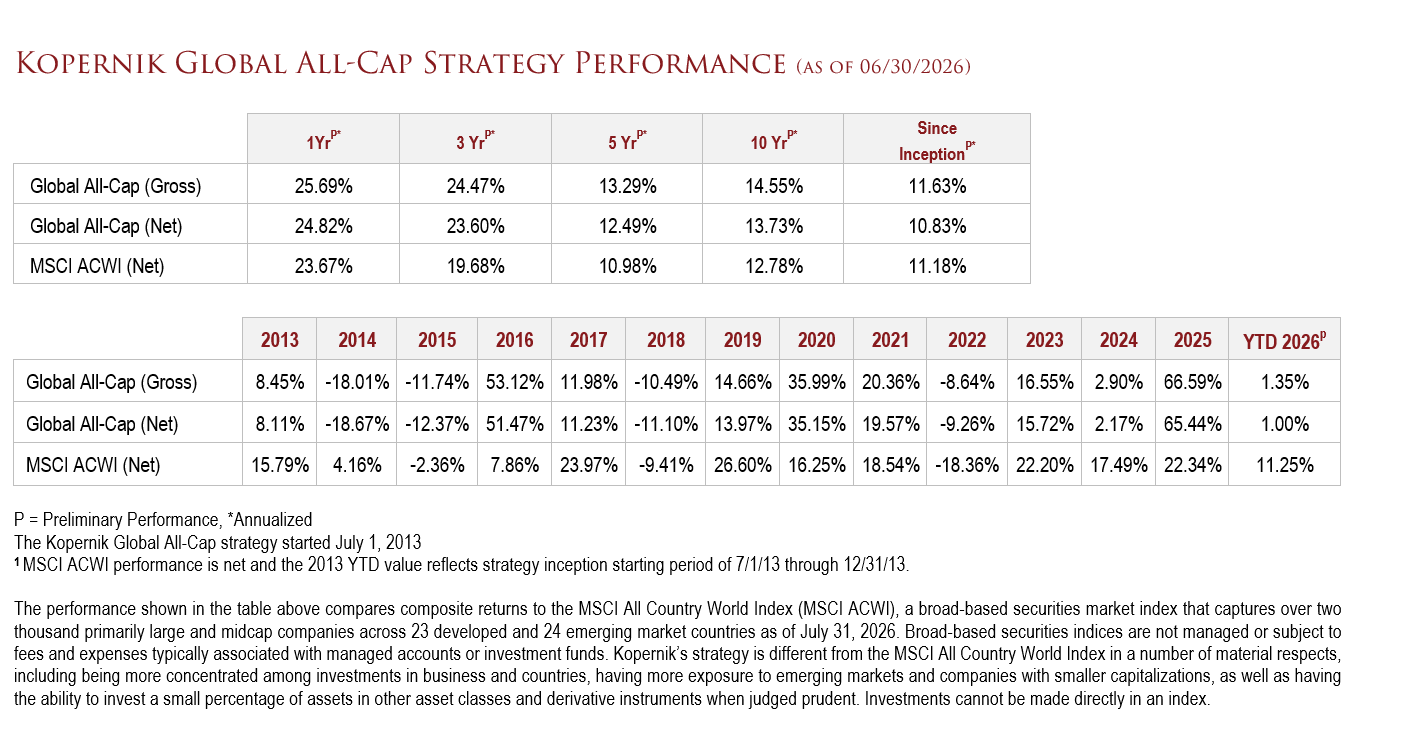
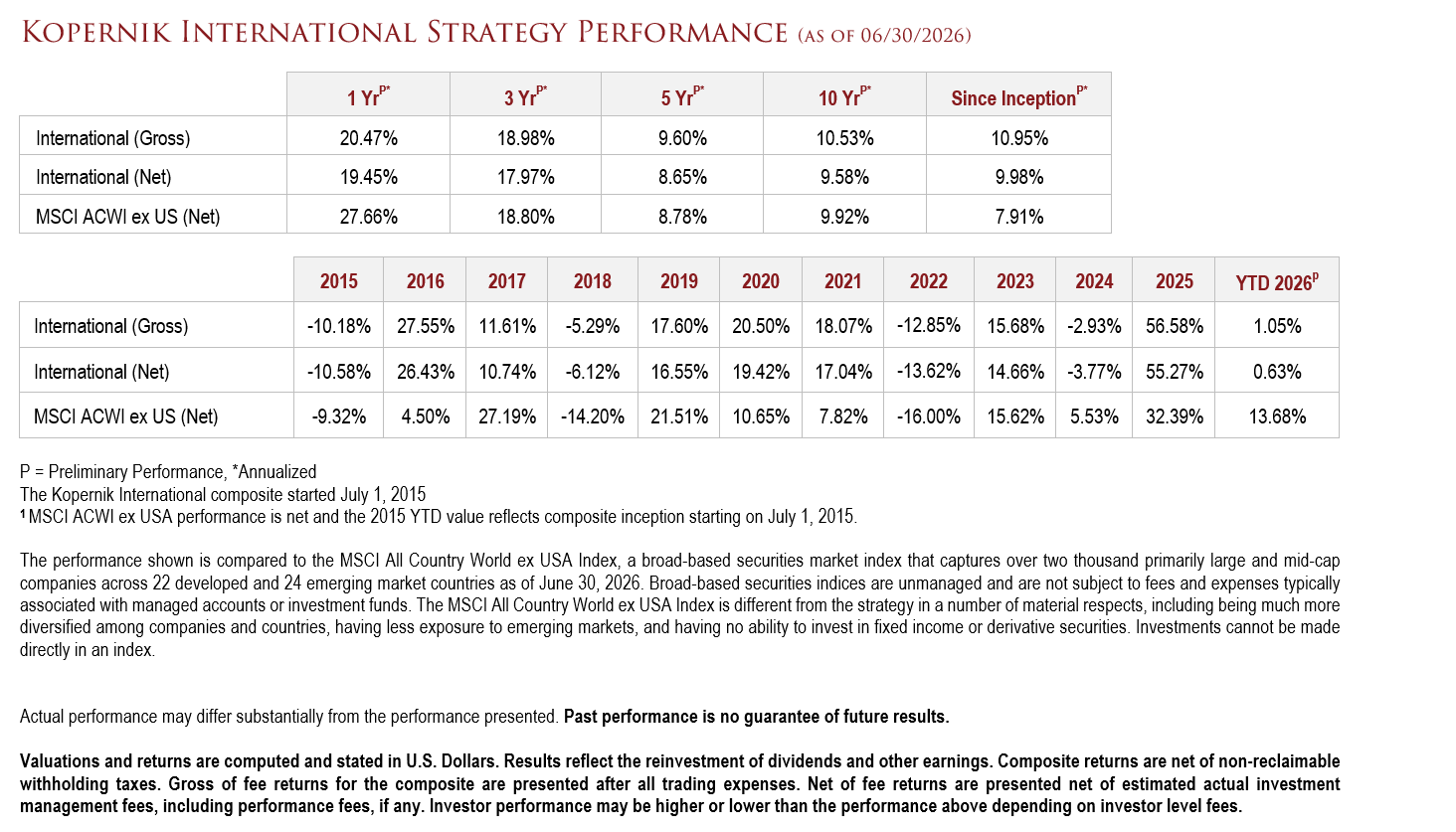
The commentary represents the opinion of Kopernik Global Investors, LLC as of July 30, 2026, and is subject to change based on market and other conditions. Dave Iben is the managing member, founder, and chairman of the Board of Directors of Kopernik Global Investors. He serves as chairman of the Investment Committee, lead portfolio manager of the Kopernik Global All-Cap and Kopernik Global Unconstrained strategies, and co-portfolio manager of the Kopernik Global Long-Term Opportunities strategy and the Kopernik International strategies. These materials are provided for informational purposes only. These opinions are not intended to be a forecast of future events, a guarantee of future results, or investment advice. These materials, Dave Iben’s and Alissa Corcoran’s commentaries, include references to other points in time throughout Dave’s over 43-year investment career (including predecessor firms) and does not always represent holdings of Kopernik portfolios since its July 1, 2013, inception. Information contained in this document has been obtained from sources believed to be reliable, but the accuracy of this information cannot be guaranteed. The views expressed herein may change at any time subsequent to the date of issue. The information provided is not to be construed as a recommendation or an offer to buy or sell or the solicitation of an offer to buy or sell any investment or security.
