
Q4 2025 Conference Call
Edited Transcript of the 4th Quarter 2025 Conference Call with Dave Iben and Alissa Corcoran
Kopernik reviews the audio recording of the quarterly calls before posting the transcript of the call to the Kopernik website. Kopernik, in its sole discretion, may revise or eliminate questions and answers if the audio of the call is unclear or inaccurate.
January 22, 2026
4:15 pm ET
Mary Bracy: Good afternoon everyone. I’m Mary Bracy, Kopernik’s Managing Editor of Investment Communications. We’re pleased to have you join us for our Fourth Quarter 2025 Investor Conference Call. As a reminder, today’s call is being recorded. At any point during the presentation, please type your question into the Q&A box, and we’ll be happy to answer it as a part of our Q&A session at the end of the call. Now, I will turn the call over to Mr. Kassim Gaffar, who will provide a quick firm update.
Kassim Gaffar: Thank you, Mary. Welcome, everyone, to the Fourth Quarter 2025 Conference Call. I’m joined by Dave Iben, our Co-CIO and Lead Portfolio Manager for the Kopernik Global All-Cap Strategy and Co-PM for the International Strategy, and also Alissa Corcoran, our Co-CIO, Co-PM for the Global All-Cap and International Strategies, and Director of Research. Before I pass the call to Dave and Alissa, I’ll provide a quick firm update. From an asset standpoint, we closed the year in strong position with approximately $9.4 billion under management, compared with roughly $5.3 billion at this time last year.
The majority of last year’s growth was driven by strong market appreciation across our funds, reflecting solid performance across all firm strategies. On the personnel side, we continue to invest in the business by strengthening our investment team and enhancing a broader infrastructure throughout last quarter and across the year. We enter 2026 with a team of 47 employees. Just a couple of key updates to highlight. As you know, our Kopernik Global All-Cap Mutual Fund has been closed to new investors since the summer of last year, and we recently announced a soft close of the overall Global All-Cap Strategy effective April 30th of 2026. [slide 8]
Please note this will not impact existing clients, as it is a soft close and not a hard close. In addition, our Kopernik Global All-Cap Strategy, we do have our International strategy and fund that remains open. This strategy is managed by the same team using the same investment philosophy and process and has delivered strong performance with a correlation of approximately 95% to our Global All-Cap Strategy over the past decade. Also, one last update. As we communicated during our last call and through subsequent emails, we are having our second-ever Super Terrific Happy Day Conference next month on February 17th [slide 7].
Many of you probably know our friends Grant Williams and Stephanie Pomboy. Some of you have heard their podcast. We’ve done this with them before, and they always have a lot of thought-provoking topics. We’re really pleased to be doing this conference again, and we have a lot of great speakers lined up. Please note, Dave, Alissa will be referring to the presentation, which can be found on our website, kopernikglobal.com, under the News & Views section. While there, you’ll discover Dave’s latest commentary, London Calling, which is a great, thought-provoking, and timely piece. Without further ado, I’ll turn the call over to Dave and Alissa. Dave, please go ahead.
Dave Iben: All right. Thanks, Kassim, and thanks to everybody for joining us. What a market. It goes up every day. Even our stocks, man. It’s been good. It’ll probably be a perfect time to have our Super Terrific Happy Day next month. In addition to Grant and Stephanie and us, there’s a whole host of speakers, many of which I think will be interesting to a lot of people, and people’s views that I think will be very relevant to the times we find ourselves in. As Kassim mentioned, we recently sent out our London Calling commentary [slide 9].
It was about our summer doing research in London, where stocks are much cheaper than they are in the U.S. It was a very good summer. We talked a little bit about the summer and the history and the culture, but we also talk about the British Empire, which, like the Romans before them, seemed invincible, but weren’t. Now, the U.S. market being priced for invincibility, it better be at these prices. Then outside of that, though, London, Europe, Asia, there’s still a fair amount of bargains despite this massive bull market we’re in. We found a lot of things that were interesting. It was very good research.
While we’re at it, it’s always good to have self-assessment. What should we think of the world we’re in and our place in that world? Increasingly, we’ve talked in the commentary about, once again, it’s a world where it’s good to be in the know. It’s nice to be part of the PayPal mafia or to have an audience at Mar-a-Lago or have the right lobbyists or right lawyers. Unfortunately for Kopernik, we are not in the room where it happens. We will never be the person with the information advantage. That is what it is. While that’s a disadvantage [slide 10], we are not feeling pretty negative at all. We wouldn’t change places with anybody because where we have an informational disadvantage, 1- we’re aware of it, but 2- our strengths lie elsewhere. We think our size is an advantage, our structure is an advantage, our mindset is an advantage, and certainly, in many cases, our way of analyzing things are. That’s what we view our competitive strengths. We think those are strengths that, once again, are going to start to be important at this part of the cycle.
Going through this [slide 11], if you are interested in investing in momentum, inside information, venture capital, or those things, we’re not the ones, but there are plenty of other people that can do a great job at that. It’s more boring to search the world, doing bottom-up analysis, looking for misappraisals, and taking advantage of that. I think we’re at the right part of the cycle. We look all around the world for assets that are good quality and they’re bargains. We think we’re pretty good at it, but that’s not our point.
Our point is we’re at this point in the cycle, the passive investing cycle, as we were in 1972 and 1999, where very few people are even bothering to try to value things anymore. That makes the market highly inefficient, and it makes it inefficient at a time where we think we have less competition than usual. Very few people are trying to compete. To back up that assertion, here’s a chart from BofA [Bank of America] showing that the majority of people now are investing where the decision is not based at all on the quality of the business [slide 12]. It’s not based at all on the price of the business. It’s based solely on the residency in an index. That’s got to be good for those of us that are still focusing on such things as quality and price. All these trillions pouring into price-agnostic products has caused high valuations on almost any metric. As this chart to the left shows, history and logic suggest that from these levels, future returns will be subpar, quite likely negative [slide 13]. Probably a good time to move some money out of the index and send to other things.
What could happen to the index? There’s all kinds. Hopefully, it goes up. History would suggest that if we go back to average, just average multiples, that we would fall roughly 40%, plus minus on the S&P [500 Index] [slide 14]. Now, we’re looking at earnings, book value, tangible book value, enterprise value to sales, free cash flow. If the NASDAQ [100 Index] were to fall back to S&P average levels, now we’re talking falling in half or more in many cases. That’s interesting, and a little bit scary. These averages are roughly 30-year averages. I think if someone were to use a 50 or 100-year average, we would find that the downside is much more pronounced.
This time is different. These are great companies. We’re fans of John Templeton, who said, “This time is different,” are the most dangerous words in the English language. We have a chart here [slide 15]. The steam engine was a major, major innovation, so was the telegraph. Assembly line cars that made cars affordable. Microprocessors, imagine life without that, and cell phones. These were all big. They all worked. The markets screamed up. In every case, they crashed at some point. Innovation is great for society, but not always good for the people that jump into the trend at the wrong time.
As far as industries or countries, the U.S. has obviously many great strengths [slide 16]. It’s a great country in many ways, will continue to be so, and likely deserves a premium. How big a premium? Do people forget that there’s increasing challenges, too? We highlight some of it. With the geopolitics of recent years, it’s amazing how many central banks are flowing out of dollars and into gold. That’s hard not to notice lately. That’s a trend that, barring major changes in the geopolitical landscape, should continue.
As far as stocks and other, I know people can say that they deserve to be here because we all knew that the Fed (Federal Reserve) would come back, and they have [slide 17]. People were right. The Fed’s back to the rescue. More importantly, they’ve come to the rescue when no rescue was needed. We’re talking 58 months of the CPI (Consumer Price Index) being above their target, and the stock market at all-time highs, and jobless numbers at pretty low numbers, GDP (gross domestic product) pretty good. Who would even imagine that you would lower interest rates into that? Historically, that’s when you raise interest rates.
The Fed does what they do best. They pour gasoline on a fire. Yesterday, today, it’s making stocks go back up. Maybe it will continue to. But if printing a bunch of money was the key to success, I imagine the best investments in the world would be Zimbabwe, Nigeria, Venezuela, places like that. History suggests this can’t go on forever. So they’re back to printing money. We have been pounding, in recent years, on Richard Cantillon and his theories that inflation is non-neutral, that, like water surging down a river, it affects things at different times and at different places [slide 18].
That’s one thing that’s helped us in recent years, catching the laggers right before they catch the wave. History will show that the last people that catch the wave is the average citizen [slide 19]. Hence, the K-shaped recovery that we hear so much about. That part’s unfortunate, and we’ll see where that goes. The rest of this presentation will be much more upbeat [slide 20].
Fortunately, many of us are in a position as investors where we can focus on that upward-sloping part of the K curve. That’s been happening. We have, and we’ll talk more as we go on, things that are way below where they were still haven’t caught the monetary wave as it is. History will show that when you print money, and we had QE (quantitative easing) – QE1, QE2, QE3, QE infinity, not QE, QE. All these waves have come in one after another. Now, we’re back to it. It’s quickly found its way into gold, and that’s good. First, before talking about the waves that we think are still in the future, let’s talk about – it might take a while. Seems to be happening now, but in the past, we’ve been early on such things. It’s famously said being early is the same as being wrong. We don’t believe so.
Those of you that know us for a while know how many years we were out in the wilderness, saying uranium’s a good thing. It’s going to go up in price. We were off by years. But a couple points: If you’re right, and you’re about to make a lot of money, the long-term returns can be pretty good. Even though we were way off on timing, off to the right, we see uranium averaged better than 8% a year [slide 21]. More importantly, if you came in at the low, and we did have the ability to add a lot to our position at the low, which we did. Then we’re talking almost 19% a year. You’ve heard us talk a lot about that free optionality you get when you own companies that own these resources. Cameco [Cameco Corp], which we no longer own, is 33% annualized, even from many years ago. Gold miners, same thing. It took gold a while to rally, but it finally did. The gold miners now are starting to rally more. All said and done, we still like gold. We see a lot of upside, but there are many things that we think are going to catch the next wave, that are the next gold. As usual, for the good part of the story, let’s hand things off to my colleague and co-PM, Alissa.
Alissa Corcoran: Thanks, Dave. As Dave pointed out, gold has started to catch the wave, up 75% over the last 12 months [slide 22]. Silver has really started to catch this wave. It’s lived up to its name of gold on steroids, up 200% this past year. Now, if you look at silver versus gold, we’re not too far off of its long-term average of a 50-year average. Platinum, on the other hand, is still just starting. It’s one standard deviation below this average. It has all the same money characteristics as gold, and it’s actually scarcer than gold. Even though platinum’s up 160%, if it just got back to gold’s price, it still could nearly double.
The precious metals have started to catch the wave and are gaining versus gold, but what is not gaining versus gold, and we are looking at gold because that is, in our opinion, real money, what’s not gaining versus gold is farm land, timber, potash. While these are up in nominal terms, they are down in gold terms. As you can see from these charts [slide 23], these are some of the best times ever to buy potash, timber, farm land. The same thing is true for nickel, iron ore, uranium [slide 24].
The takeaway is that during periods of immense monetary inflation, it’s really difficult to know what the right price is, and so ratios and comparisons become ever more important, which is why we are showing these charts. Given these charts, we are buying these valuable commodities that the market hasn’t reflected the monetary inflation [slide 25]. They haven’t kept up with gold. If you look back in a longer period, many of these companies, BHP [BHP Group Ltd], Rio [Rio Tinto PLC], Glencore [Glencore PLC][1], are trading lower than they did 15, 20 years ago. BP, as an example, was $41 a share in 2011, and today, it’s 25% lower than that. Six months ago, it was 30% cheaper than today’s price. You might think, “Okay. Well, this is a depleting business.” Actually, their resource in copper, iron ore, and potash have all increased. You might be thinking, “Well, maybe they’ve diluted shareholders. These mining companies are famous for poor management.” Well, actually, their shares outstanding have gone down. These are sorts of things that we’re seeing in the marketplace that are exciting to us.
These industrial metals have started to catch the wave, but what really has not started to catch the wave is oil [slide 26]. Energy is very interesting. The oil price is lower than it was in 2006. The balance sheet, the monetary base, has expanded more than 500% since then. As Dave pointed out, they’re printing again. Oil stocks have effectively flatlined since 2022. And versus gold [slide 27], today rivals the COVID times as one of the best entry points since 1988. Oil to gold is close to two standard deviations away from the norm.
And nobody cares. Energy’s percentage of the S&P is only 3%, and it’s only 0.5% of ETF AUM. We think now is a great time to get into energy [slide 28]. You shouldn’t be surprised if you see that area of the sector increase in our portfolio. Nobody’s interested in energy [slide 29]. And if you look at – if this sector reached a long-term average valuation metrics for the market, it has huge upside. The same goes for microcaps, frontier markets, emerging markets, small markets, small-cap companies, materials, the NASDAQ, and the S&P speak for themselves, as Dave already showed. Just for fun [slide 30], we said, “All right, what if we did this exercise and said, ‘What if these areas of the market that we find attractive – what if they traded like the current S&P multiples?’ Huge upside in microcaps, small caps, energy frontier markets. That’s where we are looking, and unsurprisingly, that is where we have been adding.
Our trims and ads [slide 31] are mostly focused in buying BHP [BHP Group Ltd], buying oil companies in Brazil, buying oil in Canada, buying iron ore in Canada, natural gas in the U.S., oil in Saudi Arabia, and then emerging markets, too. Thailand has been one of the worst markets over the past year. We recently added one of their top banks, and obviously, trimming gold miners.
Our metrics look very attractive relative to the benchmark. I will point out that our P/E (price to earnings) is high [slide 32], but we wanted to make sure that people know that we tend to invest in cyclical companies. We also tend to invest in companies that are under-earning their own history. They often are under-earning their industry as well. This is our international portfolio [slide 33], top 10 holdings and weights [slide 34], still very heavily weighted in emerging markets, very under-weighted in the US for obvious reasons, also heavily over-weighted energy and materials and very underweight tech [information technology].
To sum it up, we have a lot of disadvantages compared to our competitors. We believe our competitive advantages more than offset these.The most important advantages are our willingness to do that fundamental bottom-up research [slide 36], our willingness to trust that independent research, and our willingness to act on that research and do the right thing for clients when it is hardest to do so. With that, we will open it up for questions [slide 37].
Mary: All right. Thank you, Dave and Alissa, for another great presentation. Before we get started, just let me share a quick comment about our methodology for handling questions. I want to make sure I’m sensitive of everyone’s time and keep things flowing, so I’m going to gather these questions together thematically as we moderate the discussion. If there are two that are very similar or two on similar topics, I’ll put those together. I may or may not read each question individually. If you feel as though your question has not been answered, absolutely reach out, and we’re more than happy to follow up with you.
I want to start with a couple of questions that came in actually, before the call. You can always email your questions, too, to webinar@kopernikglobal.com, and we’re happy to bring them into the call. We often say that we’re in early and out early. What do we mean by that, though, Alissa?
Alissa: I can give the example of Cameco, which we used on that slide. We were buying Cameco shares at $8 a share, briefly at $5.50 during COVID, and exited around $50 a share. Now, the stock is $120. We did very well for our investors, especially using volatility to our advantage because we were buying even more when the price fell to extremely cheap prices at $5.50. At $120, we don’t think the risk-reward is as good. What happens with value stocks is you tend to buy them, wait. Eventually, people start to recognize the thesis that we’ve been seeing for a long time, and then momentum tends to take it to extreme valuations.
Dave: I think it’s what Bernard Baruch or someone might have been like, “get rich selling too early” or whatever. We appraise something, and you wait for the market to fall, and it gets too cheap, and then you buy it. Almost never does the market then say, “Okay, let’s start going up now.” It keeps going down. I always joke with people that for 30 years, I was famous for being six months too early, and then the last decade has been six years too early. Maybe the last year or two, we’re back to six months too early, and that works fine.
Mary: All right. Another question, just because we looked at the sector breakdowns just a moment ago. We do have virtually no exposure in tech at the end of last year. Are we seeing any interesting opportunities in that sector at the moment?
Dave: We still have Baidu [Baidu Inc]. We did have Alibaba [Alibaba Group]. We like tech. It’s just if the tech happens to be in the U.S., people love it, and all those passive flows go into it. We like tech, and they love tech. Whereas in China and other places, occasionally, you get opportunities to buy really good companies at too cheap a price. Tech is, of course, very, very loved now. When the market started to fall in 1972 or 1999, you did not want to jump in there the first month or the first year, even. It takes time. These stocks are so, so expensive. I don’t think you’ll see us in the mainstream tech for a couple of years, but we’ll see.
Mary: All right. We have quite a few questions about materials, unsurprisingly. Actually, I want to start with the precious metals and then move into some other materials stocks, because we have a broad variety of questions. We have a couple of questions on silver miners. We talked about the gold miners and platinum. Can you maybe comment on what the silver thesis is at the moment? Are we finding them particularly attractive? Are they just like gold miners? Alissa, you want to start?
Alissa: Sure. We don’t have much exposure to silver miners. Mostly, there aren’t a lot of pure play silver miners in general. Then, too, we did not find them for the longest time to have more upside than gold. Even though silver has outperformed gold, according to our models, we felt like actually owning gold was the better place to be, and even more so with the platinum mining companies. I think silver is probably going to, at this point, maybe outperform gold, but it’s getting close to its long-term average. We don’t have a strong opinion about it. Our strongest opinions are on platinum, where we still have 7% of the portfolio.
Mary: Speaking of platinum, we also have a question on palladium, which is, of course, a very similar metal, and they’re frequently mined together. Do you want to comment? Just go ahead since you’ve opened the door to platinum if you want to comment on both of those.
Alissa: Platinum and palladium are both, in our minds, monetary metals, but much more of the demand for palladium goes towards industrial uses than platinum. Our certainty of that is less in palladium. That being said, they have the same monetary characteristics as gold, and they are both scarcer than gold. It depends on where you look. It’s hard to tell if palladium is scarcer than platinum or platinum is scarcer than palladium. We like both of them. As you mentioned, they come together.
Dave: It’s interesting. They’re all scarce. They’re all valuable. But the inefficient markets we live in, they had platinum was worth five times more than palladium, and then 10 years later, palladium was worth three times more than platinum. Now, it’s back to a significant discount to platinum. Platinum, for many years, was at a premium to gold. Last spring, we were telling people that if it tripled, it still wouldn’t catch gold. Now, less than a double will catch it, so it’s catching up. It’s great on materials, same thing on energy, but with metals, people change their mind from one year to the next about which is more valuable, and that’s the opportunity.
Mary: We have a couple of questions on a specific position in a miner, and this will transition us a little bit. Northern Dynasty [Northern Dynasty Minerals Ltd.], as we know, is a very talked-about security these days. What do we believe that the market most fundamentally misunderstands about that project is one question that we have, and then another is, do we have a position on the government’s role and potential strategic ways of thinking about the pebble mine or financing the mine? Maybe just a broad comment on Northern Dynasty.
Dave: Start with a general comment on the markets. They tend to have binary thought process. The market is absolutely right that Northern Dynasty had the challenges. There is a lot of history with one particular very rich individual that spent a lot of money trying to make this mine hated and he succeeded. There are different things that management could have done better in the past. The market is absolutely right to be wary of this thing, but they shouldn’t be binary. It’s not good or bad.
There’s an article the other day that says at current prices, the metals in this mine could be worth $1 trillion. $1 trillion. They have problems. Nobody in their right mind would pay $1 trillion. Should they pay $100 billion or $10 billion? No. $1 billion? At some point, it’s a real bargain. Then economics plays a part. When something is worth that much, now you can have a win-win because building this mine would be a big win for the local peoples. It creates lots of jobs and brings infrastructure in. It’d be a big win for the state. Enough money can be brought in to better the environment and make money for construction people, shareholders, and everything else. I think there’s more than enough economics. The U.S. wants critical materials like copper. This is the largest undeveloped copper mine in the world. What the market has right is there’s challenges. What they have wrong is there seem to be completely missing what $1 trillion is. That should be enough to make everybody happy. It’s a resource that I think the U.S. feels like it needs to develop at some point.
Mary: Speaking of prices with the metals, we do have a question on potential price corrections in these metals. Do we see potentially the precious metals correcting in price, or is this a continuous movement in a particular direction?
Dave: That would be a big correction. Whether it’s now or in the future, or from this price or from twice this price, we don’t guess those things. We think fundamentally gold’s worth more and a lot of these other metals are worth much, much more. Riding the cycles is part of the price you have to pay to own scarce, valuable things at a discount.
Alissa: Sometimes it can be hard to trim, especially as value investors, when we’ve waited so long for people to finally appreciate your investment thesis. Thank God that we did, because there’ve been lots of times over the last 12, 13 years when we’ve had a lot of headaches. We finally thought gold was going to reflect the fundamental value. As Dave pointed out, maybe this keeps going, but it could correct and we would have more buying opportunities.
Mary: Let’s move on to some other questions in materials because we have quite a few. Since we just did one question on a specific portfolio position, let’s do another one. K+S [K+S AG] is, I believe it’s very close to the top 10 if it’s not in the top 10 holdings. We have a question on the valuation model and a balance sheet impairment under the German IFRS [International Financial Reporting Standards], and also how it’s different than Monsanto [Monsanto Company]. Alissa, do you want to take that one?
Alissa: Just to start with, how we value all resource companies, we start with what we believe is the long-term incentive price, which incentivizes enough supply to meet the long-term demand. Finding that price is not necessarily easy. It’s also not exact. What we tend to do is find a range. Using uranium as an example, we said, “Okay, it could be anywhere from $60 to $90 a pound.” When uranium was trading at $18, that was very compelling. We didn’t have to be exactly right to make a lot of money. The same we are finding with potash today.
Potash, there’s really no supply that’s coming online outside of BHP’s project, which they’ve been spending capex (capital expenditure) on this project for a very long time. It’s actually gotten delayed even further. Supply looks very good from an investment point of view. Then demand also looks very good. For potash, you have a lot of soil degradation globally, which therefore you need more potash. You have population growth. You need more food. You need more potash. Then there’s areas in the world like India, Africa, and Indonesia, which the amount of fertilizer they use compared to places like Brazil or the U.S. are much lower.
Those are the reasons we like potash. Now, how do you invest in them? I don’t know much about Monsanto, but given the potash to gold chart, I doubt there’s much downside. What companies have the most upside? K+S, as the questioner mentioned, the German mine took a huge impairment. That’s mostly because it’s a high-cost mine. It doesn’t factor into our models because we are modeling the company on its resource. We also like Nutrien [Nutrien Ltd.], which is part in our portfolio.
Dave: Nutrien’s a much better comparison than Monsanto, I think. Nutrien’s better, but K+S is way, way more attractively valued.
Mary: Continuing on with our not-metal materials questions, and then as tends to happen, we’re getting more questions on the metals, so we’ll come back to those again. Timber. We haven’t talked a lot about timber in the past. I think this is the first time we’ve had a timber to gold chart, maybe in one of our calls, at least in the last couple of years. Maybe we talk a little bit about that thesis and where we’re finding those opportunities.
Dave: It’s interesting, four or five years ago, when people were worried about inflation, people really weren’t that interested in gold – they liked timber. We thought maybe gold was the place to go, and there was a lot to like about timber. We thought gold was better. I think it was “GMO”, they always show these charts, and they would show what they thought the future was for timber. We noticed, they stopped doing that. We’ve looked around for people that are bullish on timber. They seem to all be gone. People are worried about things that do matter in the short term, like no housing starts or that sort of thing.
We believe that with the rapid increase in money supply that we’ve talked, it finds its way into different things at different times. Timber, it’s more complicated than I’ll get into now, but there’s lots of different kinds of trees, and different trees are good for different things. Some of the better ones only grow in certain areas. That makes them scarce. If something’s scarce and the dollar’s not scarce, the scarce thing eventually goes up in value. I think Alissa showed you the chart [slide 23], showing that the price of timber is at one of its low points relative to gold, which we can use money supply, we can use all kinds of things. Timber is way, well, behind the inflation, no matter how you want to define inflation. We like scarce assets.
Mary: We’re looking at buying timber companies, right? Not the physical timber itself.
Dave: Yes. When we’re talking timber, and we’ve talked about palm trees and that sort of thing, we’ve talked about farm land in Brazil and Ukraine, but it’s always publicly traded companies that tend to be quite profitable doing it.
Mary: Okay. Chemicals companies. Actually, I think several years ago, talked a lot about chemicals companies, and maybe now we have fewer. Alissa, do you want to take this one? Or Dave?
Dave: We have had chemical, we have BASF [BASF Corporation], and Lotte [Lotte Chemical Corp.], and some other things. There’s a sector called materials and processing. It sounds like they’re the same. We view them quite differently. Materials are scarce. Processors, not necessarily. We just talked about timber. You can only grow timber where it can be grown. You can turn it into paper. It’s nice if you’re near it, but people can build too much processing plants. It’s one thing to have iron, which China needs, and it’s another thing to turn that iron to steel, which China can do. China’s a customer for iron but a competitor for steel. Energy, oil, and natural gas, they are economic at certain places, so it’s nice to own those. China needs to import that, but China can import that and turn it into chemicals, and they do that. They’ve built chemical plants and steel plants and all these things. We, as you know, risk-adjust everything, and we view processing the materials into end products as good, but way less good than actually owning the raw materials. We have owned paper, we have owned chemicals, we have owned steel and things like that, but for the most part, we want the scarce raw materials that are in need. That’s tended to be why we haven’t had as many of the processors as we do the materials.
Mary: All right. We have a few questions on our commodities thesis in general. I want to start with, essentially, where are we in the cycle? The question says, many so-called experts are saying it’s overblown, but the 2000’s and other bull markets lasted for many years. Maybe where are we in the commodity cycle?
Dave: We can start by, we alluded to it before, where we are in the cycle for gold might be different than where we are for platinum, and that might be different than where we are for nickel, and that might be different for where we are in oil. We haven’t talked about agricultural products. Maybe gold’s in the sixth inning, and platinum’s in the fourth inning, and oil’s back to starting the game over. We’ll continue to take advantage of that.
Mary: We have a few questions on oil. I’ll come back to that in a minute. We do have a question. I’m just going to read it because I think this is the best way to do this. I don’t think I can paraphrase this one very well. I believe that Doomberg consistently makes the case that long-term, all commodities are heading lower due to tech breakthroughs by companies that extract them. While Doomberg treats gold differently, basically makes the case that there are better options than industrial metals or oil. What would we say to that?
Dave: I would say he’s a very smart guy. We love reading his stuff and talking about it. He’s right from the beginning of time, or certainly in the last 100 years or so, technology has done a great job. Technology can do a couple of things. One, it can make the prices go up less than the general price level. If inflation’s 100%, that would be a reason why some of these things might only go up 80% or 60%, but they still go up.
Another thing it’s done, and this is even more common, is rather than bring the prices down, it allows you to take reserves that aren’t that good and actually process them. The price is not going down. It’s expensive doing lower-quality reserves. What you can say, he’s right that there’s reasons why these might lag inflation, but not by that much. You got a couple of things. The nominal prices should go up in a world where they’re debasing the currency, which it will. Even if it’s going to lag by 20%, it’s one thing to buy oil at $30, and it’s quite another to buy it at $100. If the price of gold doubles and oil still doesn’t go up 80%, why don’t we buy it when it hasn’t gone up at all and sell it when it’s up 120%? There’s a lot of moving pieces. Doomberg also does a lot of good stuff comparing different liquids, gas liquids, and oil, and where there can be an abundance of propane, but not necessarily abundance of other things. There is a lot of moving pieces. You guys know us. Central to everything we do is price matters.
We can take the positive fundamentals, which there are many, and we can take the negative, which Doomberg’s pointed out some of those, put it all in, come to a fair price, and we wait until the market has a very different opinion.
Alissa: Just to add to that, there is a physical limit, like copper, for example, as Dave pointed out, technology allowed really the Chilean copper industry to come into existence. Now, grades have consistently come down, and I think now the average grade is 0.3 grams per ton. I’m not sure exactly. Very, very low. How much lower can it go? There’s a limit.
Mary: As we transition from materials towards energy, we do have a question about our weightings currently. Weightings in the platinum group metals, precious metals, and uranium.
Alissa: I think platinum is 7.12%. Gold’s about 9.54% I think so. Uranium, I’m not entirely sure.
Dave: Yes, I’m not sure.
Mary: If you’ll send an email to your IR person or to the webinar email address, we’ll get that question where it needs to go, and we’ll get specific numbers for you.
Dave: A few things that I think are relevant. Precious metals is still high, but it was more gold, and now it’s more platinum. I think we talked about why that was. We, years ago, talked a lot about uranium and said we think that the price of uranium might go up five times, and we think the stocks have this inner optionality and that maybe they go up ten times. We like to own these trusts on uranium, but we would much prefer to own Cameco at the time. Then uranium did go up five times. Cameco went from $5 to $115.
While we preferred Cameco to uranium back then, now we prefer uranium to Cameco. Cameco’s a great company, but they have to do these deals with utilities at prices that are much lower now. It was interesting over the last couple of years to see uranium fall 20% while the uranium stocks went up big. Our uranium’s come down, but more importantly, it’s gone out of Cameco and NexGen [NexGen Energy Ltd] and things that have gone up 15, 20 times and into things that had only gone up 5 times, we can say that. Kazatomprom [NAC Kazatomprom JSC], the biggest and lowest-cost producer in the world, we have, and then we have Yellowcake [Yellow Cake PLC] and Sprott [Sprott Physical Uranium Trust] that own it (Uranium). Then we have Paladin [Paladin Energy Ltd]. We’ve talked about this on all resources. We’ve always thought the market makes a mistake where it takes 20 years’ worth of reserves and marks them down 50% in the market because they had a bad quarter. The quarter has nothing to do with the next 20 years. Paladin got crushed, and we were able to take advantage of that, and now they’re back to producing again. The stock’s going back up. Like I said before, gold, platinum, uranium, we like them all, but there’s time to buy the high-optionality ones, and there’s time to buy just the boring ones.
Mary: Moving to energy, where are we seeing opportunities within energy right now? Drillers, oil, natural gas? We talked about oil in the presentation, of course. Alissa, do you want to speak to that?
Alissa: Yes. All of the above. We bought an oil driller, Borr [Borr Drilling Ltd], and that has done very well, so we’ve been trimming out of that. Natural gas in the U.S. still is compelling to us. These oil companies, they really haven’t gone anywhere since 2022, as that chart earlier pointed out. We now have a position in Cenovus [Cenovus Energy Inc.], which we got through our position in MEG [MEG Energy Corp]. There’s a lot of upside in a lot of areas in energy.
Dave: Schlumberger [SLB Ltd, formerly Schlumberger] did pretty well, too. In general, the drillers have more upside, but they also have more risk because they’re second derivatives. If the price of oil goes sideways, we’ll probably do okay with our oil companies because there’ll be no need to drill. When things really pick up, then the drilling stocks will do really good. As you know, we like to take advantage of what people think of the world, and so buying oil in Brazil now is cheaper than some other places, and we then have maybe the premier in the world, at best, Saudi Arabia. It’s been emerging markets.
Mary: Okay. We still have about 19 questions here, so we’re going to keep going. Let’s move away, actually, from commodities for a minute. We have recently seen some opportunities in U.S. healthcare, which seems very strange to say after many years of me not saying that in these questions. Maybe our thesis on those insurers, especially the ones that are focused on U.S. government-run healthcare programs like Medicare and Medicaid, Alissa?
Alissa: Sure. It was nice to see, and we took advantage of the opportunity. We bought both Centene [Centene Corp] and a smaller position in Molina [Molina Healthcare Inc.]. As the questioner points out, it’s mostly exposed to insurance companies that mostly have Medicaid members, as they thought that Trump is going to cut a lot of spending in Medicaid area. That, along with the fact that these companies were probably too aggressive underwriting and so they were losing money. If you can take a longer-term view, we thought the risk-reward was good.
Dave: This is back to the binary thought process. The market took a negative and turned it into an extreme negative.
Alissa: One thing, just over history, we’ve been able to take advantage of regulatory announcements and changes. The market tends to react very strongly in both directions. If you can keep a level head, you can take advantage of those.
Mary: I missed a couple of energy questions, so we’re going to turn around and go back. We do have a question on Russian energy stocks. Are Russian energy stocks undervalued versus other energy companies, other energy stocks?
Dave: For obvious reasons, all stocks in Russia are very, very cheap right now that they’re not tradable for those of us in hostile countries. Russia is cheap and maybe someday it’ll trade again.
Mary: What about our energy thesis and the growth of renewables? How does that impact our energy thesis?
Dave: The renewables, solar and wind, and things like that, smart people will say they’re good, and they’re cheap, and other people will say, “No, they need to be subsidized. They’re not that cheap and maybe not that good for environment.” It doesn’t matter. Either way, they’re being built because they’re being subsidized. Once they’re built, they’re very cost-competitive, even if it didn’t make sense in the first place. We think that 8 billion people, and to be honest, a lot of people in emerging markets like energy. There will be more energy consumed 10 years from now than now.
Maybe solar and wind and other things will take a bigger share of that, but I suspect nuclear and hydro and oil and gas and all that, along with solar and wind, I think we see more of them. It’s for things like biomass and ethanol. I agree with Charlie Munger when he said that’s one of the stupidest ideas he ever heard to take food and turn it into something to put in the fuel tank, but it is what it is.
Mary: Dave, you just gave me a perfect segue to a question that I did not know how to categorize. We’re going to talk for a minute about farmers. You brought up biomass and ethanol. Anytime I think about the corn fields of Indiana, I think about ethanol. We’re going to talk about cattle population and the age of farmers. The question is, farmers are getting older, and so we have a labor shortage and a lowest cattle population in the U.S. Couldn’t this be a long problem to fix? Don’t these things take a long time?
Dave: Maybe AI and robots will do all the work in the interim. I don’t think farms are that labor-intensive anymore, as it is. It’s a scale business. Then, as we’ve already talked about with timber and other things, prices will be different one place than another. Farming is cyclical, and there’s droughts, and there’s all kinds of problems and all kinds of reasons why it’s not anybody’s first choice. Food is everybody’s first choice. I think that being able to buy good farms in good areas is a good thing, and we will continue to do that. We have Ukraine, and we have Brazil, and we have Argentina, and we’re looking at various areas in the U.S. It’s an undervalued area, we believe.
Mary: Well, Dave, the questioner seems to take exception with your notion that farms aren’t labor-intensive. He says you should help him come put up some hay this summer!
Dave: I spent a couple summers hauling hay in 105 degrees.
Mary: There’s nothing like driving across the US and seeing hay bales. My southern is coming out now. My Oklahoma roots are coming out here. We have quite a few questions. I think, rightly, given the topic– or not the topic of the presentation, but the track that the presentation took at the beginning, we’re not in the room where it happens. Thank you for putting Hamilton in my head, by the way.
We have a few big-picture questions in terms of what, for lack of a better term, government decisions mean for us as investors, and particularly as value investors. Is the Fed losing control of the U.S. bond market and being forced to monetize the debt with an inflationary ending of the dollar hegemony factored into our model for monetary metals, or do we just treat them like other commodities?
Dave: A lot of people have all kinds of opinions on that. More implicitly, they’re running $2 trillion deficits. You monetize it now, or you monetize it in the future. Nobody from either party even suggests that we stop running $2 trillion deficits. Will there be more inflation in the future? Absolutely. Is it in our models? No, not at all. What is in our model is the money that’s already been printed because that’s not a projection of the future.
We talk about Cantillon and we’re saying, “If there’s a trillion dollars and the Fed prints another trillion, the value of the money’s falling in half.” Period. This happens. Now, it will take time to trickle into the system, but it will. We will pay attention to that, but we don’t put anything on the obviously they’re going to keep printing.
Mary: You brought up debt. Let’s keep going. Looking at the performance of assets such as gold and the global sovereign debt situation, do you have any thoughts on us potentially entering a crackup boom?
Dave: Maybe that’s where we are. I don’t know.
Mary: All right. I want to come back to another question that I think maybe got missed when we were talking about Northern Dynasty earlier. Do we have a position on the government’s role in building of that particular mine, essentially? What is the position on government-backed strategic or financing programs for Northern Dynasty?
Dave: The government has been much more aggressive about wanting to be partners in most everything. We have no information. We know nothing that the rest of the people don’t, but would the government likely want to be invested in the biggest undeveloped copper mine in the world? Could be.
Alissa: If only we were in the room.
Mary: Exactly. We have quite a few questions. Here we have a couple more specific questions. Seabridge [Seabridge Gold Inc.], any thoughts on potential catalysts or anything that’s happening with Seabridge? Alissa.
Alissa: Yes, sure. Seabridge, like Northern Dynasty, has an enormous resource, and also, like Northern Dynasty, lacks a partner. That is a potential catalyst if they got a major mining partner to help develop them, because neither of these companies can develop these assets on their own.
Mary: We’re going back to energy again, best opportunities for drilling, Permian, Russia, if there’s peace, Venezuela, Brazil, where do we see any opportunities for oil drillers?
Dave: Maybe Venezuela is one. The other two are already drilling.
Mary: We have quite a few questions about cash that we can summarize as, what are your thoughts about cash levels? Seems like you have a smaller pool to draw from as everything’s risen in price. What about cash that– Are we still holding a lot of it? Et cetera.
Dave: Was it the last call, I think we talked a little bit about cash and how it’s reasonable to believe it’s a horrible long-term investment, but a nice part of the process in the short term. Seabridge is worth 13% more than it was a few hours ago. We haven’t trimmed it, but ultimately, we like things less as they go up. The question almost answers itself. As things go up, cash balances are going to rise. It is getting harder and harder to find things that haven’t gone up.
Cash balances have gone up a bit. Corrections happened, almost happened on Tuesday. Eventually, there’ll be a correction somewhere, somehow, in some country or some industry. Hopefully, the cash comes down, it always does eventually.
Alissa: I saw a chart today that industry-level cash balances are near all-time lows.
Dave: They look like they’ve fallen from all-time lows. That’s a dangerous thing.
Mary: All right. A few questions about the portfolio in general. We couldn’t get away without a question on the put option. The question is roughly how much performance did your puts add since purchase? Maybe we just comment on the overall performance of the puts.
Dave: Since purchase, I don’t know which one. We made money in the first half of last year and lost money on the second half, and I think in the year, lost money. We have a couple now. Whether they’re ahead or behind, I don’t know. They were ahead two days ago, and they’re probably behind now. That’s not important. The idea is that corrections happen sometimes. Puts lose money, except for when the corrections happen. You’re going to lose money most of the time. When they happen, you need to make good money. We only buy them when they’re too cheap. A while back, I didn’t think we’d see them cheap again, but they’re cheap again. We own them. That’ll hurt us most months. Every now and then, we’ll have really good performance.
Mary: We have a question on portfolio turnover and industry weightings. All of this, we’re such a fundamental bottom-up investor that everything is based on price. Turnover, industry weightings, as portfolio managers, can you comment on what you’re thinking in terms of those things changing or industry weightings shifting or anything like that?
Dave: We always say, be wary of averages. On average, our turnover is low. When opportunity presents itself, we take advantage of it. In 2002, 2009, 2020, times like that, then turnover goes from 30 to 100, as it should. Times like Liberation Day or whatever, turnover was picking up last spring. What will it do this year? Depends on volatility. If the volatility is high, we’ll be taking advantage of it. If not, we’ll hold what we have. As far as industries, same thing there. If an industry gets cheap, we’ll buy it. Otherwise, it’ll stay kind of how it is now.
Mary: We did announce the soft close of the GAC [Global All-Cap] strategy. We have a couple of questions on that. The first is, can you clarify what the soft close means for current shareholders?
Dave: Certainly. We’ve said from day one, 12 and a half years ago, whatever it was, that somewhere in that $8 to $10 billion [range], we would soft close it to maintain our ability to buy smaller stocks whenever there are corrections or opportunities. That’s what we’ve done. It’s better to soft close earlier than wait till you get so big that you have to hard close. Soft close can be inconvenient for some of you, and we apologize for that, but then I think a lot of people appreciate that by doing that, we’re protecting the ability to make money for you in the future.
By soft closing, it still gives you the ability to add and subtract from the account and take your tax gains and put it back in or things like that. Soft close, existing clients continue to come in and out at their pleasure. No new clients.
Mary: That soft close, we had previously back in July, soft closed the mutual fund.
Dave: Just the fund.
Mary: Just the fund. Now this will be across all vehicles of the strategy [Global All-Cap strategy], including the UCITS?
Dave: Yes.
Mary: One more portfolio/Kopernik vehicles/what might we be thinking question. Is there ever going to be an ETF to allow diversification into value?
Dave: We put a bit of time into it. There’s lots of good reasons to have an ETF. Pretty much one reason not to, but it’s a compelling reason. We would not be able to soft close it. You can see some of our competitors, they have a good time, and people throw tens of billions in, and then they end up having a bad year and destroy 10 years’ worth of profits. No, ETFs are fine, but for what we do, we need to stay capacity constrained. For that reason, we’ve not done an ETF.
Mary: All right. We have one question left. I do just want to remind everyone, the slides for this presentation are available on our website. If you go to kopernikglobal.com, click on News and Views, there’s a section there for this quarterly call, but also many of our previous quarterly calls, including our Q3 call from last year, which was about cash. If you have questions, that’s a good place to go. Our last question that I want to ask – of course, we just had another question. I do want to answer this one, too. Sorry, two more questions, everybody. More info on the new Global Opportunities strategy. Just more information.
Dave: We’ve closed the Global All-Cap [strategy] for the reasons we’ve discussed. We’ve heard, particularly out of Europe, that anyway, the world’s fine, people are saying, “Okay, that’s fine. We appreciate that. What if you had something without the small cap, something that’s still going to take advantage of mispricing in emerging markets and mispricing of commodities in general and energy in general and whatnot?” Some people told us, “Don’t take it personally, but some of our clients would prefer not to have all those small stocks in there.” Since a couple of big clients would like to have a GAC [Global All-Cap strategy] ex the smaller stocks, that’s the plan.
Mary: We keep getting more questions. I really, really, really like questions, so I’m really glad about this. Alissa, do you want to comment really quick on one other specific portfolio holding, which is Comcast [Comcast Corp].
Alissa: Sure. Yes, Comcast is an interesting stock. There’s lots to like and lots to be worried about. We like that it is a duopoly on one hand and has really good market share and seems to be able to compete in the cable business. At the same time, their competitors are starting to encroach on that duopoly status, which is worrisome. Again, it’s not black and white, and so that’s where the risk adjustment factor comes in. Their media side of their business has some potential and also a lot of risk, too. We just felt like the market was overreacting. We like the family that manages the company. They’ve termed out their debt very well. They seem to allocate capital very well. For the most part, we’ve done pretty well with that stock. The upside from here is not as much as when we first invested in it.
Mary: Really, this is the last question this time. I saved it for last because it’s about one of my very favorite people, Richard Cantillon. As we know, this is something we talk about a lot. We talk about the Cantillon wave. We talk about how inflation money printing flows into these different areas of the market. The question is, please elaborate on the Cantillon wave and how that’s helping you form forward expectations.
I actually want to phrase it a little bit differently, which is how are we incorporating Cantillon and this wave idea into our process? What are we thinking about? What is our analyst team thinking about? What are you all thinking about as we are constantly telling people to think about Cantillon? How are we thinking about it?
Dave: Many years ago, when I was in school, people would win Nobel Prizes for saying that inflation is a monetary phenomenon. Now people don’t seem to believe it so much anymore, I guess. Maybe it’s starting to come back. I believe that. I believe that if the US had $0.6 trillion of money from 1913 all the way to 15 years ago, 18, whatever it was, and then it goes up ten times. In my mind, the dollar has lost 90% of its purchasing power. Period. That’s a fact. Prices need to go up ten times. Great. What do you do with that?
Cantillon comes along and says, “Obviously, the price of everything doesn’t go up ten times tomorrow. Some will go up in one year, and some will go up in 15 years, and some will go up twenty times instead of ten, and some won’t go up at all.” So what we do is say, “Well, scarce, needed things are likely to hold their value.” They’re the things that are most likely to go up ten times or more. We spend a lot of our time looking at these scarce things. Then, being cheap value investors, we like to buy these things where we’re going to make a lot of money if they go up ten times, but we’re going to make money if they don’t go up at all because they’re that cheap. That’s what we tend to focus on, is what are they worth at today’s prices, and what are they worth at an incentive price, a cost of incremental production, and what are they worth if Cantillon’s right? We get this preview. Then you have these things, and you have to be patient because you look since 1970s, money supply went up, and gold went up three times, and then it fell for four years, and then it went up, and then it fell for 20 years. Then it went up a lot. Over time, its held its value, but there were long periods of time when it didn’t.
There were these conversations a few years ago. It was like money supply’s up and gold isn’t. Maybe the correlation’s broken. Maybe people realize that gold’s a stupid, barbarous relic. Fortunately, we stuck to the idea that, no, it’s scarce. Last year, it was like, okay, gold is good, it’s monetary, but platinum’s no good. We take advantage of that. Now the conversations are, the long-term trend between the dollar printing and timber, farmland, different things, oil, it’s broken down because of improved technology or things we’re hearing about.
We suspect that that’s not right. They should go up ten times, but let’s say they shouldn’t go up ten times. They should only go up five times. They’ve only gone up two times. We can buy these things at a pretty decent price to book, and earnings, and this and that, where we’re probably okay if we’re wrong. If we’re right, the prices will adjust to what has already happened. We’ll make a lot of money. We had to be very patient on uranium and a little less on gold. Fortunately, we didn’t have to be patient at all on platinum. We’ll see what happens. I think these things we’ve tried to talk about today are early on getting noticed.
Alissa: I think it’s an incredibly important question. We have two off-sites a year where we, as a research team, discuss big concepts. This is front and center.
Dave: All day Wednesday.
Mary: It is sure to be a wonderful discussion, as this Q&A session has been. Dave, Alissa, do you have any concluding thoughts?
Dave: I appreciate the thoughtful questions. A lot of good questions. I appreciate everybody’s support. It should be another interesting quarter.
Mary: Thank you all for your time. We appreciate you tuning in today.
[1] As of January 22, 2026, Kopernik holds positions in BHP Group Ltd and Glencore PLC.
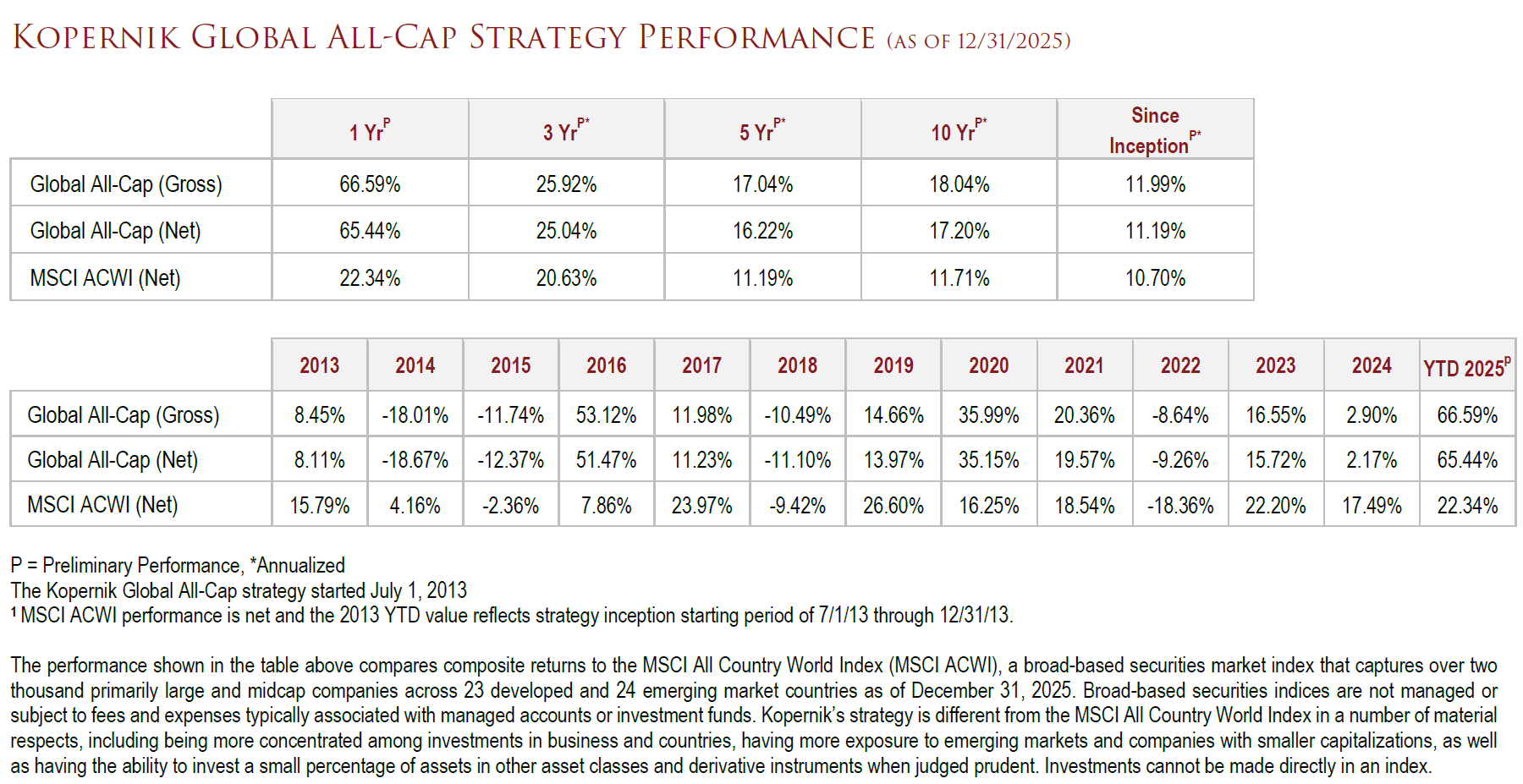
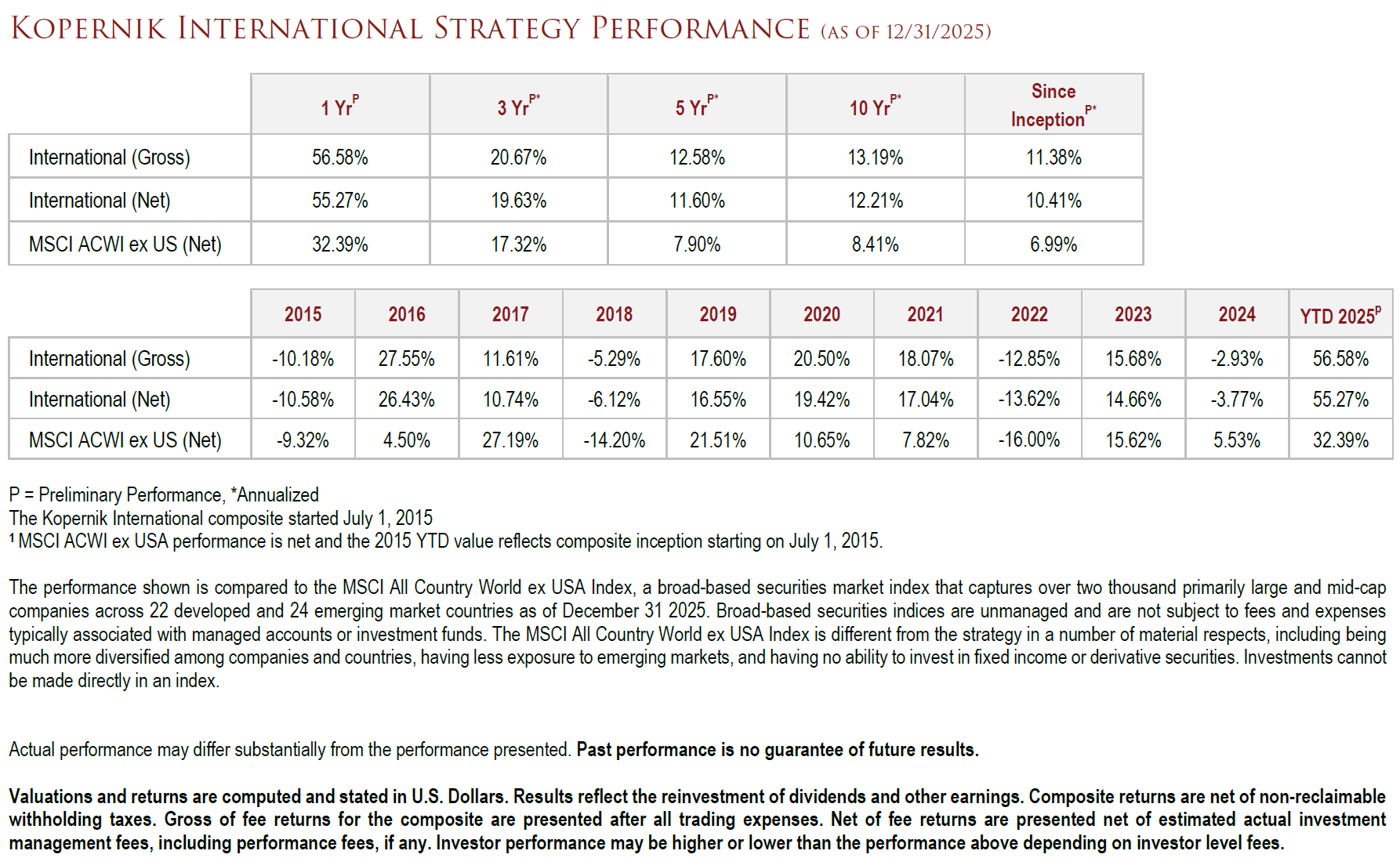
The commentary represents the opinion of Kopernik Global Investors, LLC as of January 22, 2026, and is subject to change based on market and other conditions. Dave Iben is the managing member, founder, and chairman of the Board of Directors of Kopernik Global Investors. He serves as chairman of the Investment Committee, lead portfolio manager of the Kopernik Global All-Cap and Kopernik Global Unconstrained strategies, and co-portfolio manager of the Kopernik Global Long-Term Opportunities strategy and the Kopernik International strategies. These materials are provided for informational purposes only. These opinions are not intended to be a forecast of future events, a guarantee of future results, or investment advice. These materials, Dave Iben’s and Alissa Corcoran’s commentaries, include references to other points in time throughout Dave’s over 43-year investment career (including predecessor firms) and does not always represent holdings of Kopernik portfolios since its July 1, 2013, inception. Information contained in this document has been obtained from sources believed to be reliable, but the accuracy of this information cannot be guaranteed. The views expressed herein may change at any time subsequent to the date of issue. The information provided is not to be construed as a recommendation or an offer to buy or sell or the solicitation of an offer to buy or sell any investment or security.
1The Global Industry Classification Standard (“GICS”) was developed by and is the exclusive property and a service mark of MSCI Inc. (“MSCI”) and Standard & Poor’s, a division of The McGraw-Hill Companies, Inc. (“S&P”) and is licensed for use by Kopernik Global Investors, LLC. Neither MSCI, S&P nor any third party involved in making or compiling the GICS or any GICS classifications makes any express or implied warranties or representations with respect to such standard or classification (or the results to be obtained by the use thereof), and all such parties hereby expressly disclaim all warranties of originality, accuracy, completeness, merchantability and fitness for a particular purpose with respect to any of such standard or classification. Without limiting any of the foregoing, in no event shall MSCI, S&P, any of their affiliates or any third party involved in making or compiling the GICS or any GICS classifications have any liability for any direct, indirect, special, punitive, consequential or any other damages (including lost profits) even if notified of the possibility of such damages.
