Fertilizers
A conversation with materials & real estate analyst Taylor McKenna, CFA
Let’s start with the basics. Can you describe the overall fertilizer industry?
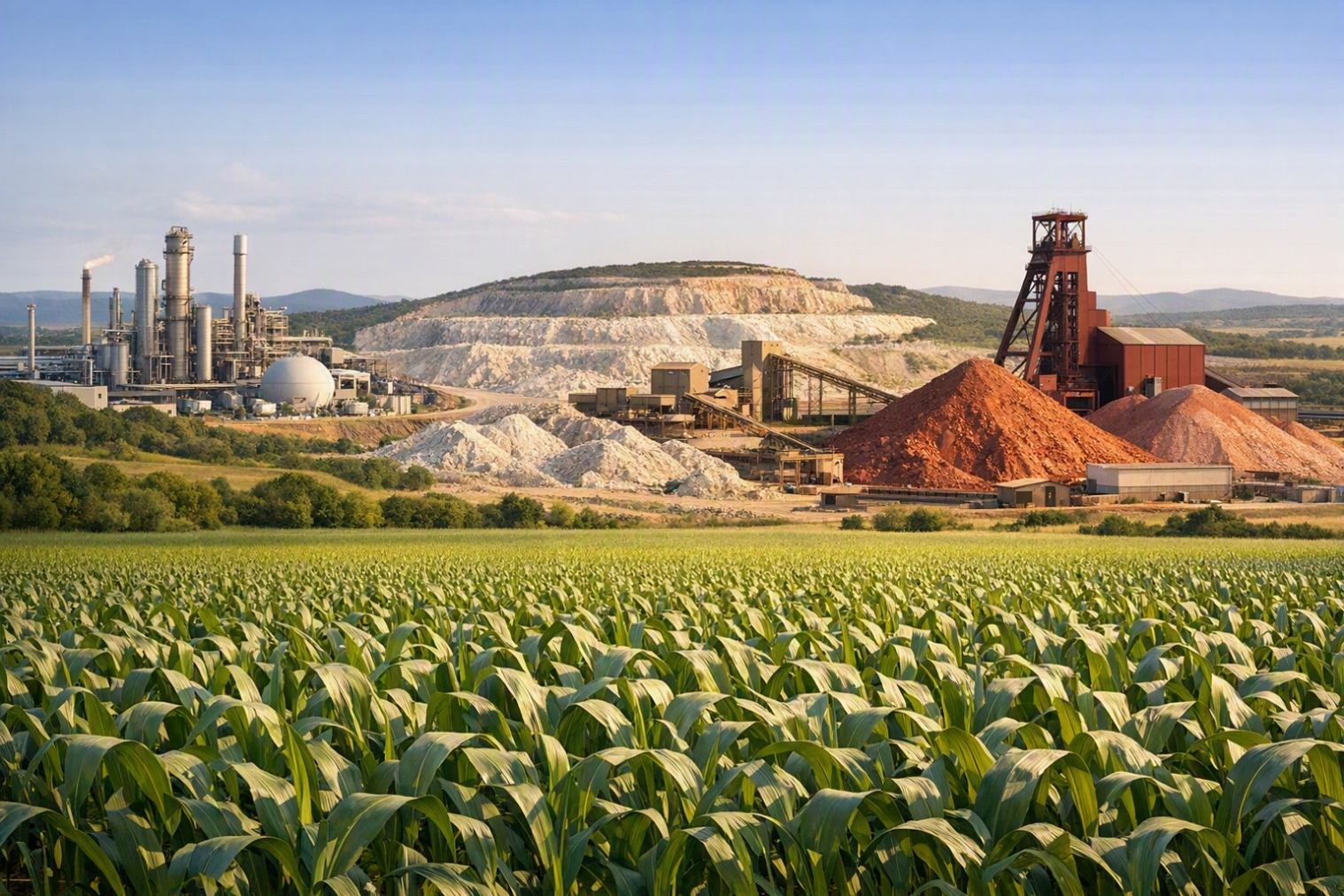
Fertilizer is often discussed as one broad category, but nitrogen, phosphate, and potash are very different businesses with different supply chains, cost structures, and price drivers.
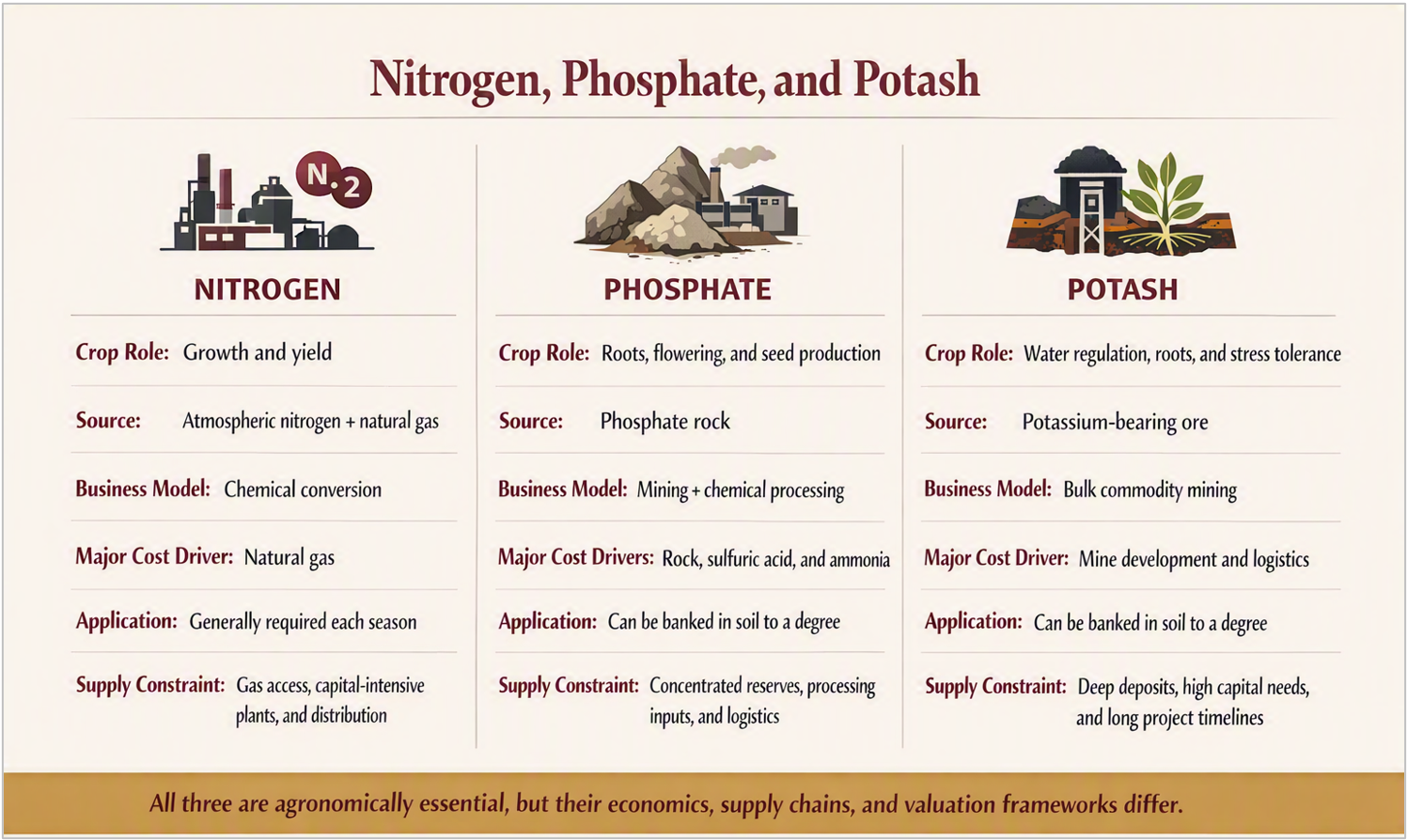
Nitrogen is an essential crop nutrient that promotes growth and increases yields. There is not enough nitrogen in the soil to supply crop demand, so farmers must apply it in either its organic form (manure, compost) or synthetic form (in which a chemical process transforms nitrogen gas into nitrogen-based products like ammonium, nitrate, or urea). 78% of our atmosphere is nitrogen; to be turned into fertilizer, that atmospheric nitrogen must be mixed with hydrogen gas, the most common source of which is methane—natural gas. Thus, the nitrogen fertilizer industry is essentially a chemical conversion business that is highly tied to the price of natural gas. China, the United States, Russia, and countries in the Middle East (Saudi Arabia, Qatar) are key producers. Because natural gas and atmospheric nitrogen are widely available, nitrogen supply may appear to be less constrained; however, converting those inputs into fertilizer requires capital-intensive processing plants, reliable gas supply, and distribution infrastructure.
Phosphate fertilizers promote root growth, disease resistance, and improved flowering/seed production. These fertilizers take multiple forms. There are organic options (bone meal, fish meal, compost), rock phosphorus (which can be ground up and added directly to the soil), and synthetic options, created by treating phosphate rock with sulfuric acid. China is the largest producer of phosphate; Morocco has the world’s largest supply reserves and is the second-largest producer. The United States, Russia, and Jordan also have significant reserves and production. Like with nitrogen, there’s a chemical process involved in producing the synthetic phosphate fertilizers; companies must first mine the phosphate rock and then process it to produce finished fertilizers such as diammonium phosphate (DAP) or monoammonium phosphate (MAP).
Potash is shorthand for potassium fertilizer. When people say potash, they’re usually referring to potassium chloride, often called muriate of potash, or MOP. MOP is mined or extracted from potassium-bearing ore, then processed into standardized granular fertilizers that can be blended with other nutrients and applied efficiently. Potassium helps the plant manage water and stress. It supports water regulation inside the plant, helps roots develop, and is associated with overall crop vitality and vigor. Unlike nitrogen and phosphate, potash is a bulk commodity mining business that does not require substantial chemical processing. Many potash deposits sit deep underground in formations left by ancient oceans. Developing them requires substantial capital and years of work. Existing mines can operate for decades, and in some cases may have reserve and resource lives measured in centuries.
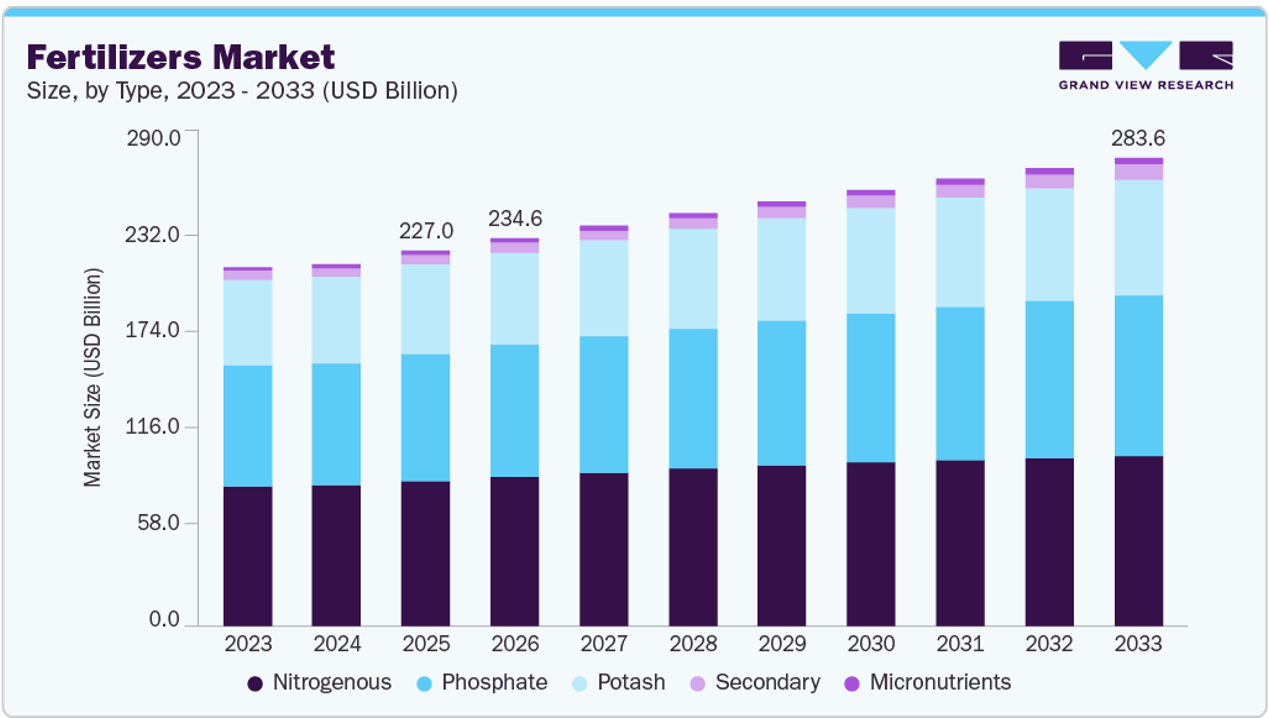
Without adequate nitrogen, phosphorus, and potassium, crop yields decline by a significant amount; according to one study, omitting all fertilizers reduced wheat and maize yields by 81% and 84%, respectively1. Organic alternatives do exist. Manure, compost, bone meal, fish meal, crop residues, and nutrient-rich cover crops and green manures (cover crops that are tilled under to replenish the soil) can improve soil health and substitute for synthetic fertilizers. However, their nutrient concentration varies, and they are bulky, harder to transport, and more difficult to apply at scale.
Fertilizers aren’t interchangeable (all 3 nutrients are necessary for crops to grow), but they all compete for space within the farmer’s budget. Farmers think in terms of growing a crop: what their soil needs, how much working capital they have, and at what prices they’ll be able to sell their wheat, soybeans, or corn. A 2026 survey by the American Farm Bureau Association revealed that 70% of U.S. farmers cannot afford to purchase all the fertilizer they need for the season.
How should we think about long-run demand for fertilizers, and where could demand growth be the strongest?
At a high level, demand across nitrogen, phosphate, and potash tracks planted acreage, crop mix, and growers’ yields, which are influenced by population growth, changing diets, and the amount of land in cultivation. Because these forces evolve gradually, long-run fertilizer demand tends to be slow and steady.
Nitrogen is necessary every season, but can be applied in a series of tranches, or in targeted amounts. If fertilizer prices rise rapidly (as they did in March 2026 when the war between the U.S. and Iran resulted in the closure of the Strait of Hormuz and damaged Qatari natural gas fields), application can be delayed or reduced slightly, but it’s still necessary. Potash and phosphate can be banked in the soil to a degree, which means farmers have more flexibility on timing: if prices spike, they can defer application for a season. However, deferral simply borrows from the soil and doesn’t really constitute demand destruction. It isn’t sustainable to skip multiple growing seasons for potash and phosphate, and nitrogen must be applied yearly. In a downcycle, the market often sees weak near-term demand and assumes it is permanent. But that demand has simply been pushed forward.
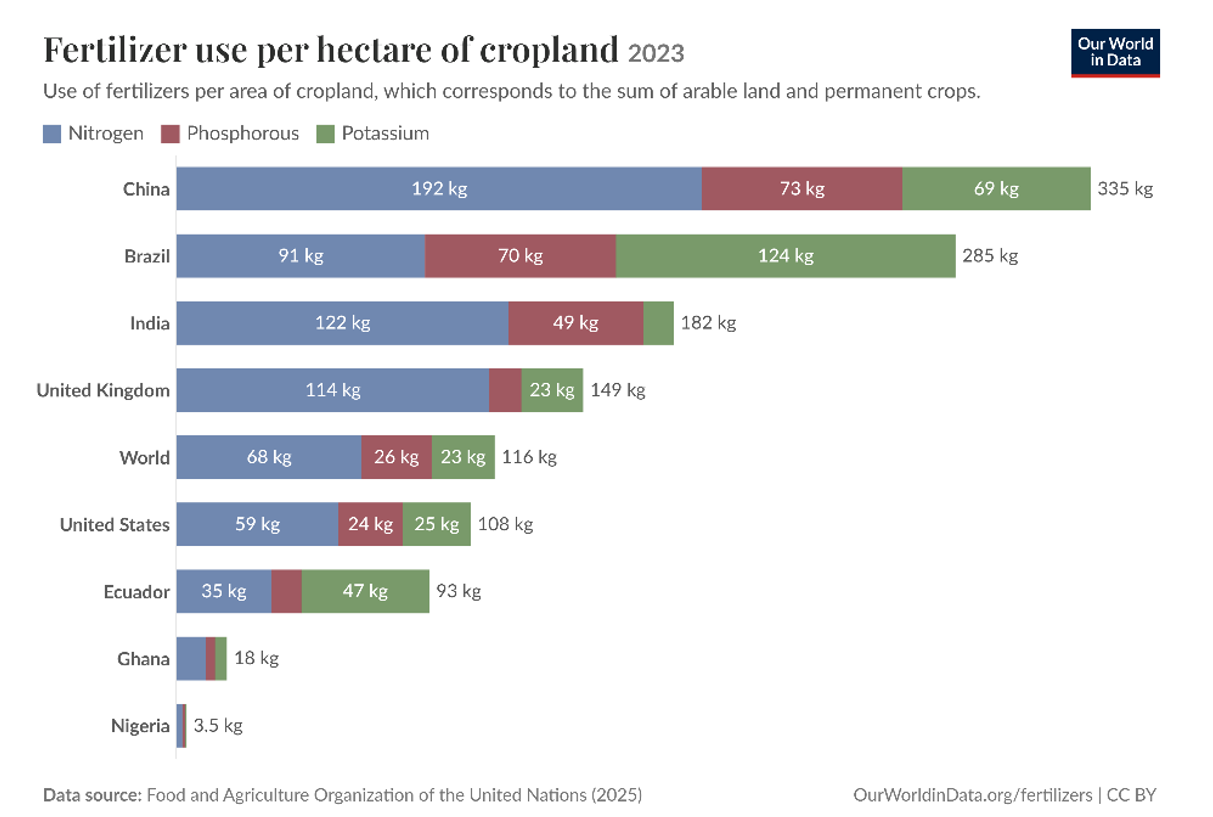
Over time, demand growth could be strongest in regions where fertilizers have historically been underapplied, and farmers are moving toward more balanced crop nutrition. As growers seek higher yields, nutrient use could rise. Some of the world’s largest emerging markets—China, Brazil, and India—already apply more fertilizer than developed markets. Some believe that these countries overapply, which means demand could decline. However, there are nuances: India overapplies nitrogen but underapplies potash; Brazil has two growing seasons, which increases its fertilizer use; and China’s geographical diversity produces meaningful differences among crops and regions. Longer-term, fertilizer use is less about simply applying more fertilizers everywhere and more about moving towards balanced and efficient nutrient use across regions and crops. Demand could drop in one area but rise in another.
Application use per hectare comparisons require context. Crop mix, soil conditions, domestic production capacity, the number of growing seasons, and how frequently nutrients must be applied are all important considerations. For example, India has significant processing capacity for nitrogen and phosphate fertilizers but must, importantly, import all of its potash. Nitrogen fertilizers, especially urea, are also heavily subsidized, and therefore cheaper. If a farmer is deciding how to spend his fertilizer budget, a subsidized urea fertilizer will be cheap, easily accessible, and will produce a visible yield response, and that farmer may be less inclined to spend his money on more expensive phosphate or potash fertilizers. In India, overreliance on nitrogen fertilizers has led to nutrient imbalances and a steady deterioration of soil health. Any growth of fertilizer use in that country is likely to come from increased use of phosphate and potash, rather than from increased nitrogen application2.
Globally, arable land per person continues to decline; population is growing, but the amount of land in cultivation is not. To meet the demands of a growing population, agricultural practices in emerging markets will likely continue to modernize, and farming is likely to become more commercialized. As the maps below show, fertilizer is most underapplied in precisely the regions where population growth is the strongest: sub-Saharan Africa and the northwest part of South America. As populations grow and need more food, yields need to increase, and fertilizer usage in these regions is likely to grow, in our opinion.
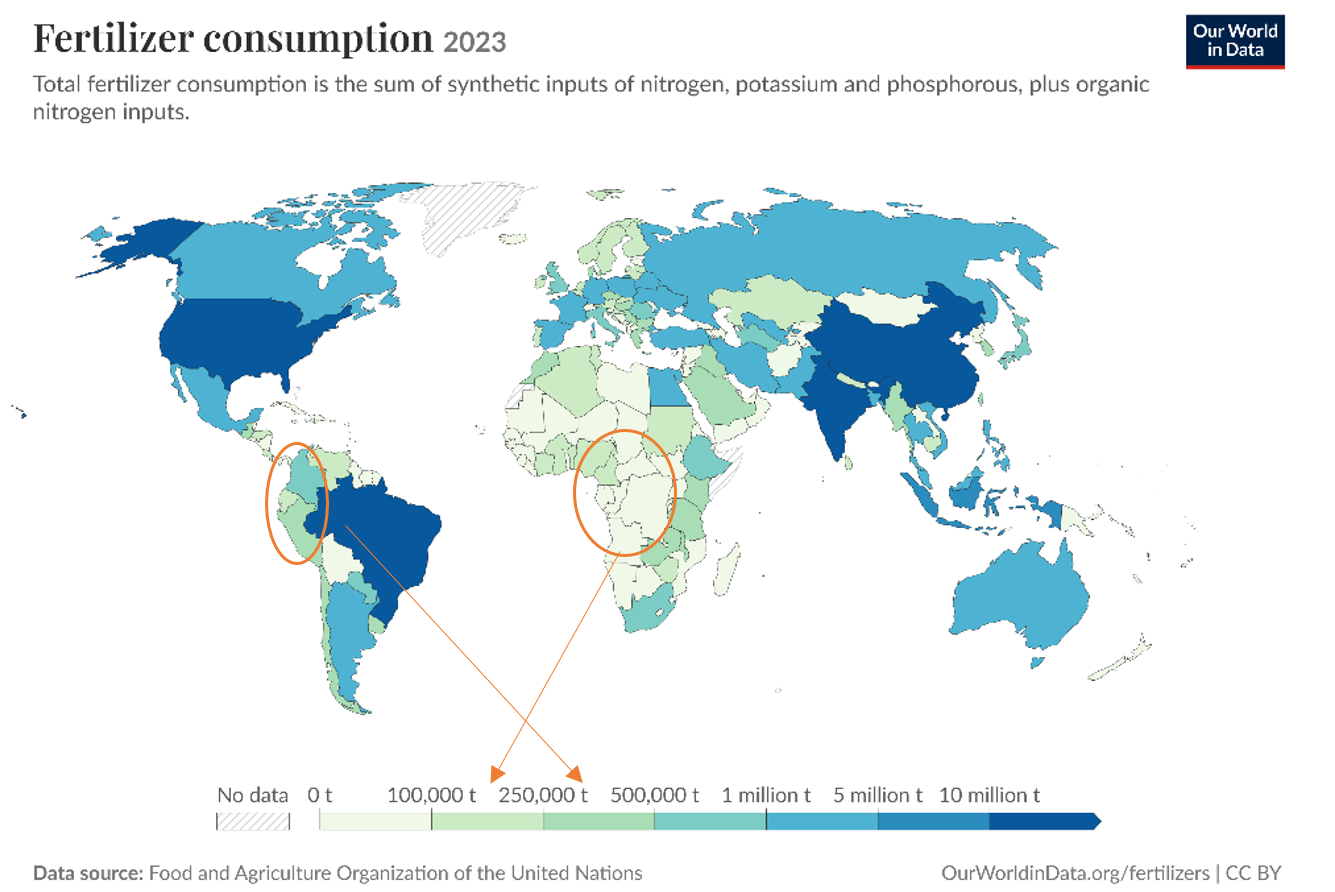
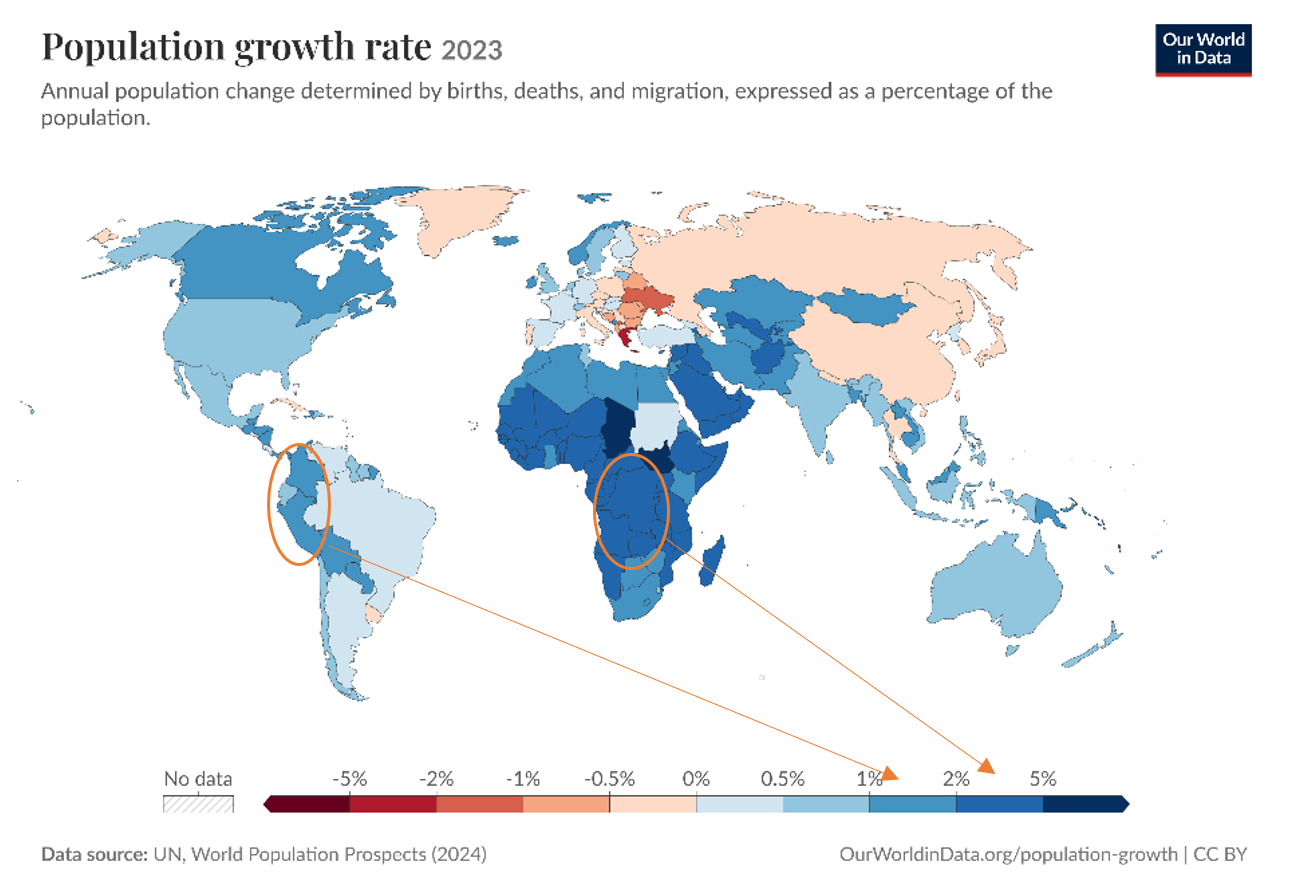
While we are reasonably confident that fertilizer demand will continue to grow, the path will not be linear. New agricultural technologies, such as precision agriculture, could change how food is produced, and better application processes may reduce waste. To date, that has not happened, and precision agriculture has not eliminated the need for fertilizers. In regions of the world that lack industrial-scale farming and processing and/or distribution infrastructure, increasing agricultural yields will require investment in both fertilizer use and the systems that deliver it.
What are the supply dynamics for the fertilizer industry?
Each market has its own bottlenecks. As we discussed above, nitrogen is heavily tied to the price of natural gas, and so when gas prices are volatile, the nitrogen price responds accordingly (the prices of various nitrogen-based products spiked 30%-40% in March 2026 when Qatari gas fields were damaged during the war with Iran, for example). Natural gas is not scarce (and atmospheric nitrogen is virtually unlimited); thus, nitrogen fertilizers are essentially unlimited in supply as well.
Phosphate supply is unusually concentrated. Morocco holds the industry’s highest-quality and largest phosphate resources, controlling roughly 68% of global reserves. China is a leading producer but uses almost all of that production domestically; the Americas (especially the U.S. and Brazil) and Russia make up the rest of the world’s supply. There is concentration risk—Morocco could theoretically bring on additional supply. Historically, however, they have maintained discipline and avoided flooding the market.
For phosphate, supply depends not only on phosphate rock but also on chemical inputs such as ammonia and sulfuric acid. Much of the world’s sulfuric acid is produced in connection with petroleum refining, so there is an additional link between fertilizer economics and energy markets. If sulfuric acid costs rise faster than crop prices, phosphate producers become caught between higher production costs and farmers who can’t afford higher fertilizer prices. The two cycles—sulfuric acid prices and crop prices—are tied together, but they don’t necessarily move in sync.
Potash production is constrained by project economics and engineering. Many deposits are deep and require large underground mines, extensive processing facilities, and dedicated logistics, which translate into substantial capital commitments and multi-year timelines. New greenfield potash capacity can take nearly a decade to bring online, with capital requirements often exceeding $3 billion per million tons of annual capacity.
BHP’s Jansen project (the only potash project currently being built) illustrates the scale of that hurdle. Stages 1 and 2 are expected to provide roughly 8.5 million tons of annual capacity—about 10% of the global market—but combined capital spending has risen to approximately $15.5 billion. Even with projected operating costs remaining low once the mine is built, the first stage is expected to earn only about 7.9% to 9.1% return at the prices used in BHP’s assumptions, below the 15% return we would prefer to see according to our models. The economics of the project therefore do not work at consensus prices of $350-$400 per ton. The first stage is expected to begin production next year, but at this point, building the second stage is uneconomical, in our opinion. BHP may still proceed because it has identified potash, alongside copper, as a commodity that should benefit from rising long-term demand.
| The common thread across all the fertilizers is that meaningful new supply cannot be added overnight. Potash and phosphate require prices to be high enough to justify building large, expensive mines and processing facilities; nitrogen expansion depends on the cost and availability of natural gas, the ability to build capital-intensive conversion plants, and distribution infrastructure. Their supply cycle is typical: high prices encourage investment, then new supply comes online, and prices come down. The reverse is also true—if too much supply comes online, prices come down, and investment slows. Nitrogen does not have the same reserve-based incentive-price framework, but new capacity still requires favorable gas economics, substantial capital, and confidence that margins will justify construction of processing facilities. |
What characteristics do we look for when selecting fertilizer companies?
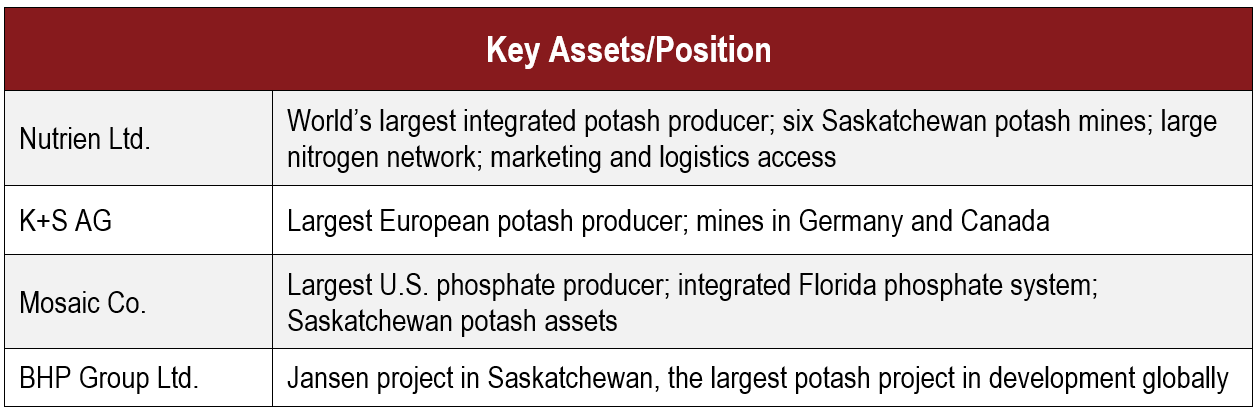
The most attractive opportunities often emerge at or near the bottom of the cycle: expected supply is arriving, demand has disappointed, and (importantly) investors extrapolate that those conditions will continue indefinitely. As of September 2026, our portfolio holdings include Nutrien Ltd., the world’s largest integrated potash producer (they also have additional businesses in nitrogen and phosphate, as well as a marketing and global logistics platform); K+S AG, a German-based company that is the largest European producer of potash and has large mines in both Germany and Canada; Mosaic Co., which is based in Florida and is the largest U.S. phosphate producer, as well as a large producer of potash; and BHP Group Ltd., one of the world’s largest diversified mining companies. BHP’s Jansen project, discussed above, is the only significant potash project in development today.
We look for good companies that are trading at significant discounts to our risk-adjusted estimates of what they are worth. We like to see high-quality long-lived reserves and proximity to infrastructure. We have tended to gravitate toward potash. It is undervalued in our opinion. Like many resource companies, we believe that opportunity exists because of the industry’s tendency to look at short-term cash projections rather than long-term asset value. See our website for more on this aberration.
K+S is a useful example of a company that has allocated capital well in the past, an unfortunately rare characteristic among cyclical companies. During the last downturn, the company faced significant cost overruns at its Canada potash asset, which was in development at the time. The prevailing view was that the company should sell the project, even though it was near the bottom of the cycle. At the time, K+S also owned a lucrative salt business; the company decided to sell the salt business, using the proceeds to complete the potash investment and pay down its debt. Thus, when potash prices improved, they had a fully built potash mine and a strong balance sheet.
How does Kopernik think about risk and valuation with fertilizer companies?
These are businesses where a lot of different factors matter: crop prices, weather, trade policy, geopolitics, local environmental regulations, shipping routes, and input costs can all have an impact. There is also company-specific risk. A company can own a good asset but be a poor investment if the balance sheet is stretched, costs are consistently too high, or management navigates the cycle poorly. We don’t try to avoid these risks, but we do demand to be overpaid for the potential downside.
Fertilizers are a cyclical industry, but the market has a tendency to treat temporary conditions as permanent. At the bottom of the cycle, weak crop prices, deferred farmer purchases, excess inventories, elevated input costs, or new capacity can depress current earnings and make good assets appear less desirable. At the top, strong prices, favorable input costs, or supply disruptions can inflate earnings and make those same businesses or assets appear more valuable than they are.
We have written elsewhere about our belief that the value of mining assets can’t be captured by a traditional discounted cash flow (DCF) model. Potash and phosphate producers own long-lived reserves and resources, with mine lives sometimes stretching to near a century of potential production. Their value extends for many years beyond the period captured by a DCF, and they have optionality to significantly higher prices. Nitrogen producers do not have the same reserve optionality, but advantaged gas access, efficient conversion plants, and well-positioned distribution networks can support through-cycle economics that are obscured by temporarily high or low margins.
Fertilizer prices will not move in a straight line. Not every producer will benefit equally. But nitrogen, phosphate, and potash are essential to sustaining crop yields, and the assets and infrastructure needed to produce those essential products are costly, slow to develop, and difficult to replicate. Periods of weak demand or compressed margins can obscure those realities, especially for investors who do not think long-term. Instead, we seek to identify companies whose long-term value is greater than the market recognizes during periods of cyclical discomfort.
Taylor McKenna, CFA, Materials & Real Estate Analyst
written in conjunction with Mary Bracy, Managing Editor – Investment Communications
Production and Design:
John W. Braukman IV, Marketing Manager
Alaukika Vaishnav, Marketing Specialist
September 2026
Important Information and Disclosures
The information presented herein is proprietary to Kopernik Global Investors, LLC. This material is not to be reproduced in whole or in part or used for any purpose except as authorized by Kopernik Global Investors, LLC. This material is for informational purposes only and should not be regarded as a recommendation or an offer to buy or sell any product or service to which this information may relate.
This letter may contain forward-looking statements. Use of words such was “believe”, “intend”, “expect”, anticipate”, “project”, “estimate”, “predict”, “is confident”, “has confidence” and similar expressions are intended to identify forward-looking statements. Forward-looking statements are not historical facts and are based on current observations, beliefs, assumptions, expectations, estimates, and projections. Forward-looking statements are not guarantees of future performance and are subject to risks, uncertainties and other factors, some of which are beyond our control and are difficult to predict. As a result, actual results could differ materially from those expressed, implied or forecasted in the forward-looking statements.
Please consider all risks carefully before investing. Investments in a Kopernik strategy are subject to certain risks such as market, investment style, interest rate, deflation, and illiquidity risk. Investments in small and mid-capitalization companies also involve greater risk and portfolio price volatility than investments in larger capitalization stocks. Investing in non-U.S. markets, including emerging and frontier markets, involves certain additional risks, including potential currency fluctuations and controls, restrictions on foreign investments, less governmental supervision and regulation, less liquidity, less disclosure, and the potential for market volatility, expropriation, confiscatory taxation, and social, economic and political instability. Investments in energy and natural resources companies are especially affected by developments in the commodities markets, the supply of and demand for specific resources, raw materials, products and services, the price of oil and gas, exploration and production spending, government regulation, economic conditions, international political developments, energy conservation efforts and the success of exploration projects.
Investing involves risk, including possible loss of principal. There can be no assurance that a strategy will achieve its stated objectives. Equity funds are subject generally to market, market sector, market liquidity, issuer, and investment style risks, among other factors, to varying degrees, all of which are more fully described in the fund’s prospectus. Investments in foreign securities may underperform and may be more volatile than comparable U.S. securities because of the risks involving foreign economies and markets, foreign political systems, foreign regulatory standards, foreign currencies and taxes. Investments in foreign and emerging markets present additional risks, such as increased volatility and lower trading volume.
The holdings discussed in this piece should not be considered recommendations to purchase or sell a particular security. It should not be assumed that securities bought or sold in the future will be profitable or will equal the performance of the securities in this portfolio. Current and future portfolio holdings are subject to risk.
Commodities may be affected by changes in overall market movements, changes in interest rates, and other factors such as weather, disease, embargoes, or political and regulatory developments, such as trading activity of speculators and arbitrageurs in the commodities. Investing in commodities entails significant risk and is not appropriate for all investors.
To determine if a Kopernik Mutual Fund is an appropriate investment for you, carefully consider the Fund’s investment objectives, risk factors, charges and expenses before investing. This and other information can be found in the Fund offering materials, which may be obtained by contacting your investment professional or calling Kopernik Mutual Fund at 1-855-887-4KGI (4544). Read the offering materials carefully before investing or sending money. Check with your investment professional to determine if a Kopernik Mutual Fund is available for sale within their firm. Not all funds are available for sale at all firms.
- National Library of Medicine: National Center for Biotechnology Information. Valuation in Yield Gap Induced by Nitrogen, Phosphorus and Potassium Fertilizer in North China Plan, December 12, 2013. ↩︎
- PIB Delhi, Balanced Use of Fertilizers: A Key Enabler of Sustainable Farming, January 31, 2026. ↩︎