
AI as Servant, Not Master (Oct 2026)
“The real problem is not whether machines think but whether men do.”
-B.F. Skinner
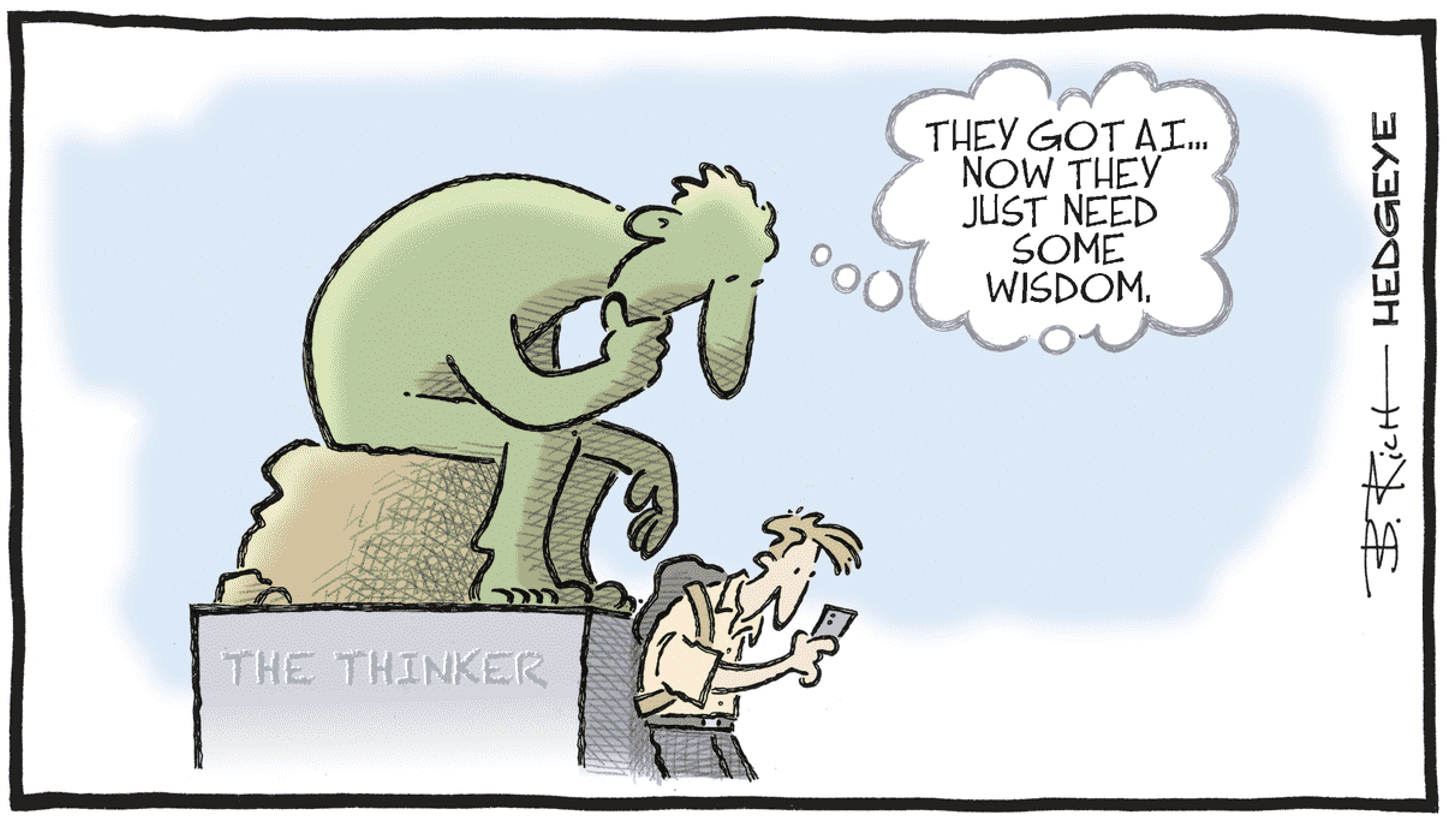
Every new technology arrives promising more: more productivity, more speed, more scale, and more efficiency. Electrification and the invention of new household appliances in the early twentieth century cut the number of hours spent on household labor from roughly 58 hours/week in 1900 to 18 hours/week in 1975.1 The printing press lowered the cost and expanded the supply of printed materials; between 1500-1600, European cities that adopted printing presses in the 1400s grew 60% faster than those that did not, according to one study.2 Spreadsheets revolutionized the financial industry, allowing analysts to test their assumptions in minutes and making rapid, scenario-based decision-making possible. Artificial intelligence (AI) now seems poised to offer the next technological leap forward, with the ability to gather, summarize, compare, translate, draft, code, and organize at a speed that was unfathomable only a few years ago.
This might seem particularly tempting to investors. Investment research involves taking a lot of information, much of it seemingly repetitive, and making sense of it. There are filings to read, transcripts to review, models to build, industries to map, companies to track, and theses to test. Used well, AI can reduce the friction around many of these tasks, helping analysts move quickly through familiarization, organize large amounts of materials, identify inconsistencies, and generate helpful questions. In that sense, it can become a wonderful servant. But AI, like most other technologies, is a horrible master.
Judgment is not the same as information processing; productivity is not the same as insight. AI is useful largely because it can detect and reproduce patterns across enormous bodies of available information. This makes it useful for identifying what is common, repeated, consensus, or easily synthesized; it makes it dangerous for the same reasons. For the market, the most available narrative is usually not the most accurate one.
At Kopernik, we have been exploring potential opportunities for AI use over the past few years as we began incorporating a small batch of AI tools to help increase efficiency and manage data and workflows. We have recently seen an uptick in the number of questions people are asking us about AI, by far the most common of which is “How do you use AI at Kopernik?” This whitepaper proposes to address that question and to make the case that AI, while a useful tool, cannot replace human judgment, independent thought, and alignment with clients.
Before we discuss how we use AI, it may be helpful to explain the vantage point from which we approach it. Like everyone else, we see things through our own particular lens—to quote Emerson, “perception is a mirror, not a fact.” Our view is shaped by our philosophy, process, and experience. Kopernik’s approach has never depended on reaching the same conclusion as other investors or reaching a conclusion more quickly. Nor have we claimed or sought an informational edge; indeed, in today’s world, it seems that having a true informational edge is either impossible or dependent upon insider knowledge. Instead, we have identified that our competitive advantage lies in what we describe as behavioral, analytical, and organizational edges. That means certain things are paramount for us: building portfolios that look different from mainstream; owning unpopular securities and having the ability to tolerate discomfort; shouldering business risk to Kopernik to reduce risk for our clients’ portfolios; emphasizing market inefficiencies and conducting bottom-up fundamental research in order to take advantage of those inefficiencies; and prioritizing independent thought. Our organizational structure—employee-owned, deliberately capacity-constrained, and investing alongside our clients—further strengthens our autonomy and shapes the priorities we bring to the question of how AI should (or should not) fit into our process.
AI can help identify consensus assumptions so they can be challenged; accelerate the collection and organization of raw material so that more time and bandwidth are available for deep analysis; compare research materials; flag calculation errors; and create a more efficient foundation for conversations and debate. Used carelessly, however, AI runs the risk of weakening the intellectual discipline that it is meant to support. If every firm asks similar tools similar questions using similar sources, the result is greater homogeneity. To counter this, human beings, with their capacity for independent thinking and their ability to invert common narratives, must come first. AI comes second, challenging (not setting) beliefs and improving (not bypassing) the process. AI should create more time for the most important work: understanding businesses, weighing risks, debating assumptions, valuing securities, and stewarding client capital.
AI makes human judgment more valuable, not less. Competent summaries and surface-level analyses are abundant. Those who rely on them do not have an advantage. Instead, the advantage accrues to those who ask better questions, recognize flawed assumptions, resist the consensus, and are patient when the evidence and independent analysis support a non-consensus view. New technologies make humans more productive, but they do not make them less human; AI makes markets faster, but it does not make them more rational. Disciplined thought is even more important in this environment. AI should be used as a servant to the investment process, not the master of it.
The question is not whether to use AI, but how (and why)
“By far, the greatest danger of Artificial Intelligence
is that people conclude too early that they understand it.”
-Eliezer Yudkowsky
Frequently, any debate around artificial intelligence is framed as a binary: firms either embrace it or resist it. This framing is unhelpful, in our opinion; it seems to us as though AI is quickly becoming de rigeur in many industries. The more useful question is “Does AI improve the investment process in ways that reinforce the firm’s investment approach, or does it introduce shortcuts that weaken it?”
AI should make Kopernik better at being Kopernik. Its value will come from being used to support the judgement, discipline, and willingness to look different that characterizes our investment approach. The table below distills how AI adoption might support (or undermine) the analytical, behavioral, and organizational disciplines on which that approach relies:
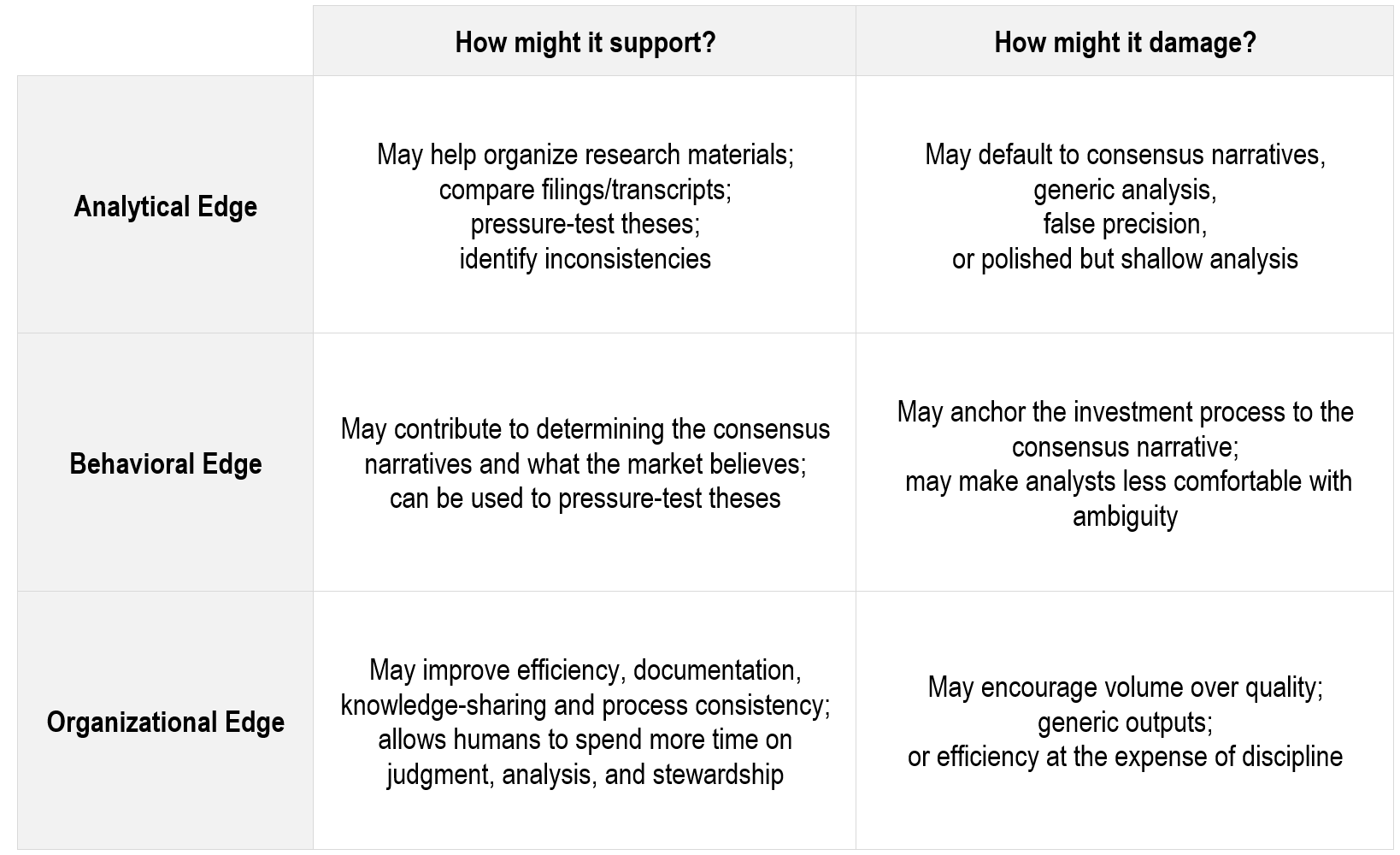
Human beings should frame questions, identify key concerns, and form an initial view. AI can then be brought in to expand the amount of information available to the analyst in support of their thesis, to challenge assumptions, to generate counterarguments, or to reconcile data. Thus, AI becomes a tool for the sharpening of thought rather than replacing it.
Using AI without outsourcing the work
“The first principle is that you must not fool yourself—and you are the easiest person to fool.”
-Richard Feynman
In our opinion, AI should help Kopernik’s analysts cover more ground, but it should not decide which ground they should cover. In practice, the most useful applications of AI in investment research are often the most boring: gathering information, organizing it, translating it (if necessary), comparing it, and checking it.
Below are some ways Kopernik analysts are using AI tools:
Familiarization. AI is useful for an analyst familiarizing themselves with a new industry: generating initial industry maps, assembling a group of competitors, inventorying public sources, and/or translating foreign-language materials.
Structure. After an analyst has identified the material questions, these questions can be converted into a more organized work plan to improve workflow efficiency and communication.
Data extraction and organization. AI can pull information from filings, transcripts, or presentations; compare different time periods; summarize disclosure changes; identify inconsistencies; and make large bodies of source materials searchable. This reduces the mechanical work required to get to the analytical work.
Monitoring. AI can help watch news, filings, transcripts, press releases, and corporate actions across an analyst’s coverage. Over time, analyst-defined rules and feedback can help direct attention towards developments that may be material.
Control. AI can assist with repetitive workflows, compare figures across reports and financial statements, and flag discrepancies and repetition.
Challenge. AI can be asked to argue the other side after an analyst has formed an independent view. In that role, AI resembles a Socratic partner, useful because it helps reveal better questions.
Analysts should own their recommendations: source verification, quality of evidence, and determining what is material. They should interpret accounting, evaluate unusual disclosures, assess management, understand competitive position and barriers to entry, and determine the appropriate valuation method. Their assumptions, scenarios, and risk adjustments should be their own. AI can help expose weak spots, but it cannot assume responsibility for the thesis, the risks, the recommendations, or the capital our clients have entrusted to us.
The same principle applies to people and team development. AI should make analysts and research associates more productive, not less necessary. If AI reduces the time spent gathering information, formatting, searching, and organizing, the result should be greater capacity for judgment, collaboration, and deeper research, not fewer people doing the thinking. AI should strengthen Kopernik’s research culture rather than flatten it. The more capable AI tools become, the more valuable it will be to prioritize the human thinking that makes the tools useful.
Controlled adoption is an important part of responsible AI use. Kopernik’s guardrails require the use of firm-approved enterprise tools, with special care to protect confidential, proprietary, client, employee, and privileged information. AI-produced summaries should be treated as something to verify and to be checked against primary sources. The firm should also remain alert to the structural limitations of AI: hallucinations, stale information, bias, inconsistency, limited knowledge, and false precision. Most importantly, AI must not be used to make investment decisions. The test for any AI use case should be practical: does it improve the process and/or help us fulfill our fiduciary responsibility, or does it merely add speed, novelty, or volume?
Concluding Thoughts
“In the short run, the market is a voting machine but in the long run, it is a weighing machine.”
-Benjamin Graham
In a world in which the markets are assumed to be efficient, it is easy to carry that forward and assume that AI will make them even more efficient. This is erroneous thinking, in our opinion. AI may make markets faster, more informed on the surface, and more productive at processing information. But if most investors rely on similar tools, trained on similar public sources, asking similar questions, the result is likely to be faster convergence around the same narrative rather than a deeper understanding. The consensus may become more polished, more confident, and more quickly distributed, but that does not mean it is correct. Indeed, in our opinion it is more likely that AI magnifies the very forces that contribute to market inefficiencies in the first place: emotions, biases, herd behavior, and the human instinct to seek conformation of existing assumptions. Peter Kaufman, CEO of Glenair and editor of Poor Charlie’s Almanack, relates a story about asking AI to write a long investment thesis for a stock. The AI produced a detailed, well-written, and convincing analysis. Then, he asked AI to write a short thesis for the same stock. The AI produced a detailed, well-written, and convincing analysis.
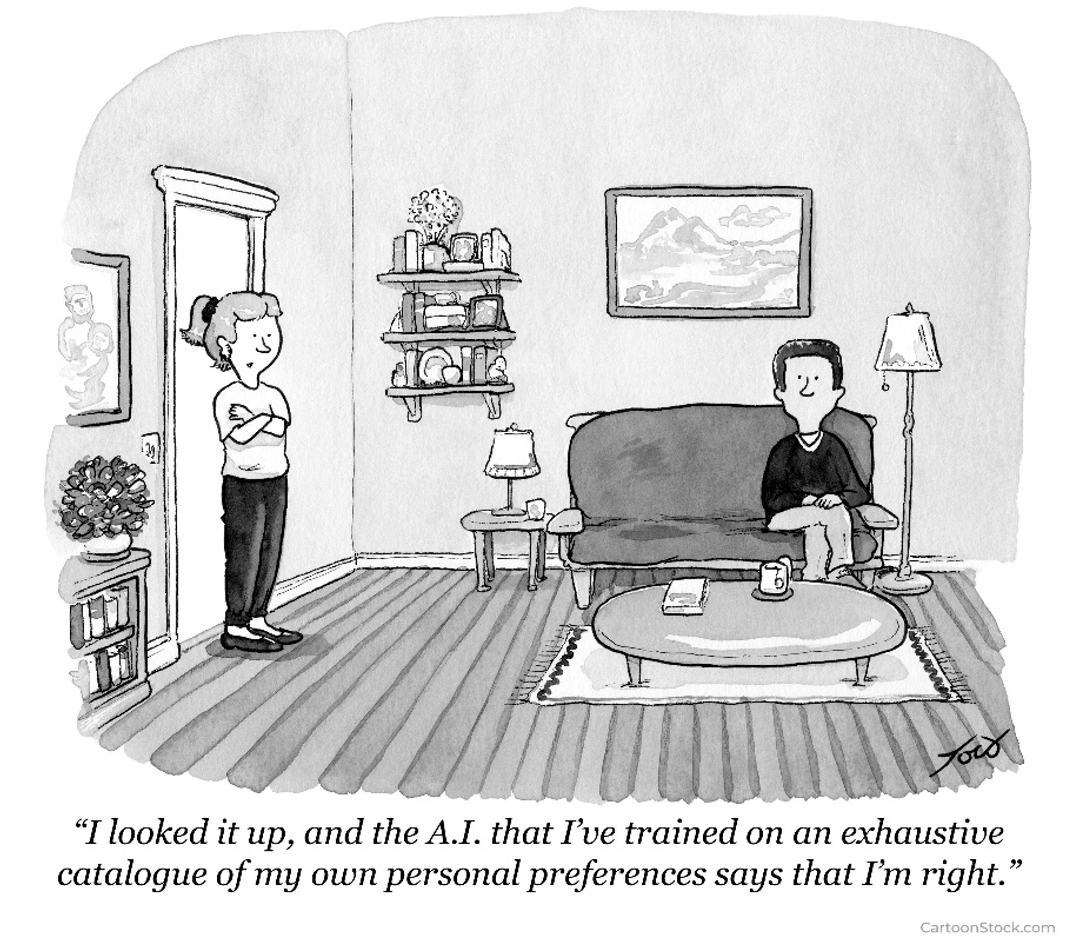
Independent thought, judgement, and a clear understanding of how AI can serve an investment philosophy and process are essential. AI can be a powerful servant if it reinforces those disciplines. But if it becomes the master, it is likely to only make the crowd move faster, and herd mentality has proven its inability to eliminate mispricings. AI cannot judge materiality, know when the consensus is wrong, invert a common narrative, or understand what is not in the data. More importantly, AI cannot bear uncertainty, exercise patience, or take career or business risk. And it cannot fulfill a fiduciary obligation to steward client capital responsibly. Those things remain strictly in the realm of human ability. In our opinion, investors are well-served to let AI do what it does best: gather, organize, and challenge. We will reserve the essential work of knowledge, judgment, conviction, and stewardship for human beings. As always, thank you for your support.
Kopernik Investment Research Team,
written in conjunction with Mary Bracy, Managing Editor – Investment Communications
Production and Design:
John W. Braukman IV, Marketing Manager
Alaukika Vaishnav, Marketing Specialist
October 2026
- Jeremy Greenwood, How the appliance boom moved more women into the workforce, January 2019. ↩︎
- Jeremiah E. Dittmar, Information Technology and Economic Change: The Impact of the Printing Press, Quarterly Journal of Economics, August 2011. ↩︎
Important Information and Disclosures
The information presented herein is proprietary to Kopernik Global Investors, LLC. This material is not to be reproduced in whole or in part or used for any purpose except as authorized by Kopernik Global Investors, LLC. This material is for informational purposes only and should not be regarded as a recommendation or an offer to buy or sell any product or service to which this information may relate.
This letter may contain forward-looking statements. Use of words such was “believe”, “intend”, “expect”, anticipate”, “project”, “estimate”, “predict”, “is confident”, “has confidence” and similar expressions are intended to identify forward-looking statements. Forward-looking statements are not historical facts and are based on current observations, beliefs, assumptions, expectations, estimates, and projections. Forward-looking statements are not guarantees of future performance and are subject to risks, uncertainties and other factors, some of which are beyond our control and are difficult to predict. As a result, actual results could differ materially from those expressed, implied or forecasted in the forward-looking statements.
Please consider all risks carefully before investing. Investments in a Kopernik strategy are subject to certain risks such as market, investment style, interest rate, deflation, and illiquidity risk. Investments in small and mid-capitalization companies also involve greater risk and portfolio price volatility than investments in larger capitalization stocks. Investing in non-U.S. markets, including emerging and frontier markets, involves certain additional risks, including potential currency fluctuations and controls, restrictions on foreign investments, less governmental supervision and regulation, less liquidity, less disclosure, and the potential for market volatility, expropriation, confiscatory taxation, and social, economic and political instability. Investments in energy and natural resources companies are especially affected by developments in the commodities markets, the supply of and demand for specific resources, raw materials, products and services, the price of oil and gas, exploration and production spending, government regulation, economic conditions, international political developments, energy conservation efforts and the success of exploration projects.
Investing involves risk, including possible loss of principal. There can be no assurance that a strategy will achieve its stated objectives. Equity funds are subject generally to market, market sector, market liquidity, issuer, and investment style risks, among other factors, to varying degrees, all of which are more fully described in the fund’s prospectus. Investments in foreign securities may underperform and may be more volatile than comparable U.S. securities because of the risks involving foreign economies and markets, foreign political systems, foreign regulatory standards, foreign currencies and taxes. Investments in foreign and emerging markets present additional risks, such as increased volatility and lower trading volume.
The holdings discussed in this piece should not be considered recommendations to purchase or sell a particular security. It should not be assumed that securities bought or sold in the future will be profitable or will equal the performance of the securities in this portfolio. Current and future portfolio holdings are subject to risk.
Commodities may be affected by changes in overall market movements, changes in interest rates, and other factors such as weather, disease, embargoes, or political and regulatory developments, such as trading activity of speculators and arbitrageurs in the commodities. Investing in commodities entails significant risk and is not appropriate for all investors.
To determine if a Kopernik Mutual Fund is an appropriate investment for you, carefully consider the Fund’s investment objectives, risk factors, charges and expenses before investing. This and other information can be found in the Fund offering materials, which may be obtained by contacting your investment professional or calling Kopernik Mutual Fund at 1-855-887-4KGI (4544). Read the offering materials carefully before investing or sending money. Check with your investment professional to determine if a Kopernik Mutual Fund is available for sale within their firm. Not all funds are available for sale at all firms.