
Q1 2026 Conference Call
Edited Transcript of the 1st Quarter 2026 Conference Call with Dave Iben
Kopernik reviews the audio recording of the quarterly calls before posting the transcript of the call to the Kopernik website. Kopernik, in its sole discretion, may revise or eliminate questions and answers if the audio of the call is unclear or inaccurate.
April 23, 2026
4:15 pm ET
Mary Bracy: Good afternoon. I’m Mary Bracy, Kopernik’s Managing Editor of Investment Communications. Welcome to our first quarter 2026 investor conference call. Please note that today’s call is being recorded. You may submit questions at any time using the Q&A box, and we’ll address them at the end of the call. I’ll now turn the call over to Mr. Kassim Gaffar for a brief firm update.
Kassim Gaffar: Thank you, Mary. Welcome everyone to the first quarter 2026 conference call. I’m joined by Dave Iben, our co-CIO and lead portfolio manager for the Kopernik Global All-Cap Strategy and co-PM for the International Strategy. Before I pass the call to Dave, I’ll provide a quick firm update. From an asset standpoint, we closed the quarter in a strong position with approximately $10.2 billion under management compared with roughly $9.4 billion at the start of the year. The majority of this growth was driven by market appreciation across our funds, reflecting solid performance across all our firm strategies. Just a couple of key housekeeping items.
As you know, our Kopernik Global All-Cap Mutual Fund has been closed to new investors since the summer of last year. As previously communicated, and at the end of this month, we will be soft-closing the Kopernik Global All-Cap Strategy across all vehicles. Please note this will not impact current clients as it is a soft close. Also, our International strategy, which, as you know, is managed by the same team utilizing the same investment philosophy and process and approved list, the strategy also has close to a 96% correlation with Global All-Cap and will remain open to new investors.
We also recently announced the launch of the Global Opportunity Strategy. This strategy will be managed by co-CIOs Dave Iben and Alissa Corcoran and will invest globally in securities with a market cap greater than $3 billion, hence ex micro-cap to small-cap names that Global All-Cap can buy. Please note, Dave will be referring to the presentation, which can be found on our website, kopernikglobal.com, under the news and views section. While there, you’ll discover Dave’s latest commentary and other thoughtful and timely pieces. Without further ado, I’ll turn the call over to Dave. Dave, please go ahead [slide 7].
Dave Iben: All right. Thanks, Kassim. Welcome, everybody. Good afternoon. Thanks for joining us. Alissa has other obligations this afternoon, so I’m on my own. Anyhow, this presentation, we are understandably getting asked by a lot of people, thoughts on the numerous goings-on in the world. After all, we have a world with a war in Iran. We have oil shocks and interest rates going up. Inflation picking up. $145 billion deficit in December alone. National debt passing $39 trillion on the way to $40 trillion. The market now more expensive than it was in 1929, 1968, 1999, all years when you distinctly didn’t want to be buying the stock market. There’s world businesses now. The CEO of Ford and Honda both came out and said China can put us out of business. It’s an increasingly tough environment. Then there’s AI [Artificial Intelligence] and the good and bad it offers. Sam Altman, always in the news, has come out to say this reminds him of January of 2020, right before COVID. The question is, are we figuratively up a tree? Wall Street’s response is, “No, it’s a party.” [slide 8]. As to our thoughts on what to make of all the negatives out there, as you’ve come to expect from us, we’ll be going off on a tangent. Hopefully, tangent is the fringe thing, and you’ll find that it is not a non-sequitur. Let’s talk trees. Now, I don’t know if they still do this, but way back when I was in high school, they gave us vocation tests and told us, “Here is what you ought to consider for a career.” Of my top five, three of them were engineers, which, of course, I didn’t do. The next was veterinarian. Some of you know that I started out as pre-vet back in college. The fifth one, oddly enough, was a forest ranger. Now, what life would have looked like if I had taken that course? I asked AI to help me out on that front. Wall Street can have fun with this environment; hopefully, so can we, so bear with it. I did learn a lot about redwoods while we were doing it. This’ll just be a minute or two, so bear with me [slide 10].
Ranger Dave: Hello. Ranger Dave here. Welcome, campers and other visitors to Sequoia National Park. Behind us is the General Sherman Tree, the largest known living single-stem tree on Earth. Hey, is anyone listening to me? It looks like 100% of you are fiddling with your phones. At any rate, this tree was named back in 1879 after the Civil War General William Tecumseh Sherman. Seven years later, the land was taken over by a utopian socialist community who changed the name of the tree to Karl Marx. In 1892, with the establishment of the national park, the name reverted back. As mentioned, it’s the largest tree with a bowl volume of 1,487 cubic meters. It is not the tallest. That would be Hyperion, a coast redwood, at an estimated age of 2,300 to 2,700 years. It is not the oldest tree either. That distinction goes to Prometheus, a great basin bristlecone pine. Other than this tree, this park has many attractions, including– oh, I see there’s a question in the back [slide 11].
Female Speaker: Wouldn’t it make more sense to see these things on a virtual reality headset and not have to deal with the sun and the insects?
Ranger Dave: No comment. Any other questions?
Female Speaker: Back before synthetic materials and AI, were trees useful?
Ranger Dave: Okay, no more questions. Let’s just head to the campfire and make some s’mores.
Dave: All right, so understandably, you can see why I passed up on Yogi Bear and traded it in for Wall Street Bears [slide 12]. Anyhow, back to trees [slide 13]. Now, as you can see, and we talked about, trees can be big, very, very big, big like the problems we talked about in front. These are real big problems, and they’re top-of-mind for everybody [slide 14]. How do we choose to look into it? Well, we try to say trees can be big, but it’s important that we look beyond that. Like looking at the tree level, oil prices are going up. That can be a problem. If you back up a little bit, what does that mean for inflation? What does that mean for interest rates? That’s another thing. Backing up further, will this be a recession? Won’t it be a recession? Going back up in the clouds where we spend most of our time looking at the whole forest, does any of this really matter in the long run, or are these big problems really a small part of the total picture? To us, the big picture is that the market’s not efficient [slide 16]. There are two sides of every coin. Where there are challenges, there are opportunities. Our job as investors is to investigate what opportunities are being given to us amongst all these threats. I think that some of these drops are temporary.
Let’s start with that, this idea that volatility is risk. We’ve talked about permanent loss of capital. That’s a risk we need to worry about. Temporary loss of capital, we’ve shown this to you in the past. We’ve shown Warren Buffett’s idea, which I think most people would have to agree with. If a stock falls in half, thus becoming more volatile, has it become riskier? As he put, that’s truly Alice in Wonderland. We’ve shown you this Shannon’s Demon chart before [slide 17]. We think it’s very interesting that buying and selling can actually add a lot of value in volatile markets. Just quickly, we’ve talked to you in the past. Axia [AXIA Energia SA] was Eletrobras [Centrais Eletricas Brasileiras SA]. We did what we like to do [slide 18]. We bought it in 2013 when we first went into business after a steep drop. Since then, it’s tripled. Tripling is good, but because of all those spikes up and down when we added and we subtracted it, we did a lot better than a triple. As a matter of fact, it’s been our most profitable holding over that time.[1]
Korea is another interesting thing. It was cheap, and it stayed cheap for a long time, but we were able to trim and add [slide 19]. When they had those problems late in 2024, that gave us the opportunity to turn this into the– right there with Canada, the largest part of our whole portfolio. You can see the volatility, the drop down, and the bounce back. Turned out to be a very good thing. Volatility, once again, was good. Valterra [Valterra Platinum Limited] is another thing where, same thing [slide 20], we were able to buy it after a long drawdown. Since then, it’s tripled. Off to the right, you can see why it was tripling. There was a lot of spikes and drops, so that allowed us to do a lot better than just buy and hold. We owned a company called MEG [MEG Energy] that we were able to buy in and out of at good prices. Things got pretty cheap. A year ago, we were able to buy. They got bought out by Cenovus [Cenovus Energy Inc.]. MEG got bought out by Cenovus [slide 21]. Then we were able to buy back into that earlier this year, before people rediscovered that oil can go up this year. Similar to oil [slide 22], there’s natural gas. Here again, we were able to buy after our stock fell from $95 all the way down to $18 [Range Resources Corp]. Of course, after we bought, it went to $2. That allowed us a chance to buy a lot more. Since then, volatility, once again, has been a very good thing. We’ve talked a lot about uranium [slide 23] and also showed a lot of things that patience matters, that buying something for $20 before it goes to $100 is a good thing, even if you have to wait half a dozen years. Volatility allowed trims in that. Interestingly, Cameco [Cameco Corporation] went up before Kazatomprom [NAC Kazatomprom JSC], and Kazatomprom went up later. Also, NexGen [NexGen Energy Ltd] was in its own world. It’s brought–all these things march to a different drummer, and that gave us opportunities to do a lot better than the overall market.
Then, last but certainly not least, is the gold miners [slide 24]. They’ve been famously volatile. Not just the whole index, as you can see here, but people sometimes like the bigger ones. Sometimes they like the smaller ones. Sometimes the long-lived ones. Sometimes, the early cash flow. Sometimes they prefer the growth economy. Sometimes they prefer the US. Lots of opportunities to add value. Then, the phone companies, tech, media, telecom were all the rage a quarter century ago [slide 25]. Since then, they’ve become much cheaper. You can see here just the chances to trim, add back. Trim and add back has allowed these to be really good holdings.Then, the last one on volatility [slide 26], people can knock a stock down from $70 down into the teens and quickly find its way back up to $70. These are the kind of opportunities where somebody could do really well or not so well, depending upon when they bought. Buying at the right price is everything. The other things that the market seems to believe they understand [slide 27], where we think they are wrong is the idea that passive is a superior way to invest, tracking error is risk, that somehow this time is different. There’s the Fed [Federal Reserve] blitz. They have our back, the idea that inflation’s good. We’ll save growth for a whole nother presentation. Then, you’ve heard us talk about the present value of cash flow, which we will touch on again. Passive investing [slide 28]. Michael Green, who spoke at our conference, read his stuff, very good. We’ve written pieces in the past, including The Passenger, probably 10 years ago. The idea that the efficient market theory holds water, the idea that people are rational in itself, is crazy. The idea that people have equal access to information is increasingly obviously not the fact. It is, of course, a bull market phenomenon. When money’s pouring in, it’s best to own the index that it’s pouring into. Eventually, there’s a correction, and it’s the opposite. You do not want to be in there. It’s a momentum-based strategy, which works well when the momentum’s there and then disastrously otherwise.
The rationality is the whole concept of career risk, too. If something is good for a portfolio but bad for one’s career, what does the rational person do? We know what the moral person does. What becomes rational is another topic, but that’s a big subject. Importantly, [slide 29] passive investing has caused a lot of money to go into a handful of stocks, leading to huge valuations. History and logic have both shown that from current valuations, losses would not be an unreasonable expectation for the S&P 500 [index] going forward. If that’s the case, tracking error [slide 30], rather than being in risk is the opposite of risk. To have low tracking error would be very risky to own an overvalued index. Certainly, you wanted high tracking error during the crashes following 1929, ’73, ’99, and 2008. As we’ve already talked about, those were from valuations that were not as steep as what we’re seeing now. Where does that leave us [slide 31]? That leaves us in an era where people should want tracking error. They should want to walk as far from the index as they possibly can right now. This is what people are referring to as the Buffett indicator, showing equities dominated by the index to be at the highest level, by far, as a percent of the economy that presumably needs to underpin those valuations. Buyer beware. Isn’t it different this time? Isn’t AI and these great, wonderful platform companies really [slide 32], really good? The answer, absolutely. They are very, very good. They deserve to sell at nice premiums. Do they deserve to sell where they are now? Time will tell. We suggest to anybody that hasn’t read Edward Chancellor’s Devil Take the Hindmost, do so, and/or the story Madness of Crowds, Charles Mackay, or anything else. Just look on the internet at different manias. When canals were invented, that was a major change. Society’s always been better off. Railroads, same. Way, way, way better off. Of course, the assembly lines and telephone and radio and all the things in late ’20s, society’s way better off. Can you imagine without semiconductors, which were all the rage in the late ’60s? The internet. Even the bulls in ’99 weren’t bullish enough on how quickly we adopted the internet. All of those were life-changing. All of those made society better. Every one of those came with a boom bust, massive crashes. The fact is that when there’s massive innovation is exactly when boom-bust cycles happen.
The question isn’t whether AI is real [slide 33]. It certainly is. It’s at what price and what are the repercussions. Other than that, it’s not just things are better this time, but there’s a Fed put. Certainly, pretty much for my entire career, 45 years where the Fed put has worked, the market gets in trouble, the Fed comes to the rescue, and everything is fine. But can that go on forever? If it was really that simple, it seems like some of the best investments over recent decades would have been Venezuela, Zimbabwe, way back, the Weimar Republic. Ask Evita and Juan [Peron] how that worked in Argentina. It can’t be that easy, we don’t think.
What are the repercussions from the debt that’s accumulated and the deficits that are accumulated to socialize the financial system and bail people out [slide 34]? That’s stuff to worry about. When I was young and read Atlas Shrugged, I loved it like a lot of people do. Back then, I didn’t fully appreciate Eddie Willers and his discussion of the old oak tree and everything, and mighty on the outside as the tree disintegrates from the inside [slide 35]. Whether you read that or read Taleb’s Antifragile, or study Rome, things can look very mighty on the outside, but when you have debt and deficits and other problems, there tends to be decay. Where are we now? Go with Chrissie Hynde. You watch the way things change. Stuff going on now. We always keep in mind there’s so much good in the world, way more good than bad. It’s a great place, but as this chart shows [slide 36], there’s enough to worry about; that it’s a fascinating time to see the market having no cares whatsoever to be at all-time highs. Certainly, cautions in order. Why that continues [slide 37]? Money continues to be printed to pay for all this. Going with the old idea of a tree falls in the forest and nobody hears, what if the Fed conjures $6 trillion out of thin air and nobody notices? Has there been inflation? Which leads us to the investment strategy.
I think owning scarce [slide 38], valuable assets are an important thing to do because the currency has been losing value my entire life and is increasingly doing so now. Jim Grant points out that at the Fed’s target of 2% inflation, prices go up fivefold in an average person’s lifetime. That’s 2%. When’s the last time they were below 2%? 60-something months ago, I think, closer to 3%, and probably accelerating now. It’s imperative that people own something that’s intrinsically valuable in our economy.
The rest of this presentation should be good news now [slide 39]. We’ve talked about the challenges, but back to every challenge has an opportunity. There are two sides to all this. All this inflation and all the changes going on in the world, certainly there’s plenty of opportunities. We don’t need to be the one following the crowd. We don’t need to be the one piling into the S&P at current valuations. Rather than own a popular group of stocks, why not own businesses that are scarce, needed, valuable, whether it’s food producers in Ukraine, which we have, or electricity producers generating transmission distribution? We own all the above. We’re eager to see how AI works without electricity [slide 40]. Electric vehicles are coming, but the old vehicles are still around. Having catalytic converters is still an important thing, so platinum’s good. Owning companies that provide cell phones, we always only semi-joke that people prefer their cell phones to food. I think having real money is going to be more important. Franchises like nice railroads in Asia. Increasingly, software companies are coming down to valuations we can look at. That’s a new thing. We’ve recently added healthcare insurance. That’s a fairly new thing. Copper’s not new. That’s where volatility’s allowed us to get in and out pretty opportunely. These are the sort of things that ought to be interesting to people in an environment of higher inflation and increasing scarcity of different goods.
If inflation’s there [slide 41], then once again, we will ask you to humor us while we discuss [Richard] Cantillon once again, and this idea that inflation’s real, but it’s not non-neutral. It affects things at the source way before it affects things at the mouth of the river. It always has gone into stocks and bonds first, and then migrates through the system. You’ve seen it’s been to the advantage of your portfolio that eventually did find its way into gold. From there, eventually it did migrate into platinum, and is migrating into copper and nickel. We believe that’s a trend that ought to continue. Now, when it happens [slide 42], it’s in its own time, but we’ll remind people that if you’re buying things that are going to double in price, being patient matters. We will continue to look for valuable things and buy them before they catch the Cantillon wave, trim them as they’re at the crest of the wave, and add them back later. That’s what we’re doing.
We’ve focused on a lot of these areas [slide 43], the metals and whatnot in the past, but now we’ll go back to Chrissie Hynde and how, in her home state, these shopping malls are where the forest and farms used to be. Farms is something that we’re continuing to add into the portfolio. We’ve had them for a long time, but we’re adding. The price of farms have not kept up at all with the money supply, or the stock market, or anything else. We’ve been able to buy things that are, we think, very attractive under any circumstances. They are getting scarcer. There’s less farmland over time, even as there’s much more money and much more people.
Now, coming full circle back to our tree, one form of farmland, in our opinion, is a farm that has different kinds of trees on it, so forest. If we look at that [slide 44], forest land’s dropped a bit over the last 50 years. The money supply is up by what, 100 times, and the population is up 3x. More people, more money. Less forest land, provided that trees still have value, which we think we do. They have become much more scarce and thus much more valuable. If you can see [slide 45], the money supply has found its way into the NASDAQ [NASDAQ Composite Index] so far, but the price of logs has done very little, next to nothing. We believe they’re an area, just like a few years ago, gold or metals or other things that have value that hasn’t been recognized in the market.
If we’re right [slide 46], it’s good to own a lot of these things. Now, because of the particulars, it’s also good to be diversified, so your portfolio owns Ag [Agriculture], including forest. It’s scattered across the globe. We get the value of these things being undervalued, but we’re diversified across regions, countries, politics, diseases, currencies, management teams. We think that’s a real competitive advantage in this time.
Now, concluding thoughts. The risks are high right now. Inflation seems to be, like people thought, endemic to the system, and it’s accelerating. The market doesn’t seem to be cognitive of these facts. The result is that there’s incredible opportunities and, at the same time, just chilling amounts of risk out there. Diligent analysis and stock selection is probably more important than it’s ever been. The results of that are[slide 48], in a market that is the most expensive in the history of mankind, your portfolios are half of what are less than book value overall. Tangible book value is just about there. Price to cash flow is 40% better than the market. Price to sales, it’s one quarter what the market is.
We’re talking not just relative [slide 49], but absolute values that are very interesting and continue to take advantage of the fact that people don’t appreciate the value of materials or a lot of other goods, and maybe they over-appreciate the value of financials [slide 50-51]. Anyhow, back to the volatility[slide 52], that’s given us an opportunity. We tend to be buy and hold, but when there’s a lot of volatility, gives us the ability to do things like buy more Kazatomprom in January and trim it in March at a lot higher prices, or to sell an energy company in January and buy another energy company, one at multi-year highs and another one towards its lows.
It’s given us the ability to continue to take profits in some of the metals by buying some of the forest products we’ve talked about or some of the other businesses out there. We’ve been able to buy consumer businesses. I mentioned earlier being able to buy healthcare, insurance, that sort of thing. Some of the diversified resource companies, we’ve been able to buy. Really, it’s a great thing to be able to take advantage of that.
With that [slide 53], I’ll just reiterate that in a world where they can close off the Strait [The Strait of Hormuz] and cause all kinds of shortages of oil, and interest rates may go up or down, or the economy may go up or down, that it’s really important to not only undervalue scarce needed assets, but diversify across these regions. When these things have been happening in the Middle East, it’s hurting some of the companies in your portfolio. It’s helping a lot of other companies in the portfolio. It’ll help an oil company and hurt the chemical company. When things reverse, it’s the opposite way, or it’ll hurt things in Asia and help them in Latin America. Very, very important on the right companies and to have them diversified. We’re finding lots of opportunity in an otherwise increasingly scary environment. With that, we’d love to take questions.
Mary: All right. Thanks, Dave. We’ll now begin the question-and-answer portion of the call. Thank you for joining us. Please submit your questions in the Q&A box. I see them coming in, which is great. Just to help us manage time, I’m going to group similar questions together, so I may not read each one verbatim. If you feel as though your question has not been addressed, please reach out to us after the call, and we’re more than happy to follow up with you.
Let’s actually start back where we left off, which is with the stocks that are impacted by the current crisis in the Middle East. We have a question on publicly traded fertilizer companies. We own K+S [K+S AG], which is a potash producer, but publicly traded phosphate producers and/or nitrogen producers, given the shortages that are coming through the conflict.
Dave: Okay. That’s sort of an example of what I’m talking about. We’ve got fertilizer companies having some diversification across the types of fertilizer, the potash and the phosphates, and the nitrogen. They have different dynamics. Nitrogen, if you can’t get access to the natural gas or oil feedstocks, or potash, it doesn’t really matter. Phosphates are in the middle because they’re easily combined with other things into a formula, so they get affected. It’s good to have different kinds of chemicals, and it’s good to have some in Europe and some in Canada, as we do.That’s the part that has worked out at K+S that’s not done as well as some of the others has done better, I think, in various times recently. I think it’s important, as I said before, to buy them when they’re cheap and diversify across chemicals and across geographies.
Mary: Speaking of, we have not a related question, but it came in from the same person, so I am going to stick it on to this question. Polish stocks, are we seeing any opportunities there in Poland?
Dave: Yes. There’s something we’re working on now that I can’t talk about, but yes, you should see something.
Mary: All right. Continuing on, we have quite a few, as is typical, resources questions, so we’re going to keep going with those. You mentioned one uranium miner in Kazatomprom, and then the Sprott Trust [Sprott Physical Uranium Trust], which holds the physical. Can you share your current thoughts on uranium miners? Are they overpriced now, or should we expect them to remain in the portfolio?
Dave: We tend to think that whether uranium is worth $85 or worth $125, that if you’re buying it at $85, you’ve got upside and not a lot of downside. We loved it, of course, when we could buy it below $30, so that’s when we owned a lot of it. From here, we’re happy to own the Sprotts and the Yellowcakes[Yellow Cake PLC] because maybe we make 50%, maybe we don’t make that much, but the risk-reward’s really good. The miners, they have more operational upside, which is a good thing, but they also have complex books. One of ours just announced yesterday, I think it was, that their selling price in the last quarter was $62. A lot of them, they locked these things in when $62 was good. The upside might not be as much as people think.
We think things like Cameco, we owned it at $5, and we sold the last of it at $50, and then it more than doubled from where we had it. If the price goes to $125, Cameco seems fairly fully priced. We still like it. Whereas Paladin and Kazatomprom, we think they still do pretty well at those sort of prices. Then, just a reminder, when uranium was really cheap, the value was in these highly operationally-levered companies, the ones that didn’t have their mines built. That’s where the NexGens [NexGen Energy Corp] and Fissions [Fission Energy Corp, acquired by Paladin in 2024] went up 10x. Cameco, of course, did more than that, too, where the Sprotts and Yellowcakes did not go up 10x, they went up 4x or 5x. Where we had less of the uranium companies and more of the miners, now we’re happy to have more of an equal balance or more of the uranium holders. We think it’s more clear that we get the one-for-one upside from here.
Mary: All right. Next question is about precious metals and precious metals miners, particularly if we’re seeing any M&A in that space, and are we supportive of those acquisitions?
Dave: Yes. Even a broken clock is right twice a day. For years and years, it’s been obvious to us, but it’s yet not obvious to the industry that the big companies should be buying the small companies. The small companies are in a bind because they fortunately have wonderful assets, but they don’t have a market cap. They don’t have any way to raise money. They probably don’t even have the right people to build out and operate mines. The big guys have got market capitalization, access to capital, really good people, people that know the engineering and the building and the operations and marketing and the finance. You name it.
The only problem is that they can’t find building anywhere near as fast as they are producing it. They’re depleting assets. The big guys need to buy the small ones that have the resources they need, and because of the bind the small ones are in, they can buy them at unbelievable bargains. Instead, big guys like to buy other big guys because then they get to be in charge of really big companies. No, the industry has not been playing out the way we think it should. Maybe we’re wrong, or maybe they’ll eventually figure it out, but we think it’s a real opportunity.
Mary: We have sold out and trimmed back a lot of our gold positions. Having said that, now on the past two calls, how much would the gold miners have to fall for us to buy back to the previous position? Essentially, how do we triangulate our view with the gold price?
Dave: There again, it’s stock by stock. Just like I talked about with the uranium, there’s been times where we had big positions in Newmont [Newmont Corporation], Newcrest[2], Barrick[Barrick Mining Corp.]. Now there are times where Barrick and Newmont are fine, but we’re finding way more value in the Seabridges[Seabridge Gold Inc.] and Tower Hills [International Tower Hill Mines Ltd.] and Northern Dynasties [Northern Dynasty Minerals Ltd.]. The small ones are still way undervalued, where the big ones are not as undervalued. We put huge margins of safety on gold companies. We love the fundamentals but we agree that there’s a lot of risks when you’re dealing with complex chemistry, geology, and geopolitics, and whatnot. Big margins of safety. If you put a 40% margin of safety on a Newmont and 80% margin of safety on some of these smaller ones, the smaller ones still have way more upside. That’s why we have more of the smaller ones. Then also, it used to be that gold miners were really undervalued, and the big companies like the BHPs[BHP Group Ltd.], and Vale[Vale SA] and Glencores[Glencore PLC] were fully priced. That changed last year. We want more of the multi-mineral ones versus gold. It’s hard to answer the last part. It would be what you expect. Every time you see these mining stocks shoot up, we’re probably trimming something. Every time there’s a correction in one or more of them, we’re probably adding to them. Once things are disclosed, I think you’ll see that’s what happens. Three months from now, it’ll be how did gold stocks do? In an absolute sense, did they fall? How did they do compared to other miners?
Mary: Continuing with our real assets question theme here, given where oil is going, what do we think about biofuel and that sort of value chain? That actually ties in with our timber conversation and all of our trees here in the call, because, of course, so much of wood is still used for fuel.
Dave: My personal opinions of biofuels are one thing. A lot of the companies we have had in recent years, the First Resources and the Golden Agris[Golden Agri-Resources Ltd.], and these things have benefited from the fact that they do use some of their stuff to add to fuels. Whether that’s good or bad. One time I heard Charlie Munger talk about it. He said, “man, putting corn in people’s gas tank was the stupidest thing he’d ever heard”. Mr. Buffett said, “Could you believe you said that on the Iowa border? We’ll smuggle him out of town tonight.”
I don’t know how much it makes sense, but it is something that has happened and will happen, and so it benefits our companies. Whether we get more of that or less than that, I don’t know, but it benefits the companies. It’s not put into our analysis that we expect growth there, and not in the model.
Mary: What about real estate? Any opportunities there?
Dave: Real estate is a big, complex thing, like stocks. I think we are back to the cliche, it’s a market of stocks, not a stock market. I’ve made the case that individual analysis is going to be increasingly important, like it was for years. Real estate’s the same thing. There are people that know a lot more about real estate than we do. I suspect people that know what they’re doing will make a lot of money in real estate, and a lot of other people will get hurt.
For us, from time to time, we do see opportunities, and real estate’s gotten cheaper in a lot of places. It’s not so easy. I remember when China got to 30% of book value, we fortunately decided not to buy because they eventually went down to 10% to 15% of book value, and we did buy a few things. We had real estate in Australia years ago. We’ve been looking at a lot of real estate in the Philippines and places like that. They’re very cheap, but there’s so much oversupply.
Finally, the other day, we got the first hint that people are recognizing they’ve been overbuilt. That might create an opportunity there. We will buy when we get real bargains because, other than that, what’s our competitive advantage?
Mary: All right. A few other questions about some of the newer places and companies that we have in the portfolio. A question on healthcare insurance and what companies in particular we’ve added there.
Dave: Healthcare is such an interesting thing. It’s so important. It’s needed. It’s not going away. The US is famously inefficient, would be the nice word for it, I guess, on our healthcare systems. It’s gotten to the point where the public celebrated the assassination of a CEO. That’s a pretty bad reputation at that point in time. The margins were too high across the board. These things have come down a lot in recent years.
We’ve spent a lot of time looking at it and did buy one of the big insurance companies with Humana[Humana Inc.], a small position. Centene[Centene Corp.] and Molina[Molina Healthcare Inc.], they have focused more on Medicaid. The Republicans seem to not like Medicaid. It’s gotten to be where they are squeezed to make any money. The stocks are down tremendously. We think they’re down too much. The problems are real, but the problems are something that we’ll get through because these are companies that need to exist. We like companies that are good in a niche that needs to exist that are priced as if they’re not going to exist. That’s our interest there. It’s still not big positions, but it’s something we wouldn’t have been able to afford to buy for a lot of years.
Mary: Then software. You mentioned software companies on the call. Maybe talk a little bit more about where we’re finding opportunity there.
Dave: I was wondering if that would come up. Software SaaS services is a big field, and there’s lots of these guys. They’ve been all the rage for many, many years. All of a sudden, the stocks are down 70%, and people think AI is the end of it. It’s all going to be replaced with AI. Undoubtedly, AI is going to change things. It’s going to be a problem for many. Some will get put out of business. Some will use AI. A lot of us will find we would rather have a company that can make life easy for us, and they deal with the AI, versus we hire a bunch of our own programmers and get through it all. We suspect that while the challenges are real, and there’s probably way too many software and service companies out there in the world, that there’s going to be damage done, that when you get a panic like we’ve had out of software, usually the cliché baby being thrown out with the bathwater, that’s what we’re looking for.
Mary: All right. A few questions now on are we seeing any opportunities in blank. Let’s start with Vietnam. Are you finding any opportunities in Vietnam? Have you looked at it? What’s the thought there?
Dave: No, we’ve looked at it. It’s a vibrant economy. We haven’t done much there in the past. We’re looking at a few things, so maybe.
Mary: What about, do you see any opportunities in private credit?
Dave: Private credit. I like the saying that “No investment is so good that it can’t be ruined by too much money chasing it”. Let’s start with private equity, which was not the question. What a wonderful idea. It’s better in so many ways, and yet it’s worse in other ways. When trillions of dollars go chasing things, what was attractive about it is you get a big illiquidity premium. You can get a bargain. You can buy things private that are trading at big discounts because they’re private. That flipped.
There was so much money chasing things that private equity were pouring money into things at any price, and it got to be where they were more expensive than public equity. Matter of fact, private equity tends to be on the smaller end of the deal, so you need to compare more with the smaller mid-cap indexes. Public equities are a lot more attractive. Not because private equity is bad, but because too much money went into it and chased it, to, even with public, I talked about too much money chased the index; the index is, I think, not where you want to be.
Private credit, in so many ways, they have a big advantage over the banks. In other ways, they don’t. Is it conceptually a good idea in a lot of ways? Yes. Money poured into it, and now you get a time where it seems like people didn’t care about having governance and things to protect them. They started using a lot of this to make loans to their own sister companies, and then pay dividends with it.
Now, you’re seeing where the whole idea of putting illiquid things and trying to provide liquidity to it, now people are having to gate their funds. We’re not putting ourselves out as private credit experts. It just seems like what a weird thing with the fundamentals in the world for spreads to be so tight. I don’t see the risk-reward. I think people will do a lot better just buying undervalued stocks. We’ll wait to see what happens. My view is not worth more than you paid for it on that, but that’s the view.
Mary: A few company-specific questions as well. First, Meituan[Meituan], can you touch on the thesis for that?
Dave: Yes. The idea is you have a strong, basically, duopolist, and it’s in a country that has dense populations in China, where having a delivery service can make sense because you don’t have to go miles, and people on bicycles can swing through the traffic jams and get it done. Here’s a company that’s dominant and was starting to do pretty well, and then Alibaba[Alibaba Group] takes them on. Alibaba’s a big, strong company that can afford to lose money and has been losing money, and so now Meituan’s losing money.
This will probably go on for a while, although the government’s telling them to stop it. What that means, I don’t know. The stock now is, of course, way, way off its highs. Duopolies sometimes have troubles, but often they do pretty well. Big economy in China with a need for services like this, and this used to be an expensive growth stock that’s now a down-and-out value stock. We think the potential upside is a lot more than the downside.
Mary: Any update on Northern Dynasty?
Dave: Northern Dynasty, as most people know, the largest undeveloped copper and gold property in the world. It’s in the United States. The United States increasingly is interested in securing supplies that can’t be disrupted easily because of COVID or wars in Iran or those sort of things. The idea that it gets built, it’s our opinion when, not if, it must get built. Will that be tomorrow? No. In a world where mine after mine is seeming to move forward, that one is not. It’s frustrating.
However, I think the company’s starting to do some right things, and we think they’re starting to strengthen the board. We believe that it’s inevitable, and we think the upside is absolutely tremendous on this. It pays to be patient. It is a project that the Army Corps of Engineers came out, what, five, six years back, I can’t remember, and said, no harm to the environment. It’s just a matter, and then it was pulled back with politics, and we’ll see where politics goes nowadays.
There’s the case in court where the company, along with the state of Alaska and the local peoples are suing the EPA over their seemingly illegal veto. They vetoed something that had never been submitted. Quite likely, that case goes positive, but when that goes positive, then there’ll still be appeals and other problems. This is something probably we got to wait a while, but then the upside is really tremendous in most of anything we have, I think. Yes, maybe things go better sooner rather than later, but our thesis is not that things go well tomorrow. It’s that the upside is massive, and it seemingly must happen.
Mary: Circling back a little bit to healthcare, we have a question about how we value pharmaceutical companies. It’s actually a two-part question, so I’m going to give you that part first. How do we value pharmaceutical companies?
Dave: We do a lot of things rather uniquely. Pharmaceutical companies are chemical companies. They tend to have stronger patents and stronger lobby, have the FDA on their side, whatever, so their margins have tended to be big. How one should think about the fact that drugs in the US sell at 5, 10 times the amount that they sell for the same drugs in other countries, that’s good if you’re a US investor, but is it sustainable? We don’t pay for things that ought to be sustainable.
We just assume that these margins eventually fall to something more normal. Normal, over the last 30 years, valuations means we think we can make a little money on some Asian drug companies, where we can’t make any money on any of the US companies. If we’re wrong, so what? These companies will do well, but over time, we want companies that are under-earning and under-priced. Then, if they start to earn a fair amount, then we get increased margin and increased multiple on top of that.
We make a lot of money when we’re right, where if you buy expensive stuff, assuming the margins stay big forever, you make a little bit when you’re right, but you can get really hurt if margins fall in half and then the multiple falls in half. That’s painful. That’s been our approach. We just generally don’t want to assume. You look at it, it’s interesting how five years ago, Pfizer[Pfizer, Inc.] was all the rage and they had the big margin, the big stock price, and their stock’s been hammered since then.
Whereas a year ago, Eli Lilly [Eli Lilly and Company] got to 21 times, not earnings, 21 times sales. That’s not a small growth company, that’s a huge company. We’ll let other people play that one. We’ll look for what we think are decent companies that happen to be in Japan, or China, or Korea, or things like that. That’s why we tend to not own that many healthcare companies, although we have done okay with the ones we’ve had.
Mary: The second part of that question is about the International strategy in particular, which doesn’t appear to have any healthcare companies in it. The specific question is about Novo[Novo Nordisk A/S]. Some other value funds do own Novo…[jumbled words]…I’m having a hard time talking, Novo Nordisk, excuse me. Would that be something we might consider for International, or are you looking at other things that would fit into that strategy specifically?
Dave: Say that five times quickly, just right now. [laughter] That’s an example of what might be a great value. That’s going to make money. That’s also an idea of what we will not own. Are they a good company? Absolutely. If you make a chemical that helps people lose weight, and Lilly also makes chemicals to do that, and other people also make people to do.
The compounding pharmacy, you can do the whole thing for five cents on the dollar, but you need the government to not allow that. No, we’re not going to bet on that. Could their margins keep falling? Yes. Should they keep falling with bias, I will say yes. If I’m wrong, so what? Others will make money, and we’ll make money somewhere else. For good and bad, we tend to not own over-earning companies.
Mary: Cresud [Cresud SA] is another company that is in the portfolio. The question is is that an agriculture holding in terms of how we think about it, or is it an Argentina holding? Do we like other things in Argentina as well?
Dave: It is mostly an agriculture holding. We need to look at politics…somebody asked earlier about real estate. We get real estate for free with that one, and really good real estate. Now we view it as farmland. I think the three best places in the world historically in terms of topsoil are Argentina, the US Midwest, and Ukraine. Argentina and Ukraine, we own agriculture at bargain prices.
Mary: Stepping back into the big forest here, we’re going to do a few questions on bigger themed things before circling back around to end the questions with our process. The question is about supply chain disruptions and how those are providing in this particular moment, both opportunities and risks, such as the disruption to the sulfuric acid supply due to the conflict in Iran.
Dave: It’s what we’ve been trying to talk about here. These things are going to create all kinds of problems and all kinds of opportunities. It’s therefore important to have a diversified portfolio and an undervalued portfolio. Sulfuric acid, the companies that have that as a byproduct are winning, and the ones that need to buy a lot of it are getting hurt. Yes, things like the Australian economy and other places, you can get hurt. I don’t have a specific answer other than that in our portfolio, we’ve got plenty of companies that are winning and that are losing.
We think we’ve got it diversified, and at bargain prices; the portfolio, fortunately, is up so far. Hopefully, we’ll continue to have more winners than losers from the disruption. This whole idea that for most of my life, we were going from nationalized economies to a global economy, and now we’re going back to national economies. The globalization helped with disinflation, and the current trend now tends to be more inflationary. When people start to care more about having access to materials than they do care about pricing and efficiencies, that’s an inflationary mindset. There again, that probably tends to help companies in our portfolio, but it’s not so good for bonds and some other financials.
Mary: Question on the relationship between the US market and the Canadian market. If the US stock markets are overvalued and enter a correction, do you think Canada will likely suffer significantly as well, or will the desire to diversify away from US help Canada?
Dave: The biggest concern is that a lot of the US stock market and the bond market, too, arguably need to find lower prices. When that happens, it worked out well for value investors after ’99 and in the ’70s, but not in the 1930s. As the money comes out of these things, does it rotate into our stocks, or it take everybody down? That’s what we don’t know. The biggest opportunities, value stocks, and international stocks are still obscenely small compared to the valuations of Nvidia [Nvidia Corporation] and things like that.
Quite likely, we do get this continued migration and out of big overpriced stocks into the things we own, which, to repeat, we own smaller capitalizations, but they’re pretty big companies, dominant companies. That’s a big opportunity. Then, as inflation winds its way through the system, agriculture, lots of agriculture and forests and things like this, if you look at compared to money supply, compared to history, compared to gold, compared to other things, they are really, really attractive.
Mary: I’m going to shift into some process questions now. Those are the ones we have remaining. We have received a question on the valuation of Russian assets and securities. Dave, can you comment on how Kopernik values those?
Dave: This whole idea that you guys, as clients of ours, if for whatever reason you need to take some money out of the funds, is it fair for us to give you zero for your ownership of one of the best banks in the world with Sberbank[Sberbank of Russia PJSC]. Or the biggest gas company with Gazprom[Gazprom PJSC] or maybe the most profitable gold mine with Polyus and cheap, clean, carbon-free electricity with RusHydro[RusHydro PJSC]. These things are all in your portfolio.
If you need to withdraw money, for our standpoint, we should price it at zero and give you an incentive not to take money out and give other people incentive to come in and get them for free. That never seemed right to us. The future has many, many possibilities. Only one of which is that we get zero for these. Maybe we get zero, maybe we get half of book, maybe we get book, maybe we get it three times book. Whether these things should trade at a 20% discount or 40% or 60%, we’ve been using 70% discount., pricing these things at $0.30 on the dollar. Some trades happen. These are trading every day on the Moscow Exchange. Legitimate market prices that we’re then marking down 70%. We think, if anything, we’re being quite conservative. I know it’s been convenient for some others to price them down 100%. That doesn’t feel right to do that to our clients. We, from day one, have not done that.[3]
Mary: Our next process question. Someone did point out that on the portfolio characteristics, pages in the slide deck, the exposure percentage is only some up to less than 100. The question is, is the remainder of the portfolio in cash or in something else that’s not an equity security?
Dave: Cash.
Mary: We talked about cash two calls ago on our Q3 2025 quarterly call. You can go back on the website and check out that presentation. Next week, we will have a white paper on this as well. You can take a look at that for more of our thoughts on how we use cash and its optionality.
We cover a very wide variety of securities, markets, companies, geographies. The question is, how do we track all of that and apply our criteria?
Dave: I could give the three-hour answer, but I won’t. We’ll give the quick one, and people can call for more. It’s a big world. We start out with each sector writing templates on what matters. To try to look at software companies the same way we look at a gold company makes no sense, or to compare Microsoft[Microsoft Corporation] to an oil company. We try to say, what are the barriers to entry? What are the advantages? What quality does the winner probably have? What’s the ability of this industry to sustain good margins? Identify who we want to be long-term owners of.
Then we value them six, seven different ways. We’ll say, we’ll value resources, on what are those resources worth. We can’t do that with Microsoft. We would look at that on our sustainable cash flow, that sort of thing. Once you’ve done that, it becomes easier to screen out the vast majority of the stocks and focus on the things we want to own. Now, there’s pros and cons of that. If we were a big company with analysts all over the world, I guess we can know more. I think we do a pretty good job of distilling it down.
We also always point out that, being big fans of John Templeton, he chose to be in the Bahamas, away from the everyday noise. He did a good job following the world from there. Buffett prefers to be in Omaha rather than get sucked into the noise. Information now is something that—access to it is not something you need. The ability to filter out 98% of it is more important. We try to filter out the noise. We also are quite comfortable that we’re going to miss a lot of things, but we’re less interested in that than just catching the winners and not being wrong that often when we see what we want.
There again, Warren Buffett…like baseball, except for that there’s no limits on the strikes and balls. You could just sit there and wait till you get your pitch. We’re not trying to be an expert in anything. We’re able to distill down what we’re looking for and catch it when the opportunity comes.
Mary: All right. Our last question actually was withdrawn, but I’m going to use it to ask a bigger question. The question was to explain this potential upside chart that is here on slide 53, what is being illustrated here. What I want to take from this is to ask you to explain why long-term thinking is so important, especially for how we choose to invest.
Dave: Some people will say the long-term is a bunch of short-terms put together, so you should focus on the short-term, where we tend to say, great, but nobody knows the short-term. If you do better in the long term, then by definition, you would have done better in most short terms. We’re looking at it that way. We’ll try to know what we can know. We’ve been talking for years now about DCF models and how they’re like the Hubble telescope that when the data you put in is right, you exactly get what you want, but if you’re off by a little bit, you’re in the wrong galaxy.
A DCF model presumes next year’s revenues and next year’s margins, and the year after that’s revenues, and the next year’s margins, and so on, upward 10-plus years. You know those with precision, and you know the exact right discount rate to discount them back in. That’s great for bonds, but it doesn’t work for most stocks. It’s really bad for cyclical stocks. Once again, following [Charlie] Munger, we invert, invert, invert. We flipped it upside down and said, “Well, yes, if we know that you need to have a copper price of $4 to get people to build a copper mine, then the price of copper will go there. If it’s below $2, we will double our money, but we don’t know when. That’s what this chart is. We’re going to buy things mostly that we think are going to double, and sometimes a lot more than that. The good news is it’s going to double. The bad news is we don’t know when.
A lot of people say, if you can’t show us the catalyst and tell us when, we’re not interested. We say, fine, you can go buy the 10-year bond. You know you’re going to get your 4% or whatever. Where we say, you take your 4%, we’ll take our double. If it happens this year, we’re going to make 100%. If we have to wait two years, then that’s 41% per year. If it takes three years, that’s 26% per year, and the whole rule of 72%. If it takes seven years for it to double, we’re making a double-digit return. If it takes a whole decade, we’re doing way better than the 10-year bond. That’s just a matter of trying to focus on what we think we’re going to be right on most of the time, and that is the ultimate value of the stock. We will seldom be right on the timing of when these cash flows happen. That’s what this is about.
Mary: All right. That does it for our questions today, Dave. Do you have any concluding thoughts that you’d like to share?
Dave: I don’t, it’s been a fascinating year, and it seems like it’s going to continue to be a fascinating year. It should continue to be quite volatile, I would think. Volatility is a good thing, not a bad thing, for people that like to buy low and sell high. We’re pretty encouraged, despite the obvious challenges. We appreciate everybody’s support and look forward to talking again soon.
Mary: All right. Thanks, everyone, for joining us. Have a great evening.
[1] Full portfolio performance is available upon request.
[2] Newmont Corporation acquired Newcrest Mining Ltd.
[3] Kopernik generally relies on independent third-party services for pricing of portfolio holdings. When market quotations are not readily available, Kopernik determines a fair value in good faith through its internal valuation process. This process considers relevant qualitative and quantitative factors, including observable trading in related securities, market liquidity, foreign exchange movements, governmental actions, and other material market developments.
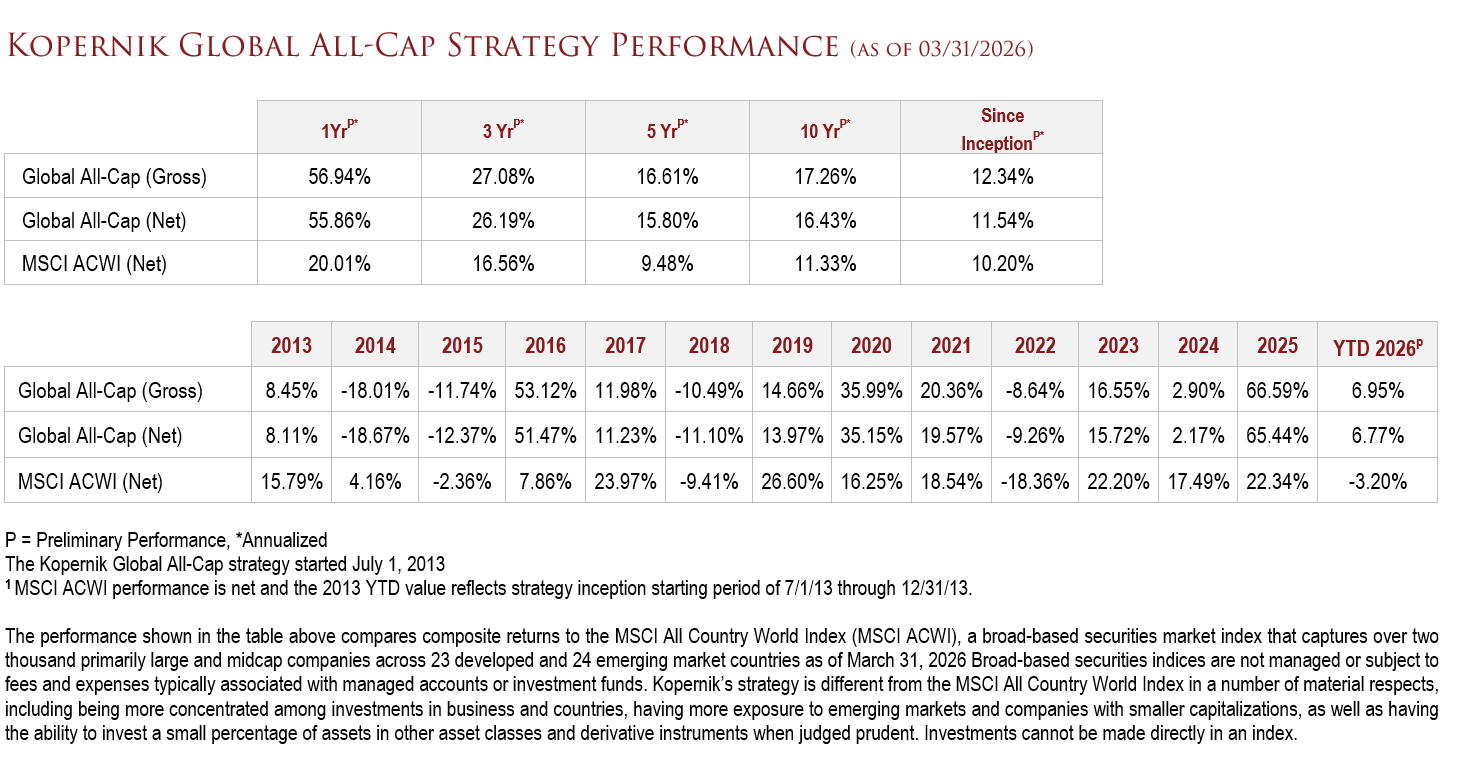
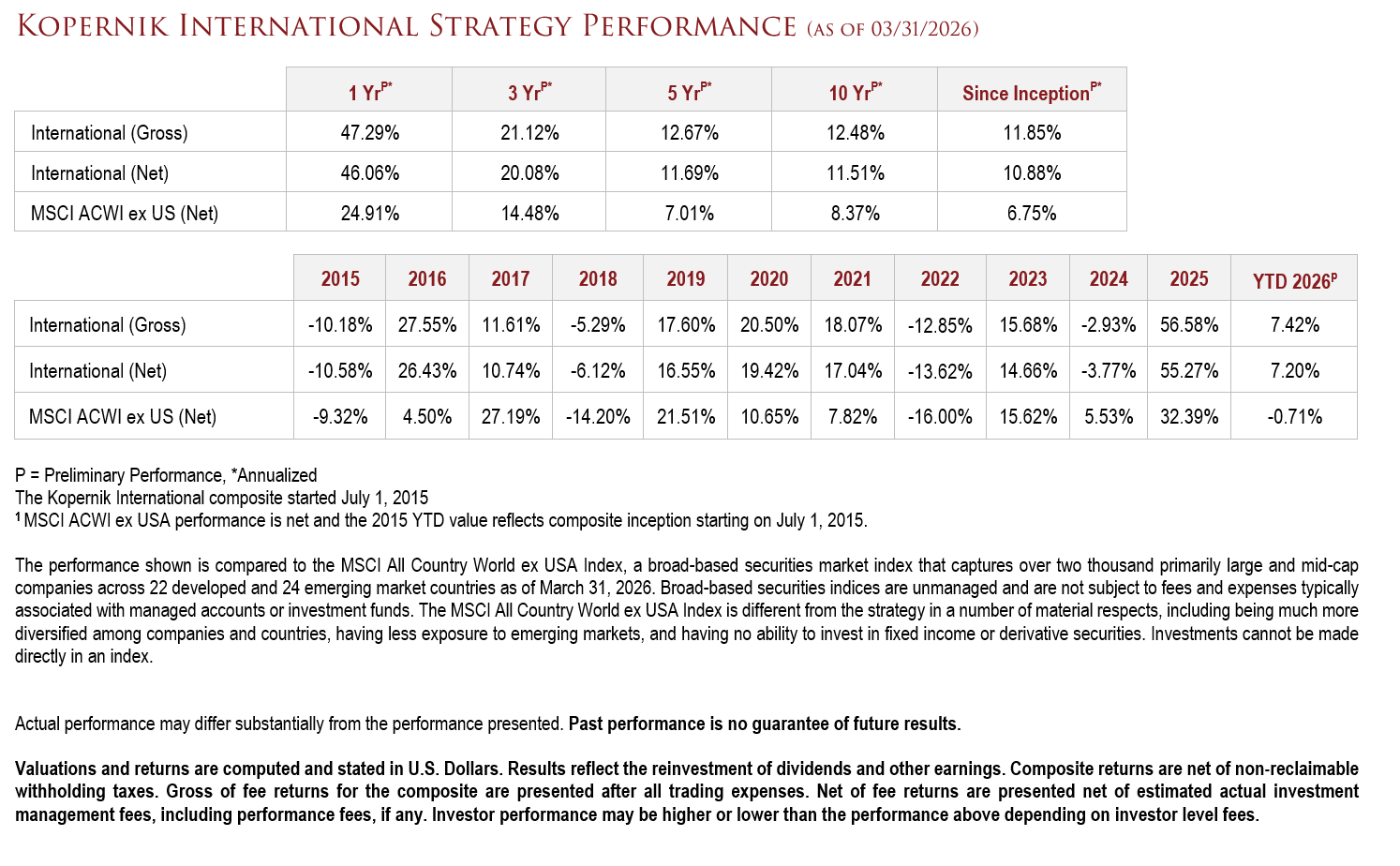
The commentary represents the opinion of Kopernik Global Investors, LLC as of April 23, 2026, and is subject to change based on market and other conditions. Dave Iben is the managing member, founder, and chairman of the Board of Directors of Kopernik Global Investors. He serves as chairman of the Investment Committee, lead portfolio manager of the Kopernik Global All-Cap and Kopernik Global Unconstrained strategies, and co-portfolio manager of the Kopernik Global Long-Term Opportunities strategy and the Kopernik International strategies. These materials are provided for informational purposes only. These opinions are not intended to be a forecast of future events, a guarantee of future results, or investment advice. These materials, Dave Iben’s and Alissa Corcoran’s commentaries, include references to other points in time throughout Dave’s over 43-year investment career (including predecessor firms) and does not always represent holdings of Kopernik portfolios since its July 1, 2013, inception. Information contained in this document has been obtained from sources believed to be reliable, but the accuracy of this information cannot be guaranteed. The views expressed herein may change at any time subsequent to the date of issue. The information provided is not to be construed as a recommendation or an offer to buy or sell or the solicitation of an offer to buy or sell any investment or security.
1The Global Industry Classification Standard (“GICS”) was developed by and is the exclusive property and a service mark of MSCI Inc. (“MSCI”) and Standard & Poor’s, a division of The McGraw-Hill Companies, Inc. (“S&P”) and is licensed for use by Kopernik Global Investors, LLC. Neither MSCI, S&P nor any third party involved in making or compiling the GICS or any GICS classifications makes any express or implied warranties or representations with respect to such standard or classification (or the results to be obtained by the use thereof), and all such parties hereby expressly disclaim all warranties of originality, accuracy, completeness, merchantability and fitness for a particular purpose with respect to any of such standard or classification. Without limiting any of the foregoing, in no event shall MSCI, S&P, any of their affiliates or any third party involved in making or compiling the GICS or any GICS classifications have any liability for any direct, indirect, special, punitive, consequential or any other damages (including lost profits) even if notified of the possibility of such damages.
