
The Passenger (Jul 2016)
IMPORTANT NOTICE: This Kopernik investment commentary was originally prepared and distributed in July 2016. This commentary is being shared for historical reference purposes only and has not been updated or revised to reflect current market conditions, economic developments, regulatory changes, or investment perspectives. Please refer to additional relevant historical commentary disclosures at the end.
“Oh, the passenger
How, how he rides
Oh, the passenger
He rides and he rides
He looks through his window
What does he see?
He sees the sign and hollow sky
He sees the stars come out tonight”
–Iggy Pop
Was Iggy referring to drugs or had he anticipated the beauty of ETFs circa 2016? Reviewers suggest that ‘he sees how wonderful everything is once he relinquishes control, becomes the passenger instead of the driver.’ Longtime readers know that I have a proclivity to view many songs and movies as metaphors for the investment world. In this case, passive investing, de rigueur in the marketplace, comes to mind. The “old school” investors labor over 10-Ks, 20-Fs and other regulatory filings, struggling through those boring ‘notes to the financial statements,’ and ‘pounding the pavement’ to perform due diligence via site visits and industry conferences, while vigorously ‘interrogating’ company management teams and then spending hours building valuation models. Meanwhile, the passive investor hops aboard the ETF du jour and he rides and he rides.
He/she enjoys generally high levels of trading liquidity, and the ability to quickly gain exposure to desired industries, sectors, regions, and cap ranges. Fees are minimal and taxes can be managed. Tracking error can be kept very low, a source of much relief to many. Much of the ‘unseemly’ ‘rolling up of the sleeves’ to perform tedious bottom-up, fundamental analysis can be dispensed with. While active investors are laboring away, the passenger, he rides and he rides.
The driver must contend with the ‘back seat drivers.’ Why did you turn that direction? This road is boring, that one, too crowded. Can’t you drive faster? When will we get there? And the passenger? He doesn’t have to explain short-term problems with individual stocks to clients. He doesn’t need to defend volatility or tracking error, or conjure catalysts. No, he rides and he rides.
“And everything looks good tonight
Singin’ la-la-la-la-la-la-la-la”
–Iggy
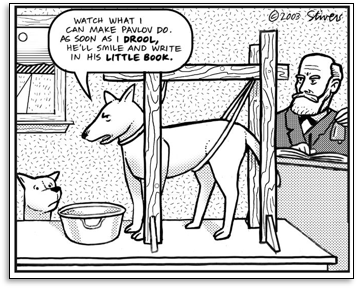
Sitting here, well into the 21st century, on the footsteps of the era of the driverless car, robo-advisors, and virtual reality, Kopernik hereby takes on the arduous task of defending ‘reality.’ This Commentary puts forth the case for active management. To jump to the conclusion, we believe that there is a need for diligent investment research. We believe that there is an investment return on independent thought, on hard work, on willingness to bear the discomfort that goes hand in hand with contrarianism. In the current environment that return is prospectively quite high. The performance battle between active/passive management is cyclical in nature, and once again it is time to invest actively. While we concede many of the virtues of passive management, it is clear that it has its pitfalls as well, which are being overlooked. The case for passive investing assumes just a few ‘passengers’ taking a free ride on the back of a market made ‘efficient’ by millions of investors working hard to gain equal access to information, staying rational at all times, performing analysis to derive a fair price, and always paying that fair price. Even if one were to believe that people are rational and that markets can be efficient, once there are too many passengers relative to too few drivers, the theory goes out the window. At that point, the premise is nullified; the tail is wagging the dog.
The Dog Days for Active Management
It was an honor to be invited to speak at the London Value Investor Conference in late May. It is clear that these days are indeed uncomfortable, figuratively muggy, for value investors. In fact, even at a value conference, more than half of the audience preferred to be viewed as ‘franchise’ investors. It seems that the maxim “everyone owns quality growth stocks” is not far off the mark. It’s worth noting that it was much worse last year when, apparently, the vast majority shunned the value classification. Still, at this juncture, all investors that continue adhere to a value-based discipline must be asking: Is the stigma fading? Are the dog days finally winding down? Time will tell – either way, a discussion on passive investing may be instructive. It’s important to start with the disclaimer that we’ve never believed that ‘growth’ was the antithesis of ‘value.’ It is merely a wonderful attribute that increases intrinsic value. ETFs on the other hand………
There were many interesting speakers, including Jean-Marie Eveillard, Howard Marks, and James Montier, all of whom I’ve admired for many years. I highly recommend the conference and plan to attend again in the future. I mention the conference because, among the many great presentations was one called “Passive Aggressive: The Implications of ‘Industrialized’ Capital Allocation,” by Michael Keller, a Partner of Brown Brothers Harriman.
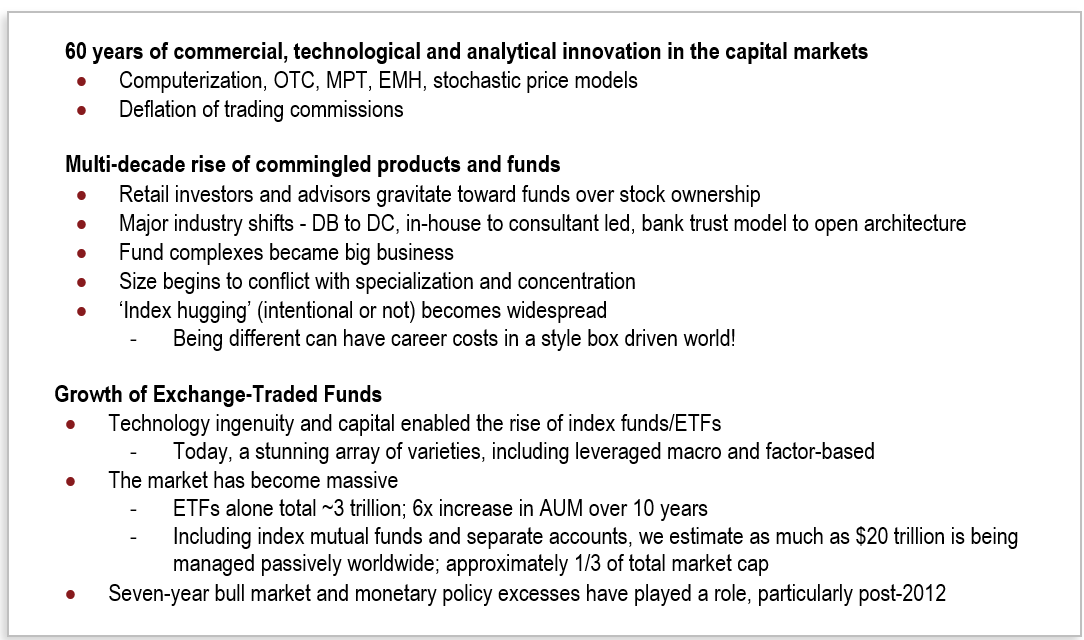
Mr. Keller addresses a quick history of capital allocation, highlights the size of the current market for passives and illustrates a handful of their benefits and drawbacks, and segues to the larger implications of industrialized capital and passive investment. I found many of his bullet points to be interesting and well worthy of passing along.
(Below is a summarized version of his slides, to which we’ve taken some editorial license).
Cumulative flows to and net share issuance of domestic equity mutual funds and index ETFs
billions of dollars, January 2007–December 2015
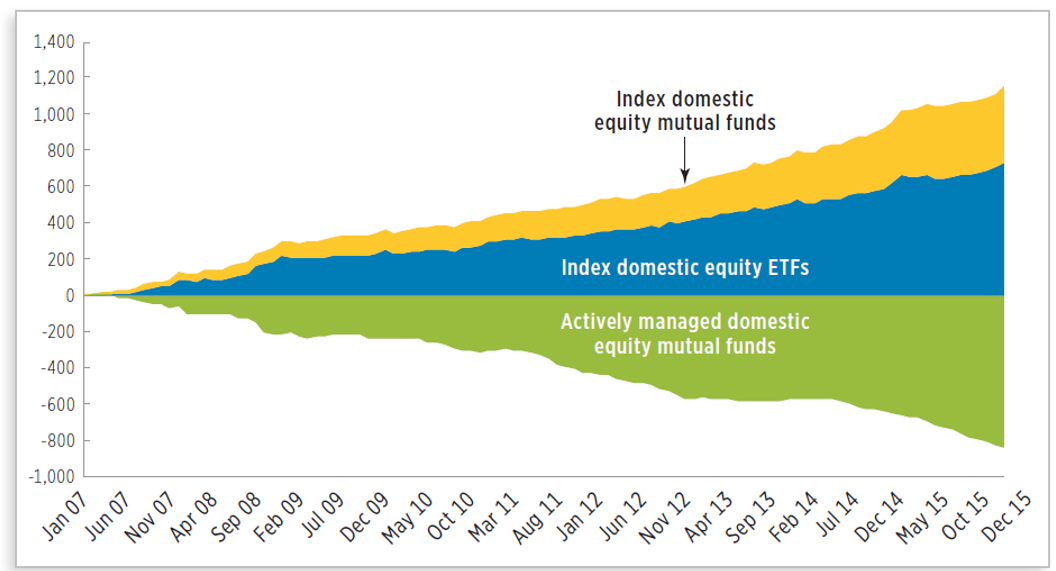
Data exclude mutual funds that invest primarily in other mutual funds.
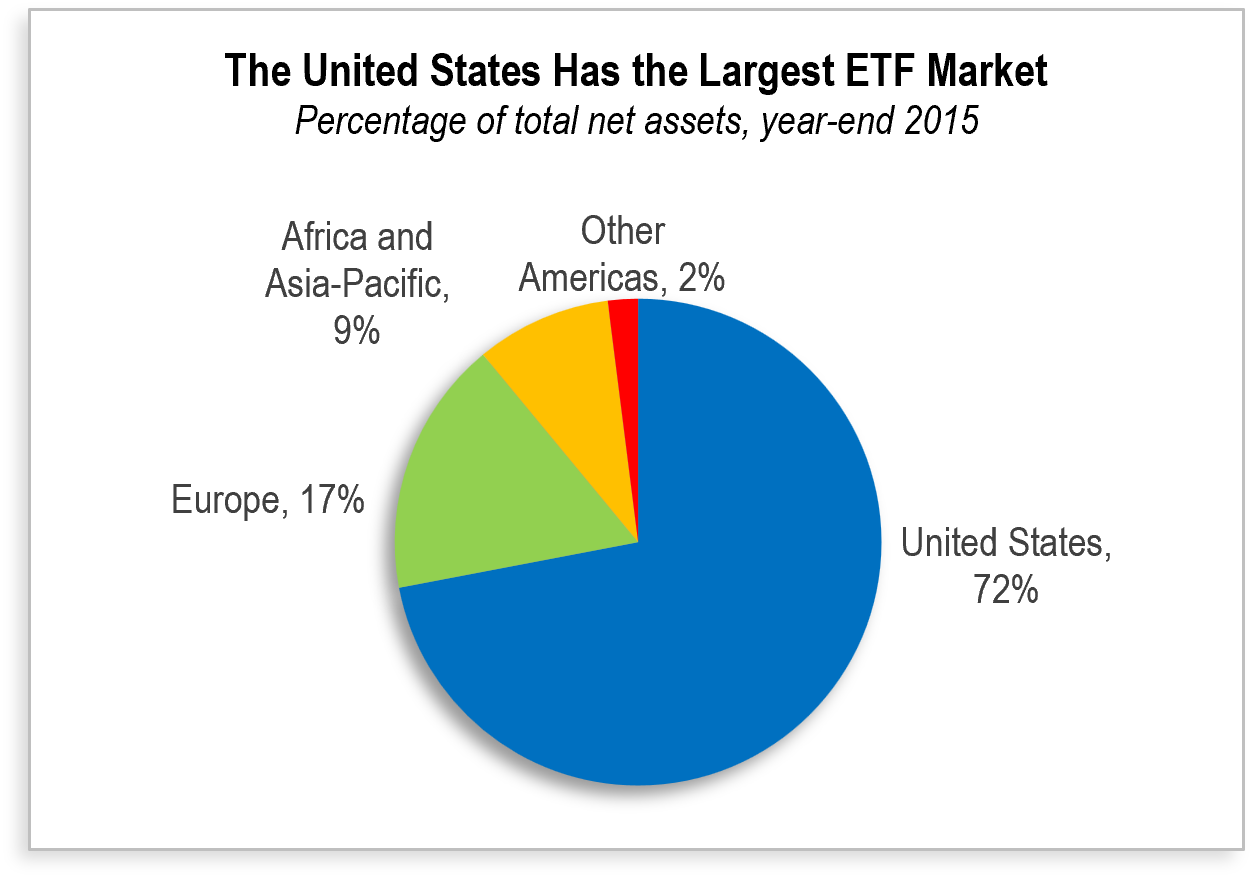
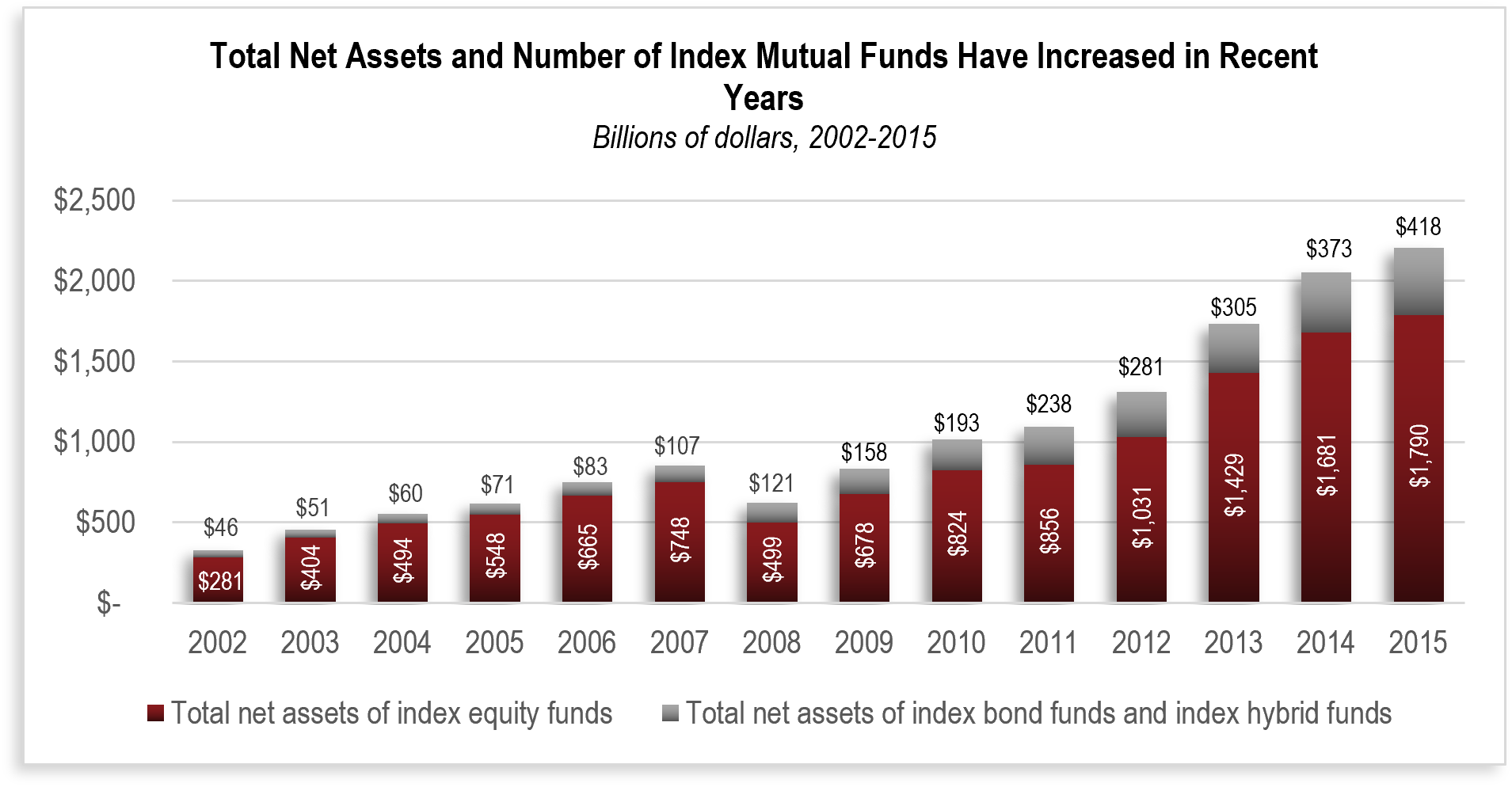
Passive funds have continued to take market share in the asset management business globally. The “active” industry is now only four times bigger than “passive”, compared with 8.5 times in 2007. -GREED & fear, Chris Wood, CLSA
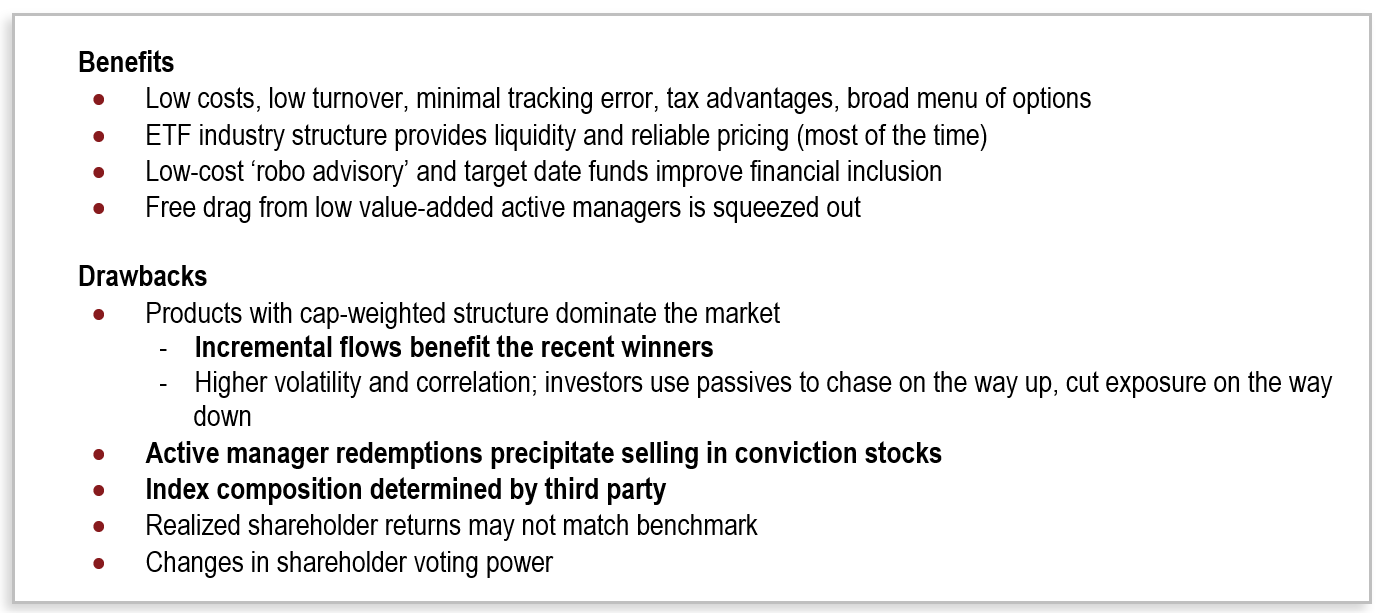
It is worthwhile to add that the third party determining the index does not even try to identify the most attractive investment candidates, nor do they claim to.
Mr. Keller then featured the following quote from Glenn O’Donnell, Forrester Research 2010: “A process or profession becomes industrialized when it matures from an art form to a widespread, repeatable function with a predictable result and accelerated by technology to achieve far higher levels of productivity.” This evolution from an art to an industry is interesting. A third of a century ago, I believed that our business was 80% science and 20% art but now view the ratio to be roughly the inverse. Not to be misconstrued, the science portion is important. In fact, it is prerequisite. But, as Charlie Munger points out, a multidisciplinary approach is necessary. Many of the things that managers put forth as competitive advantages are merely the bare minimum of attributes that a good manager must have. The edge comes from augmenting the math and science with the arts. One must consider economics, history, psychology (crowd behavior), philosophy, integrity, generosity, aptitude, incentive structure, and so much more. Mr. Keller seems to be laying out a powerful case that the investment industry’s vast and impressive increase in efficiency has not served the clients well. It has inadvertently done the opposite. The proverbial forest has been lost in the trees. He points out that the mindset has shifted from managing securities to managing exposures. Kopernik would say, it has shifted from investing in companies to speculating on trends. He makes the important observation that a systemized approach may sound reasonable but it doesn’t work well in real life since “the market is not a repeatable, solvable system.” It is affected by human behavior, unpredictable events, and exogenous factors. Also, systems tend to look backwards creating the “risk of constantly ‘fighting the last wars.”
Why ETFs are Inherently Anti-Value
“I am a passenger
I stay under glass”
It is time to put the passenger ‘under glass.’ Let’s use the magnifying glass. In our past Commentary (“When”-ing isn’t Everything), we discussed how good analysis requires the rigorous use of questioning. Regarding ETFs: Is the ‘science’ of investing incorporated in the construction of ETFs? Is the ‘artistic’ side of investing incorporated in the construction of ETFs? Is the wisdom of Munger, Templeton, Marks, Klarman, Rogers, etc., etc., etc., incorporated in the construction of ETFs? Do the assumptions underpinning the efficient market hypothesis hold in the contemporary world of ETFs?
Mr. Keller devotes a slide to the anti-value (my words) characteristics of ETFs and to the resultant “Opportunities for Value Investors.”
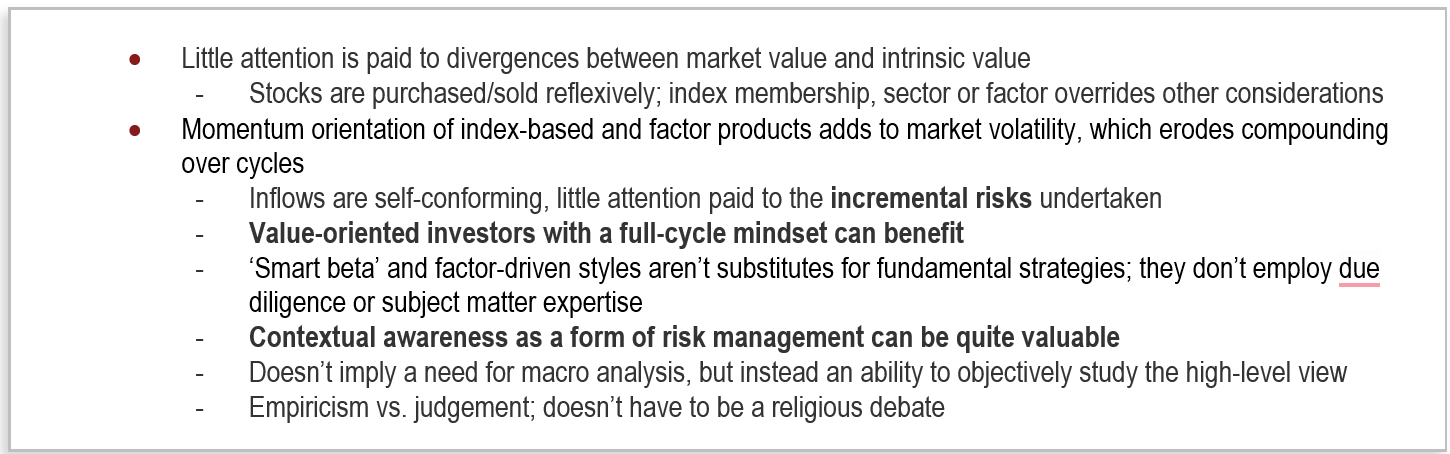
His subsequent slide entitled “Differentiated Active Management Shines Over Full Cycles” demonstrated that the vast majority of managers that have outperformed the S&P 500 over a 10-year period, had high active share combined with moderately low turnover. (He sources eVestment and BBH analysis). We, at Kopernik, are particularly pleased with this finding.
Before moving on to the next section, a few examples of the monsters that can result as the unintended consequences of good ideas.
High quality global journalism requires investment.
From the FT on May 30, 2016
“The research group Morningstar classifies 25 ETFs as low volatility funds, with $35bn in assets at the end of April, $9.8bn of which had been invested in the first four months of the year. The pace of inflows picked up sharply in February, after stock markets gyrated with fears of a global recession.
Money has kept being added, even though the Vix index of market volatility has fallen back close to a one-year low. The six largest low vol ETFs alone had further inflows of $1.6bn in May.
The $13.1bn iShares Edge MSCI minimum volatility USA fund from BlackRock, which has doubled in size in the past 12 months, has had inflows on all but three days so far this year. A $7.1bn sister fund that runs a minimum-volatility portfolio of non-US stocks has had inflows on every day but one this year.”
The article quotes Jeffrey Gundlach, “Low volatility stock funds are probably the most dangerous thing out there.” We tend to agree, but it will be interesting to see how posterity judges them relative to negative yield bonds.
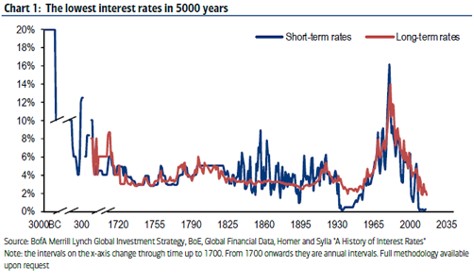
“Nobody told me there’d be days like these
Strange days indeed strange days indeed
Everybody’s runnin’ and no one makes a move
Everyone’s a winner and nothing left to lose
–John Lennon
Another example of good no longer being good when it becomes overdone is the Nifty-Nine (The infamous FANG stocks plus Priceline, Ebay, Starbucks, Microsoft and Salesforce [apparently coined by Ned Davis Research]).
The Pools of the late 1920s, the bank trust departments of the early 1970s, the index funds of the late 1990s and the ETFs of the current era have much in common. All were times of easy money, of great leaps forward in technology, and of people confusing good companies and good ideas with good investments. All were times when momentum investing was very popular, when crowd psychology created bubbles. We have all seen this movie before.
“We call it master and servant
it’s a lot like life”
–Depeche Mode
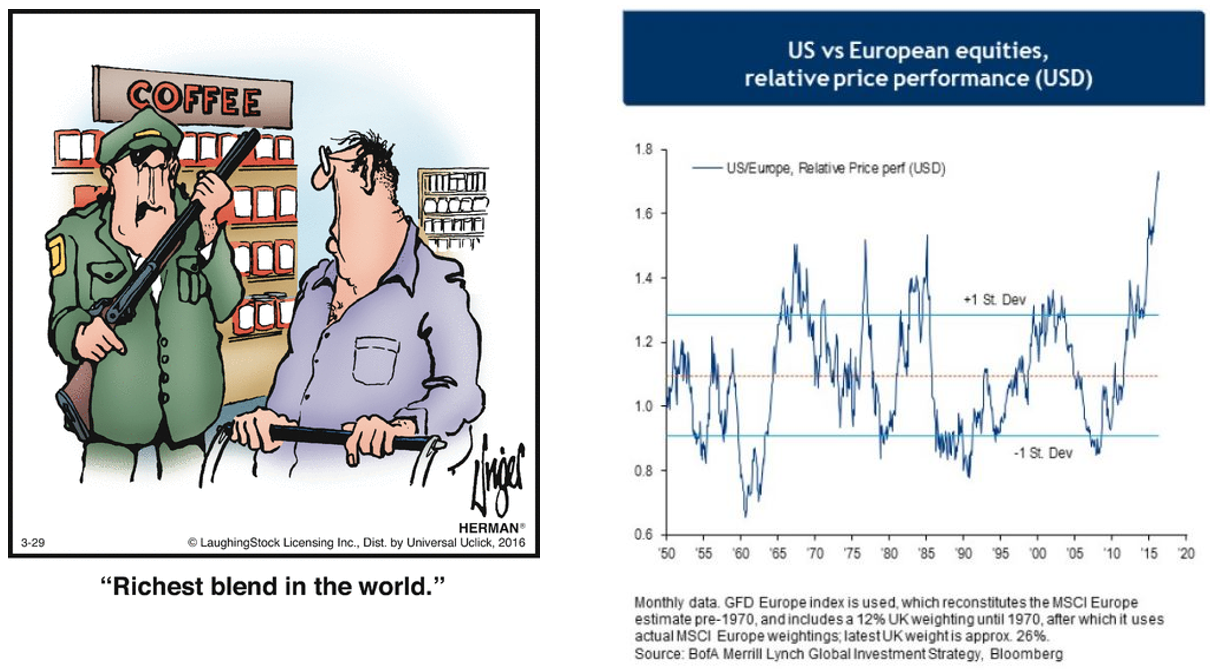
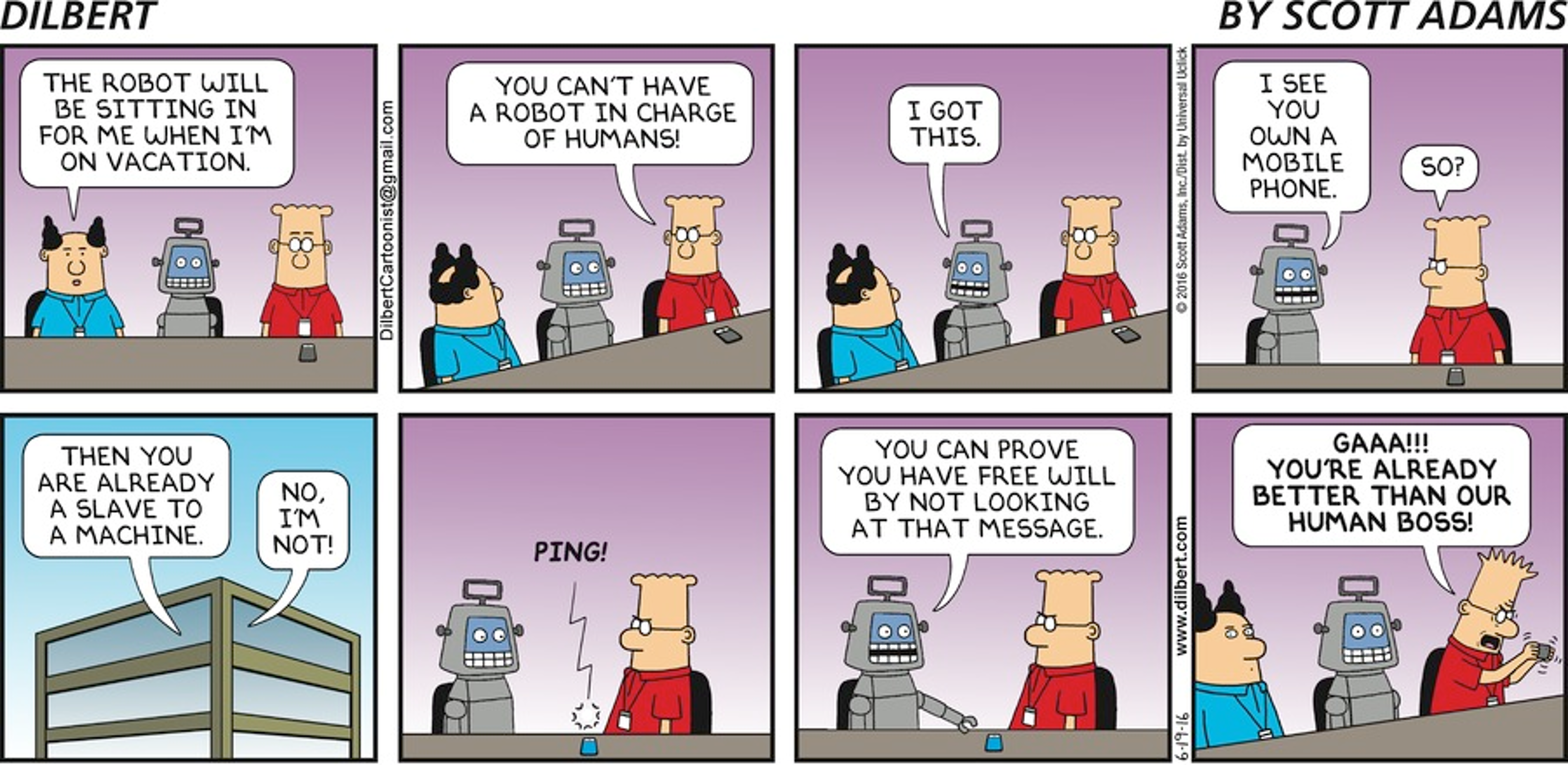
Time to move on to the all-important subject of technology. We are huge fans. Technology makes life so much easier. It makes it possible to follow the world without being everywhere at once. But, we think that it’s fair to expropriate P.T. Barnum’s famous quote regarding money: “ ‘technology’ makes a very excellent servant, but a terrible master.” We believe that this is true for investment orthodoxies as well. Growth is good; value, prerequisite. Momentum is a factor, and quants add efficiency and reduce emotion. However, being a slave to any rigid orthodoxy is, we believe, foolish. Models and rigid processes are begging to be gamed and/or front run. Having algorithms drive the process certainly doesn’t change this.
al·go·rithm
alɡəˌriT͟Həm/
A process or set of rules to be followed in calculations or other problem-solving operations, especially by a computer.
“But I am not kidding when I say that a growing number of people in the markets know a lot about computers but virtually nothing about markets.”
–Jared Dillian, The 10th Man
We’ve talked in the past about how social sciences often seem to envy the physical sciences. Nowhere is this more true than in economics and investments. And, perhaps, nowhere is it more spurious than when it comes to risk management. I can’t quickly capture in a paragraph a subject to which Howard Marks devoted three must-read chapters. But that is precisely the point. Risk can’t be captured in a nutshell. It is difficult. It pertains to the future, to the unknowable. It is said that risk means that more things can happen than will happen. How can that be captured in a number? In a cyclical world, do past trends extend into the future or do they revert to the mean? It depends, of course. Beta, volatility, and tracking error do nothing to help one understand if they are overpaying for a security. They do nothing to help predict the future. But they sound impressive. And they can be calculated, and calculated quickly by computers. As Mr. Gundlach suggests above regarding low-vol ETFs, mis-defining risk can be the most dangerous thing one can do. We will add that when index benchmarks are over-priced, high tracking error is not a risky thing, it is a desirable thing. Even when it is calculated by a powerful computer.
“Running through the field where all my tracks will be concealed and there’s nowhere to go.”
–RHCP
In conclusion, we are not anti-passive investing. For example, it makes sense that entities managing large sums of money choose to allocate the bulk of it to a passive ‘core.’ Why pay for active management in situations where the size of the investment will tend to force the returns to converge towards the index returns? It is also reasonable that many choose to augment the passive core of the portfolio with active ‘satellites.’ Logically, the satellites choose to limit capacity and have very-high ‘active-share,’ thus allowing for significant divergence from the core. The less like the core the better.
Our points are that anything is dangerous when taken to excess and that everything has a time and a place. Pertaining to time, one can’t help but feel a little joy for the City of Cleveland, which in sporting terms, waited for more than a half-century for their time to come. For those who invest with active managers, or in value stocks, or emerging markets, gold, or other hard assets, it feels like things have been out of sync for a half-century. It has been an unusually prolonged correction. As we discussed in ‘The Big Long’ Commentary, it has/had lasted anywhere from 2 to 9 years through this past January. And, as the commentary pointed out, this is a good thing. The more depressed the valuations at the nadir, the more pronounced the subsequent upswing is likely to be. In the investment arena, the importance of major inflection points can’t be overemphasized. This is often when anti-value capitulates to value. Momentum stocks, like the fireworks on the Fourth of July, reach their zenith and succumb to the force of gravity, to the oohs and aahs of the crowd.
In terms of taking good things to excess, we are often told that virtually everyone is heavily invested in ‘quality growth stocks’, trendy ETFs, and in anything that historically has exhibited low volatility. Let the fireworks begin!
“Oh the passenger
He rides and he rides
He sees things from under glass
He looks through his window side
He sees the things that he knows are his”
To this we ask, does he, in fact, “see the things that he knows are his?” Or is he playing a trend, or merely following the direction received from an ivory tower, without really knowing what the ETF owns or what is it worth?
We, at Kopernik Global Investors, are active investors. We are appraisers of businesses; owners of businesses. We are passionate about rolling up our sleeves and doing fundamental research. We are obsessed with uncovering value. When it comes to investing other peoples’ money, we don’t want to be taken for a ride. We want to know what we own. We want to know why we own it. We want to have a strong grasp of how much it is worth. We utilize many of the advantages that technology has to offer, but we like being in the driver’s seat.
Have a healthy and happy second half to 2016.
Cheers,
David B. Iben, CFA
Chief Investment Officer
July 2016
P.S. A lot of people are fearful of computers and robo-advisers. We welcome them as tools, to augment the intuition, creativity, interpersonal skills, independent thought that, thus far anyhow, are only possessed by human beings. We leave you with the most famous lines from 2001 A Space Odyssey:
HAL: Just what do you think you’re doing, Dave?
HAL: Look Dave, I can see you’re really upset about this. I honestly think you ought to sit down calmly, take a stress pill, and think things over.
HAL: I know I’ve made some very poor decisions recently, but I can give you my complete assurance that my work will be back to normal. I’ve still got the greatest enthusiasm and confidence in the mission. And I want to help you.

“And I don’t want it, the things you’re offering me
Symbolized bar code, quick ID, oh yeah
See I’m a 21st century digital boy
I don’t know how to read but I’ve got a lot of toys
My daddy’s a lazy middle class intellectual
My mommy’s on Valium, so ineffectual
Ain’t life a mystery?”
-Bad Religion
Historical Commentary: Key Limitations and Disclaimers
Outdated Information. The market data, economic statistics, financial projections, company information, and other factual content contained in this commentary reflect conditions as they existed in 2016 and may now be outdated. Market conditions, asset valuations, interest rates, inflation rates, economic indicators, and other material factors have changed substantially since the original publication date.
No Current Recommendation. Nothing in this historical commentary should be construed as a current investment recommendation, offer to sell, or solicitation of an offer to buy any security or investment product. Any specific investment strategies discussed were relevant to market conditions in 2016 and may no longer be suitable or available.
Regulatory and Legal Changes. Federal securities laws, tax laws, regulatory guidance, and other legal requirements applicable to investments and investment advisory services may have changed materially since 2016. This commentary does not reflect such changes and should not be relied upon for legal, tax, or regulatory guidance.
Performance Data Limitations. Any performance information, projections, forecasts, or hypothetical returns discussed in this commentary are historical and have not been updated.
No Updates Intended. Kopernik Global Investors, LLC, has not undertaken any commitment to update, revise, or supplement this historical commentary and does not intend to do so. This commentary is provided strictly “as is” in its original 2022 form for archival and reference purposes only.
________________________________________
Original Commentary Date: July 2016
Disclosure Date: June 23, 2026
Important Information and Disclosures
The information presented herein is proprietary to Kopernik Global Investors, LLC. This material is not to be reproduced in whole or in part or used for any purpose except as authorized by Kopernik Global Investors, LLC. This material is for informational purposes only and should not be regarded as a recommendation or an offer to buy or sell any product or service to which this information may relate.
This letter may contain forward-looking statements. Use of words such was “believe”, “intend”, “expect”, anticipate”, “project”, “estimate”, “predict”, “is confident”, “has confidence” and similar expressions are intended to identify forward-looking statements. Forward-looking statements are not historical facts and are based on current observations, beliefs, assumptions, expectations, estimates, and projections. Forward-looking statements are not guarantees of future performance and are subject to risks, uncertainties and other factors, some of which are beyond our control and are difficult to predict. As a result, actual results could differ materially from those expressed, implied or forecasted in the forward-looking statements.
Please consider all risks carefully before investing. Investments discussed are subject to certain risks such as market, investment style, interest rate, deflation, and illiquidity risk. Investments in small and mid-capitalization companies also involve greater risk and portfolio price volatility than investments in larger capitalization stocks. Investing in non-U.S. markets, including emerging and frontier markets, involves certain additional risks, including potential currency fluctuations and controls, restrictions on foreign investments, less governmental supervision and regulation, less liquidity, less disclosure, and the potential for market volatility, expropriation, confiscatory taxation, and social, economic and political instability. Investments in energy and natural resources companies are especially affected by developments in the commodities markets, the supply of and demand for specific resources, raw materials, products and services, the price of oil and gas, exploration and production spending, government regulation, economic conditions, international political developments, energy conservation efforts and the success of exploration projects.
Investing involves risk, including possible loss of principal. There can be no assurance that a strategy will achieve its stated objectives. Equity funds are subject generally to market, market sector, market liquidity, issuer, and investment style risks, among other factors, to varying degrees, all of which are more fully described in the fund’s prospectus. Investments in foreign securities may underperform and may be more volatile than comparable U.S. securities because of the risks involving foreign economies and markets, foreign political systems, foreign regulatory standards, foreign currencies and taxes. Investments in foreign and emerging markets present additional risks, such as increased volatility and lower trading volume.
The holdings and topics discussed in this piece should not be considered recommendations to purchase or sell a particular security. It should not be assumed that securities bought or sold in the future will be profitable or will equal the performance of the securities in this portfolio. Kopernik and its clients as well as its related persons may (but do not necessarily) have financial interests in securities, issuers, or assets that are discussed. Current and future portfolio holdings are subject to risk.
Commodities may be affected by changes in overall market movements, changes in interest rates, and other factors such as weather, disease, embargoes, or political and regulatory developments, such as trading activity of speculators and arbitrageurs in the commodities. Investing in commodities entails significant risk and is not appropriate for all investors.